


The allure of decentralized finance (DeFi) lies in its permissionless nature. On decentralized exchanges (DEXes) across networks like Ethereum, Solana, and Base, anyone can deploy a smart contract and launch a trading pair in seconds. This frictionless ecosystem has birthed legendary market rallies, but it has also given rise to highly predatory fraud.
Among the most technically deceptive traps in the Web3 space is the honeypot scam. Unlike traditional pump-and-dump schemes where a developer simply dumps their holdings on the market, a honeypot uses a malicious underlying smart contract to strip retail traders of their fundamental ability to exit a position.
This comprehensive guide breaks down the technical inner workings of a honeypot token scam, highlights why these traps pass traditional filters, and provides the essential tools needed to identify a “buy-only” contract before your capital is permanently locked.
What is a Crypto Honeypot Scam?
In traditional cybersecurity, a “honeypot” is a decoy system designed to lure in hackers so security teams can study their behavior. In the cryptocurrency market, the concept is inverted: scammers deploy a malicious token or smart contract designed to act as a sweet trap for retail investors.
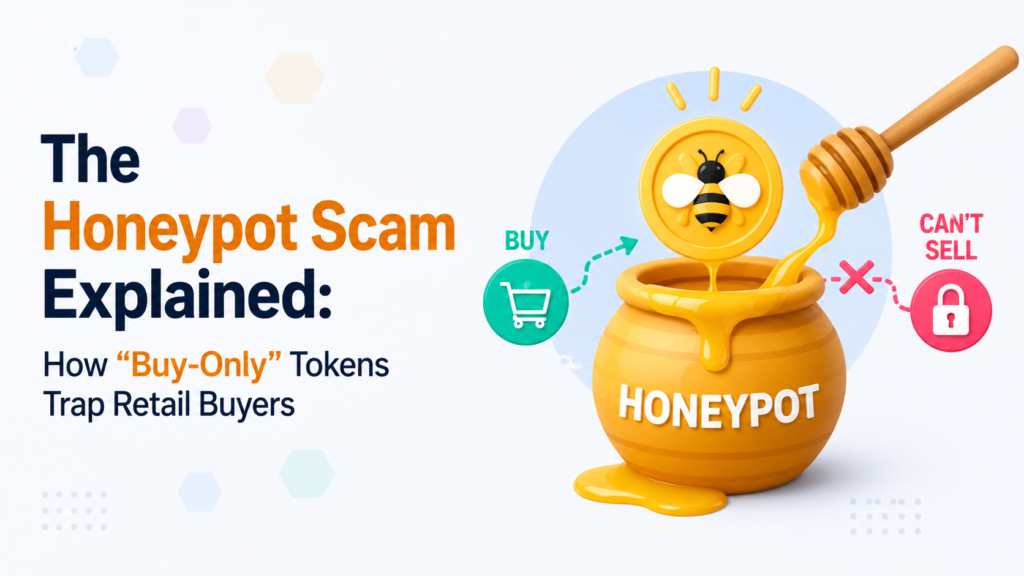
A honeypot token functions as a one-way financial street. The underlying code is engineered to process incoming buy orders from any wallet address without restriction. However, the moment a buyer attempts to swap their tokens back for a baseline asset such as native $ETH$, $SOL$, or $USDC$ the transaction fails. The sell function is intentionally restricted, leaving the victim’s capital permanently trapped inside the liquidity pool, completely at the mercy of the developer.
The Perfect Psychological Trap: The “Only Green” Chart
Honeypots do not succeed because they are complex; they succeed because they exploit human psychology specifically, the Fear Of Missing Out (FOMO).
Because the smart contract code prevents retail participants from executing sell orders, the token’s trading feed displays an unnatural anomaly: an unbroken sequence of buy orders. On charting aggregators like DEX Screener or DEXTools, this generates a price chart consisting entirely of massive, upward-trending green candles.
  Honeypot Price Action (The Illusion)
   Price (USD)
     ▲
     │              /▲
     │             /
     │            /   ◄── 100% Green Candles (No Sells Allowed)
     │       _───/
     │   _───/
     │  /
     └────────────────────────► Time
To an untrained observer or an algorithmic trading bot scouring the network for momentum, the asset appears to be a viral sensation. Investors rush to buy into the token, believing they are early to a parabolic trend. In reality, the price increase is a mathematical fiction fueled by trapped liquidity that can never be extracted by the public.
3 Technical Methods Scammers Use to Lock Your Funds
To effectively spot a honeypot before trading, you must understand the primary programming mechanics scammers write into solidity or rust-based smart contracts.
1. The Direct Wallet Blacklist
The most direct approach involves a conditional block function written into the token’s core transfer protocol. When a user purchases the token, the contract executes the buy flawlessly. However, the contract contains a hidden array or list controlled exclusively by the owner.
- How it works: The contract’s
_transferfunction checks the sender’s address against a designated blacklist or “snapshot” list. - The Trap: If the wallet trying to execute a transfer or sale matches the restricted criteria, the code automatically throws an error (such as “Insolvent balance” or “Transfer reverted”), blocking the transaction from completing. Only the creator’s white-listed wallets retain the ability to sell.
2. The Balance-Manipulation Threshold
Sophisticated scammers alter internal accounting logic to make code audits difficult for automated scanners. They introduce dummy variables that alter the mathematical requirements for a successful sell order.
- How it works: The code might require that in order to execute a sell, a user’s wallet must hold a balance higher than their actual maximum balance plus an arbitrary hardcoded integer.
- The Trap: Because a standard user can never satisfy a condition requiring them to sell more tokens than they physically possess, the sell function remains broken for retail users while functioning normally for the developer.
3. Dynamic “Tax” Manipulation (The Switch)
This hybrid model relies on an adjustable transaction fee structure built into the contract metadata.
| Project Phase | Buy Tax Metric | Sell Tax Metric | Practical Result |
| Launch Phase | 0% | 0% | Maximum organic volume; retail buyers are attracted by low fees. |
| The Honeypot Switch | 0% | 99% or 100% | The contract allows buys, but any sell instantly transfers 100% of the value to the dev. |
By scaling the sell tax dynamically to 100%, the developer turns a standard token into a functional honeypot without explicitly modifying transfer permissions.
Step-by-Step Blueprint: How to Verify a Token
Protecting your web3 wallet requires moving beyond surface-level charts and performing basic structural checks. Follow this verification framework prior to interacting with any new low-market-cap token pool:
Step 1: Analyze the Real-Time Transaction Logs
Open the token’s trading profile on an on-chain analytics dashboard. Scroll past the automated summary and look at the raw, microscopic log of individual transactions.
- Look for the balance of buys versus sells. If a token has recorded 500 consecutive buys over the last two hours without a single retail sell order, it is statistically impossible in an open crypto market. This absence of organic selling pressure is your primary visual confirmation of a honeypot.
Step 2: Utilize Automated Code Scanners
Before manually interacting with a contract address, leverage reliable automated smart contract scanners designed to simulate trades within an isolated sandbox environment.
- Recommended Security Infrastructure: Use proven platforms such as Token Sniffer, Honeypot.is, Solsniffer, or HoneyBadger.
- What to look for: These tools automatically simulate a buy-and-sell order sequence against the target decentralized liquidity pool. If the simulation detects that a standard user’s sell order cannot be processed or triggers a 100% fee, the tool will explicitly flag the contract as a verified honeypot.
Step 3: Run a “Micro-Transaction” Test
If automated tools yield ambiguous results but you still want to participate in the asset’s market, always perform a low-value test trade first.
- Swap a negligible, fractional amount of your base currency for the target token.
- Immediately attempt to swap that small fraction back to your original base asset. If the decentralized exchange router rejects the transaction or displays an uncorrectable slippage error, do not commit any further capital. Your test fund is gone, but your core capital remains safe.
Recovery and Post-Incident Security
If you discover that you have already purchased a token that has been flagged as a honeypot, do not panic and do not send more funds.
            [ Stop Interacting With Contract ]
                           │
                           ▼
             [ Audit Active Permissions ]
                           │
                           ▼
  [ Revoke Wallet Approvals via Revoke.cash / Block Explorer ]
                           │
                           ▼
          [ Discard/Isolate Compromised Wallet ]
Scammers often embed secondary traps into their infrastructure. They may suggest using a specific “recovery tool” or a paid engineering service to bypass the block code and extract your trapped tokens. These are invariably recovery scams designed to exploit your desperation and steal additional capital from your wallet.
Accept the initial loss as an educational expense, disconnect your web3 wallet interface from the project’s decentralized application, and use tools like Revoke.cash or native block explorer approval checkers to revoke any infinite spend permissions you may have signed off on during the initial token purchase.
Final Summary
Honeypot scams succeed by converting market momentum into a digital cage. While clean green candle charts look incredibly enticing, they are frequently the signature mark of a totally illiquid, heavily manipulated trap. By incorporating simulation tools into your daily workflow, checking transaction ratios, and remaining deeply skeptical of “risk-free” hyper-profitable trends, you can trade securely across decentralized networks.