


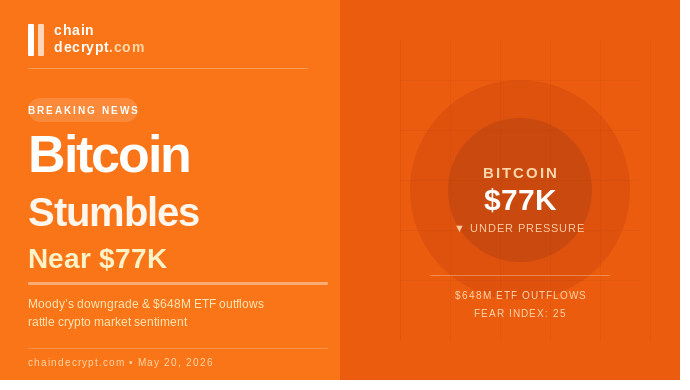
Bitcoin is struggling to hold its footing this week, caught in the crossfire of deteriorating macro sentiment, a historic U.S. credit downgrade, and the sharpest stretch of institutional outflows seen in months. While the asset has not collapsed, the pressure building beneath the surface tells a more uncomfortable story than the price chart alone suggests.
Moody’s Pulls the Last Top-Tier U.S. Credit Rating — A Historic First
The trigger for this week’s turbulence arrived after U.S. markets closed on May 16, when Moody’s Investors Service downgraded the United States’ long-term credit rating from Aaa to Aa1 — marking the third time since 2011 that a ratings agency has stripped the U.S. of its highest tier, following similar actions by S&P in 2011 and Fitch in 2023.
The decision was not made lightly. Moody’s cited the U.S.’s ballooning $36 trillion debt pile, with federal deficits projected to reach 9% of GDP by 2035, up from 6.4% in 2024, and warned that interest payments on U.S. debt are expected to consume 30% of federal revenue by 2035 — a significant rise from 18% today.
The bond market responded swiftly. The 10-year Treasury yield opened at 5.53% post-downgrade on May 19, while the 30-year yield climbed to its highest level since October 2023. Rising yields typically compress risk appetite across markets — and crypto, despite its “digital gold” framing, was not immune.
The White House dismissed the downgrade as politically driven, with lawmakers still negotiating a $3.8 trillion tax and spending package. But the market’s reaction was harder to dismiss.
$648 Million Exits Bitcoin ETFs in a Single Day
At precisely the wrong moment, institutional money began heading for the exits.
Spot Bitcoin ETFs shed $648.64 million on Monday alone, following last week’s $1 billion in outflows, according to SoSoValue data. BlackRock’s IBIT led the single-day exodus with $448 million in outflows, followed by ARK Invest and 21Shares with $110 million, and Fidelity with $63 million.
U.S. spot Bitcoin ETFs have shed nearly $1 billion in outflows since May 16, with Bitcoin dropping from roughly $82,000 to around $77,000 over the same period, while the total crypto market cap fell over $100 billion to $2.65 trillion.
The scale of the institutional retreat is striking given how central ETF inflows have been to Bitcoin’s narrative throughout 2025 and early 2026. For much of that period, BlackRock’s IBIT was posting consecutive inflow days — a streak that made daily ETF flow data must-watch reading for serious traders. That dynamic has now reversed, at least temporarily.
Analysts at CEX.IO attributed the outflows to “de-risking strategies conducted by fund managers in light of geopolitical events,” while others pointed to the macro deterioration following the Moody’s downgrade as the more direct cause.
Sentiment Collapses Into “Extreme Fear”
The numbers behind market psychology are equally grim. Investor sentiment on the Crypto Fear and Greed Index has dropped to 25, indicating “Extreme Fear” — a level not seen in several months.
Extreme Fear readings are historically ambiguous. They often mark local bottoms — moments when the last weak hands capitulate before a recovery. But they can also precede further drawdowns when the macro environment genuinely deteriorates. The current setup, with rising Treasury yields, institutional outflows, and a weakening risk-on narrative, gives bears more ammunition than usual.
Coinglass data shows 124,022 traders were liquidated in the past 24 hours for a combined $816.06 million, amplifying the bearish pressure. Cascading liquidations in over-leveraged long positions can accelerate sell-offs well beyond what fundamental selling alone would produce.
The Broader Crypto Market Feels the Pressure
Bitcoin’s struggles are rippling outward. Ethereum has entered a four-session losing streak, and Solana’s DeFi total value locked has dropped from its 2025 peak of $13.1 billion to around $5.5 billion.
Not everything is bleeding, however. XRP is drawing institutional interest through its ETF products, which posted record weekly inflows even as the broader market bled. TRON and XRP held up better than the rest of the market.
Meanwhile, Goldman Sachs’ Q1 2026 13F filing revealed a complete exit from XRP and Solana ETF positions, down from roughly $154 million in XRP ETF exposure at the end of Q4 2025 — at the time making Goldman the largest disclosed institutional investor in spot XRP ETFs. That kind of institutional rotation is not a panic sell — it reflects calculated portfolio repositioning in response to changing macro conditions.
Bitcoin’s Relationship With the Moody’s Narrative: Complicated
Here is where the story gets interesting. Bitcoin maintained its position above $100,000 following the immediate Moody’s announcement, highlighting its emerging status as a non-sovereign hedge against fiscal instability. In the days that followed, however, broader risk-off pressure has brought it back toward the $77,000 range — suggesting that Bitcoin’s safe-haven thesis is real but not yet dominant enough to fully decouple it from institutional risk sentiment.
Despite the prevailing risk-off sentiment, analysts note that Bitcoin may find itself in a relatively stronger position in the current environment due to its “digital gold” narrative and the supportive effect of a weaker U.S. dollar.
The longer-term logic is straightforward: the U.S. credit rating cut reduces confidence in dollar-denominated sovereign debt, and as the total public debt surpasses $36.8 trillion with no credible deficit reduction in sight, assets outside the traditional financial system gain narrative appeal. Bitcoin’s fixed supply of 21 million coins is a direct structural contrast to a government deficit path pointing toward 9% of GDP by 2035.
What Traders Are Watching Now
Three scenarios are in play heading into the next few weeks:
Bull case: Treasury yields stabilize below 5%, the Fed signals patience on rates, and ETF flows reverse into net positive territory. Bitcoin reclaims the $82,000–$88,000 range as institutional buying resumes.
Base case: Bitcoin consolidates in the $76,000–$82,000 range for two to four weeks. Outflows moderate but don’t sharply reverse. Price digests the post-$100K rally in a sideways pattern before the next catalyst — likely a Fed pivot signal or a fresh wave of institutional allocation — triggers the next leg.
Bear case: A persistently hot CPI print combined with continued ETF outflows exceeding $300 million per day breaks Bitcoin below $75,000. A loss of that level would likely trigger another wave of leveraged long liquidations and a retest of deeper support.
Several structural factors could cushion further downside, however. Vetle Lund, head of research at K33 Research, previously noted that Strategy’s perpetual preferred stock could be fueling recurring mid-month rallies for Bitcoin — a mechanical support mechanism that doesn’t disappear simply because sentiment is poor.
The Bottom Line
Bitcoin near $77,000 is not a crisis. But it is a test — of the ETF inflow thesis, of the safe-haven narrative, and of whether institutional holders acquired over the past year have the conviction to hold through a genuine macro headwind.
The Moody’s downgrade is historically significant regardless of Bitcoin’s near-term price. It confirms what many in the crypto space have argued for years: that sovereign debt is not as risk-free as it has been priced, and that alternatives exist. Whether that argument drives Bitcoin higher in 2026 depends heavily on how traditional markets absorb the implications of a United States that now carries no top-tier credit rating from any major agency — a situation that has never existed in the modern financial era.
For now, the market is processing. The next move will be decided by what comes next: the macro data, the ETF flows, and whether institutions decide the current prices represent opportunity or continued risk.