


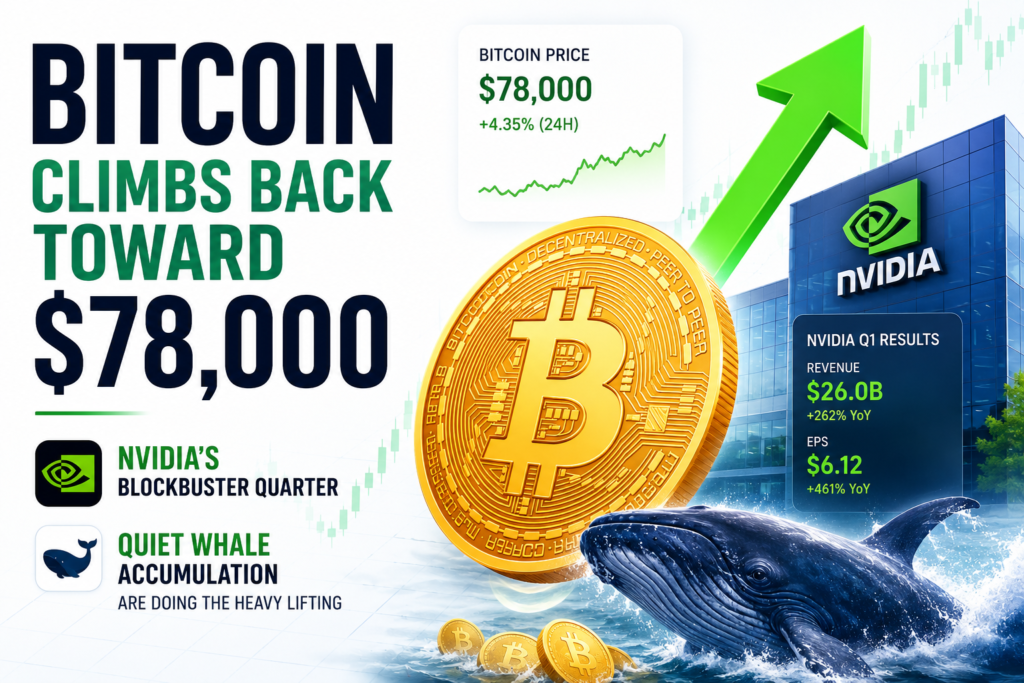
After a brutal week that saw Bitcoin dump from $82,000, slapped around by Moody’s credit downgrade and $648 million in ETF outflows, the market got exactly the macro catalyst it needed. Nvidia just reported one of the most dominant earnings quarters in tech history and Bitcoin noticed immediately.
As of May 21, Bitcoin has reclaimed the $78,000 level, with the price touching $78,200 in early Asian trading before pulling back slightly to around $77,700. That might not sound dramatic on its own, but the context matters: this rebound is happening quietly, without the kind of leverage-fueled frenzy that typically precedes a flush. And underneath the price action, on-chain data is telling a more constructive story than the headline numbers suggest.
Nvidia Printed $81.6 Billion in Revenue. Crypto Traders Exhaled.
Let’s start with the number that moved markets.
Nvidia reported fiscal Q1 2026 revenue of $81.62 billion, up 85% from a year earlier and comfortably above Wall Street’s estimate of $78.9 billion. Adjusted earnings per share came in at $1.87, beating the $1.76 consensus. The company announced an $80 billion stock buyback, raised its dividend sharply and guided Q2 revenue toward $91 billion.
The Data Center segment was the engine: revenue jumped 92% year-over-year to $75.2 billion and now accounts for more than 90% of Nvidia’s total revenue. Jensen Huang’s company has effectively become the infrastructure backbone of the global AI buildout and markets treat it that way.
The reaction was swift and broad. U.S. equities staged a recovery. The S&P 500 added 0.38%, the Nasdaq climbed 0.59%, and Alphabet jumped 3% to fresh all-time highs on enthusiasm around Gemini 3. Nvidia itself gained roughly 3% during the session and extended those gains after the earnings call.
Bitcoin didn’t miss the memo. Crypto traders increasingly treat Nvidia as a proxy for risk sentiment and strong GPU demand signals continued investment in AI infrastructure, which translates directly to a long-term bullish signal for risk markets broadly. Nvidia now contributes heavily to S&P 500 earnings growth, influencing broad liquidity conditions, and when that picture brightens, capital rotates back into risk assets including crypto.
Just days earlier, Wintermute had warned that Nvidia’s earnings report could decide whether Bitcoin held its support zone between $76,000 and $78,000 or cracked below $75,000 toward the low $70s. The beat resolved that question, at least temporarily.
The Iran Factor: A Geopolitical Tailwind Nobody Was Fully Pricing
Nvidia’s earnings weren’t the only force at work.
Bitcoin reclaimed $78,000 as expectations for easing Middle East tensions grew after U.S. President Donald Trump said negotiations to end the war with Iran were in their final stage. Trump told reporters that talks were in the last phase and that a deal could be reached, though he noted other measures were possible if no agreement was struck.
Risk assets, crypto included are deeply sensitive to geopolitical uncertainty. The prospect of a U.S.-Iran deal removes a meaningful tail risk from the macro picture and reduces the probability of an oil-price shock that would further complicate the Fed’s inflation calculus. That combination of Nvidia euphoria and diplomatic progress gave Bitcoin exactly the sentiment environment it needed to stop bleeding.
What the On-Chain Data Actually Shows
Here’s where the story gets more interesting than the price chart alone suggests.
Beneath the surface of a market that looks battered, accumulation has been happening steadily. Stablecoin deposits are building dry powder while BTC outflows from exchanges point to holders moving coins into self-custody. Exchange Bitcoin reserves have fallen to near 3 million BTC down from a peak of 3.3 million BTC in early 2022 with available liquid supply contracting even as the price has climbed from prior cycle peaks toward six figures.
The pattern is consistent and telling. Bitcoin exchange reserves sitting near multi-year lows alongside a rising price suggests buyers are moving coins directly into custody rather than leaving them on exchanges ready to sell. Whale wallets holding 1,000 or more BTC have grown by 142 addresses over six months to reach 2,028 total whale addresses, according to Bitcoin Magazine Pro data. These are not retail traders chasing momentum, they are large holders who are quietly stacking during a period of fear.
Strategy (formerly MicroStrategy) continues its relentless accumulation cadence, holding 818,334 BTC as of Q1 2026 despite reporting a net loss of $12.54 billion for the quarter. The losses haven’t slowed the buying. If anything, Strategy has become the most visible signal that the largest Bitcoin holders are treating current prices as a long-term opportunity rather than a reason to exit.
The SpaceX IPO filing, which landed this week, added another unexpected dimension. Elon Musk’s space company disclosed holding 18,712 Bitcoin as of March 31, 2026 with a cost basis of $661 million and a fair value approaching $1.45 billion at current prices. That figure significantly exceeded prior on-chain estimates of around 8,000 BTC. SpaceX’s Bitcoin holdings now rank 11th globally, ahead of Tesla and Coinbase. This is not a company that buys Bitcoin as its primary business, SpaceX’s core mission is Starship, orbital AI satellites, and infrastructure for the Moon and Mars. The fact that it’s sitting on nearly 19,000 BTC as a balance sheet asset is a meaningful signal about where serious institutional thinking about Bitcoin stands in 2026.
The ETF Picture: Still Bleeding, But Slowing
Not everything is improving. Spot Bitcoin ETF outflows recorded another $330 million on Tuesday, extending withdrawals for the third consecutive day. That’s a meaningful improvement from Monday’s single-day bleed of $648 million, but it’s still net negative.
The divergence emerging in the data is worth watching. April spot ETF inflows hit their strongest monthly figure since October 2025 at $2.44 billion suggesting that last week’s outflows represent institutional de-risking in response to the Moody’s downgrade and bond market volatility rather than a structural change in sentiment toward Bitcoin. When the macro noise clears, the institutional bid tends to return.
That reading aligns with the broader on-chain picture. Daily active addresses at 623,382 remain below the six-month average this is not a retail-driven rally. What’s happening is long-term holder repositioning: patient capital absorbing supply from short-term traders who got shaken out during last week’s drawdown.
Miners and AI: The Emerging Infrastructure Play
One underreported part of this week’s story is the surge in Bitcoin mining stocks but the reason is more nuanced than you might expect.
Nvidia’s stronger-than-expected results and bullish AI outlook lifted crypto mining stocks tied to data center and high-performance computing demand. The connection is direct: Bitcoin miners who have pivoted to hosting AI computers in their data centers are now dual-revenue businesses. When Nvidia confirms that AI infrastructure spending is accelerating, those miners benefit not just from their Bitcoin production but from their HPC hosting contracts.
This convergence of Bitcoin mining and AI infrastructure is one of the more structurally interesting trends of 2026. As data center demand continues to accelerate, Nvidia is guiding to roughly $1 trillion in revenue from its flagship processor lines across 2026 and 2027 the miners who made the pivot early are sitting in an increasingly valuable position.
The Macro Setup Heading Into the Next Few Weeks
Here is the honest picture as of May 21.
The immediate catalyst headwinds Moody’s downgrade, ETF outflows, rising Treasury yields haven’t disappeared. The 10-year yield is still elevated. The Fed isn’t cutting rates. The U.S. debt trajectory is still pointing in the wrong direction. Moody’s action was a statement, not a one-day story, and its implications for risk appetite will continue to reverberate.
But several forces are pushing back:
Nvidia has confirmed that AI infrastructure spending is not slowing and crypto markets benefit from the same liquidity conditions and risk appetite that AI spending signals. The Iran diplomatic progress removes a geopolitical tail risk. On-chain accumulation is steady and structural. SpaceX’s disclosed Bitcoin position is a new institutional endorsement that the market hasn’t fully processed yet. And ETF outflows appear to be moderating after last week’s spike.
Bitcoin holding above $77,000 after everything it absorbed last week a credit downgrade, nearly $1 billion in ETF outflows, and cascading liquidations is itself a form of strength. The asset tested $75,000 support, held it, and is now recovering.
The range to watch heading into the end of May is $76,000 on the downside and $82,000 on the upside. A sustained reclaim above $80,000 on meaningful spot volume not leverage would be the first real technical signal that the correction from $82,500 has fully run its course. Until then, this remains a consolidation that could resolve in either direction depending on the next macro datapoint.
What the on-chain data says, quietly and consistently, is that the people with the most Bitcoin are not selling. And in a market defined by short-term noise, that structural reality is worth considerably more than any single price print.