


Most memecoin traders lose not because they’re bad at picking tokens, they lose because they’re always late. The token is already up 300% by the time it shows up in their Telegram group. The chart looks parabolic. They buy the top. It dumps. Rinse and repeat.
The traders who actually catch these moves early aren’t smarter. They’re just watching the right screen at the right time and that screen, more often than not, is DEXScreener.
If you’ve heard of it but haven’t gone deep on how it actually works, this guide is for you. If you think you already know DEXScreener, stick around most people are using about 20% of what it can do.
What Is DEXScreener and Why Is It the Standard?
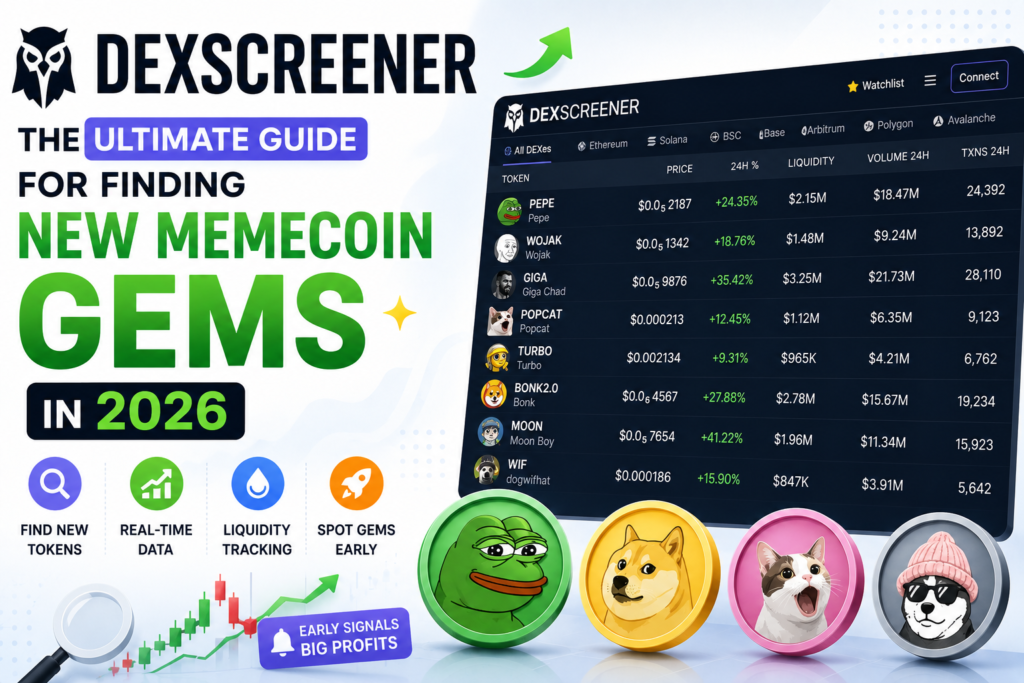
DEXScreener is a real-time multi-chain token analytics platform that tracks every DEX trading pair across more than 80 blockchains the moment a liquidity pool is created. Think of it as the Bloomberg terminal for on-chain token activity except it’s free, requires no signup to use, and updates in real time from on-chain DEX smart contract data.
Unlike CoinGecko or CoinMarketCap, which aggregate data with significant delays and only list tokens that have gone through some vetting process, DEXScreener shows you tokens the moment they start trading. No gatekeeping. No delay. A token launches on Raydium at 3:17 AM UTC. DEXScreener has the pair live by 3:17 AM UTC.
That speed is the entire value proposition for memecoin hunters. In a market where being 60 seconds early versus 60 seconds late can be the difference between a 10x and buying the bag, real-time visibility isn’t a feature, it’s the game.
DEXScreener pulls data directly from on-chain DEX smart contracts, making it as accurate as the blockchain itself. Prices are real-time and reflect actual executed trades. No oracle lag, no API delay what you see is what’s happening on-chain at that exact moment.
The platform supports Solana, Ethereum, Base, Arbitrum, BSC, Avalanche, Polygon, Sui, Aptos, TON, and dozens more. For the vast majority of memecoin activity in 2026, Solana is ground zero and DEXScreener’s Solana coverage is as close to real-time as anything available.
The DEXScreener Interface: Learning to Read the Dashboard
Before you start hunting, you need to understand what you’re looking at. The DEXScreener homepage can feel overwhelming at first dozens of tokens moving, numbers flashing everywhere. Here’s how to break it down.
The Trending Feed
The homepage defaults to a trending view across all chains. These are tokens generating the most volume and transaction activity right now. It’s useful for gauging what’s hot at a macro level, but for early gem hunting, trending is already late. The tokens on the trending page have usually already made their biggest moves.
The New Pairs Feed
The New Pairs page shows tokens the moment their first DEX liquidity pool is created. This is where alpha hunters spend most of their time. Filter by chain, set it to Solana for memecoin hunting and sort by volume or transaction count to surface tokens gaining early traction.
Every new pair listing shows you the listing time, current price, liquidity depth, early volume, percentage move from launch, and the number of buys versus sells. Those six data points, read together, tell you more about a token’s first minutes than most research processes capture in hours.
The Trends Page
The Trends page surfaces pairs that are moving now. Filter by trend type, price change, volume increase, new listings, pick a timeframe from 5 minutes to 24 hours, and scope your search to a specific blockchain. It’s a fast way to scan heat across the market without having to manually scroll through hundreds of new pairs.
For Solana memecoin hunting specifically, the 5-minute and 15-minute Trends filters are where early momentum shows up before it becomes obvious to the broader market.
The Advanced Screener: Your Most Powerful Tool
The screener is where DEXScreener graduates from a chart tool to a genuine edge. Most casual users don’t touch it. That’s your advantage.
Access it from the main navigation and you’re presented with a filter panel that lets you set precise parameters across every token on every supported chain. Here’s the filter stack that experienced memecoin hunters run:
Filter 1: Minimum Liquidity ($20K–$50K)
This is the first and most important filter. Tokens with less than $20,000 in liquidity are almost untradeable for any real position size your buy order alone moves the price significantly, and getting out requires someone else to buy after you. Pro traders use filters including minimum liquidity thresholds to weed out illiquid traps. Set your floor at $20K minimum, $50K if you want more safety.
Filter 2: Market Cap Range ($70K–$3M)
The ideal market cap range for early memecoin discovery sits between $70K and $11M. Below $70K is usually too early and too risky, often still in the initial bundling phase. Above $3M and you’ve likely already missed the fastest part of the move. The $70K–$3M window is where tokens are real enough to have survived the first few minutes, but small enough to have meaningful upside remaining.
Filter 3: Token Age (Under 24 Hours)
The most explosive memecoin moves typically happen within the first 24 hours of launch. Filter to tokens created in the last 24 hours to stay in that window. For even earlier entries, tighten this to 6 hours but be aware that the earlier you go, the more rugpulls you’ll encounter in the results.
Filter 4: Volume Spike
Sort results by volume change over the last hour. A token with flat volume for its first three hours that suddenly spikes 400% in the last 60 minutes is showing you something worth investigating. Volume precedes price when people start buying faster than they have been, the chart typically follows.
Filter 5: Buy/Sell Ratio
Look at the transaction breakdown, DEXScreener shows buys versus sells as a count and a color coding. A token where 70%+ of transactions are buys, and that ratio has been holding for 30+ minutes, is showing organic buying pressure. A token with equal buys and sells or more sells than buys is likely being distributed.
Reading a Token Page: The Six Numbers That Matter Most
Once you find a candidate through the screener or new pairs feed, DEXScreener gives you a full token page. Here’s what to look at first, in order:
Liquidity depth: Is there enough liquidity for your position size without moving the price more than 2–3%? Under $20K, walk away. Over $100K, you have room to work with.
Age: When exactly was this launched? Three minutes old is different from three hours old. The risk profile changes dramatically.
24-hour volume vs. market cap ratio: A healthy memecoin in early momentum has daily volume that equals or exceeds its market cap. A $500K market cap token doing $2M in daily volume is on a run. A $500K token doing $30K in volume is going nowhere.
Maker count (unique wallets): DEXScreener shows how many unique wallets have transacted in the token. Under 100 unique makers is extremely early. Over 1,000 and retail discovery has begun. Over 5,000 and you’re chasing mainstream momentum.
Boosted status: DEXScreener’s Trending Score can be boosted by token teams who pay for visibility. To maintain the credibility of the Trending Score, such tokens are marked with a lightning bolt. A lightning bolt next to a token’s trending position means someone paid to be there. That’s not automatically a red flag, paid promotion is normal but it means the trending position reflects marketing spend, not purely organic momentum. Weight it accordingly.
Price chart shape: Look at the 1-minute and 5-minute charts. A healthy early memecoin makes a series of higher lows as it climbs. A token that went vertical in the first 30 seconds and has been bleeding since is showing you the classic insider pump-and-distribute pattern.
Moonshot: DEXScreener’s Native Launch Platform
Moonshot is DEXScreener’s own token launch platform, built with a fair launch model: no pre-sales, no insider allocations, capped supply of 1 billion tokens, and fully audited smart contracts with ownership renounced. Once a Moonshot token’s market cap reaches 432 SOL (~$64,000), all remaining tokens and liquidity automatically migrate to major DEXes like Meteora or Raydium.
The migration event, when a Moonshot token graduates to Raydium is one of the most reliable short-term momentum triggers in the Solana memecoin market. Tokens that reach graduation have survived the initial shakeout, have real liquidity, and appear on the main DEXScreener feed where a much larger audience sees them for the first time. Trading around migration events is a strategy in itself.
Watchlists and Alerts: Turning DEXScreener Into an Early Warning System
Creating a free DEXScreener account unlocks watchlists and alerts. This is the feature most traders overlook, and it’s one of the most practically useful for active memecoin hunting.
Set up multiple watchlists: one for tokens you’re actively monitoring, one for tokens you’ve entered, and one for tokens on your radar that haven’t triggered your entry criteria yet. Star any token to add it to your watchlist, and DEXScreener will surface it in your personal feed with updated metrics every time you check.
Alerts let you set price or volume triggers on any token, so instead of staring at the screen waiting for a token to move, you get notified the moment it crosses your threshold. For traders watching dozens of potential gems simultaneously, this is the difference between catching a move and missing it while looking at a different chart.
What DEXScreener Doesn’t Tell You And How to Fill the Gap
DEXScreener is exceptional at the surface layer: price, volume, liquidity, transaction counts. What it doesn’t show you is the wallet-level intelligence underneath those numbers.
It won’t tell you if the wallets buying a token are known smart money addresses with a track record of early profitable entries. It won’t show you whether the top holders are a coordinated insider cluster or genuinely independent buyers. It won’t reveal if the team wallet is quietly distributing while the chart looks healthy.
The Professional Workflow: Putting It All Together
Here’s the actual workflow that experienced memecoin hunters run:
Step 1. New Pairs scan (Solana, sorted by volume, updated every 10 minutes): Flag any token under 6 hours old showing volume growth with a buy/sell ratio above 60% buys.
Step 2. Screener filter pass: Run flagged tokens through the screener: minimum $20K liquidity, $70K–$3M market cap, positive volume momentum. Filter out anything with a lightning bolt trending score if you’re looking for organic signals.
Step 3. Token page deep dive: Check liquidity depth, maker count, chart shape, and whether the price action shows higher lows or a bleed from an early spike.
Step 4. On-chain verification: For any token passing steps 1–3, check the holder distribution on Bubblemaps and verify there’s no obvious insider cluster controlling more than 25% of supply. Cross-reference with Arkham or Nansen if the position size warrants deeper wallet intelligence.
Step 5. Entry decision: If DEXScreener shows momentum, the on-chain distribution looks clean, and smart money isn’t already at the exits, that’s your window.
The whole process, once you’ve built the muscle memory, takes 3–5 minutes per token.
The Bottom Line
DEXScreener is not a crystal ball. It won’t tell you which tokens will 100x, and no tool can do that reliably. What it does do better than any other free tool available is give you real-time visibility into where capital is moving on-chain, the moment it starts moving.
The traders who consistently find memecoin gems early are the ones who’ve built a systematic process around that visibility. They’re not guessing. They’re watching the chain, reading the signals, and acting on data rather than social media noise.
DEXScreener is where that process starts. What you build around it determines whether it stays a chart tool or becomes a genuine edge.