


Every significant price move in crypto is preceded by something quieter: a wallet accumulating, a position being built, capital rotating from one sector to another. By the time that movement shows up on a chart or in a news headline, the traders who were watching on-chain already have their positions.
Whale wallet tracking is not a passive activity. It is a systematic research practice that, done correctly, gives you access to the same information that the most consistently profitable on-chain traders are acting on sometimes hours before the price reflects it.
This walkthrough covers the complete process: what whale wallets actually are, how to find the right ones to track, which tools to use and why, and how to build an alert system that notifies you without requiring you to watch a dashboard around the clock.
What Makes a Wallet a ‘Whale’ And Why It Matters
The term gets used loosely, but in a tracking context, a whale is any wallet that holds or moves enough capital to meaningfully influence price action or signal meaningful conviction. In practice, this breaks into several distinct types, each carrying different signal weight:
- Smart Money wallets: Wallets with documented win rates above 60% across multiple tokens and timeframes. These are the most valuable to follow because the track record is verifiable on-chain.
- Institutional wallets: Labeled addresses belonging to funds, treasuries, and known entities. When a fund address accumulates a new token, that represents a deliberate allocation decision, not retail speculation.
- Sniper wallets: Addresses that enter tokens in the first blocks after launch. High-frequency, often insider-adjacent. A yellow flag for the token, but worth knowing about.
- KOL (Key Opinion Leader) wallets: Addresses belonging to known influencers. These carry lower signal weight than independent whales KOL entries often precede promotion, not necessarily conviction.
- Dormant whale re-activation: A wallet that has been inactive for months suddenly making large moves is one of the highest-conviction signals available. It suggests deliberate decision-making after a period of observation.
The most important distinction: a whale making money consistently is fundamentally different from a whale who made one large bet. Always check win rate and track record, not just position size.
Step 1: Finding Wallets Worth Tracking
This is where most traders make their first mistake. They find a whale wallet that recently made a lot of money and start following it without checking whether that performance is repeatable or a one-time event.
The right approach is to build a curated list of 5–10 wallets that have demonstrated consistent performance across multiple tokens and timeframes. Here’s how:
Using Cielo Finance Wallet Discovery
Cielo Finance’s Wallet Discovery feature is the most efficient way to find consistently profitable wallets. The platform filters its database of 2 million+ tracked wallets by win rate over 7-day and 30-day windows, surfacing wallets tagged as Gem Finder (early low-cap entries), Whale, and New Wallet. Filter by win rate above 60% and look for wallets active within the last 24–48 hours.
Before following any wallet, open its full profile and check three things: the number of trades in the scoring window (at least 20–30 for statistical validity), the average holding period (must align with your own trading style), and whether the wallet shows consistent patterns across multiple tokens or appears to have made one exceptional trade skewing the stats.
Using GMGN.ai Smart Money Feed
GMGN tracks over 50,000 smart money wallets across Solana, Ethereum, and Base networks. Its free feed shows labeled wallet entries in real time, categorized by type. The most useful filter is the Gem Finder tag these are wallets with a documented history of entering low-cap tokens before significant price appreciation. For Solana memecoin tracking specifically, GMGN’s smart money feed updated in near real-time is the fastest signal available.
Using Nansen’s Smart Money Rankings
Nansen classifies wallets by behavior across 30+ chains, tracking portfolio moves, win rates, and realized profit and loss in real time. The platform’s Smart Money label covers verified institutional actors, consistently profitable independent traders, and DeFi power users. For Ethereum and EVM chain tracking, Nansen’s labeled wallet database is the most comprehensive available.
Step 2: Understanding What You’re Seeing
A whale buying a token is raw data. Whether that buy is a signal worth acting on depends on context that the transaction alone doesn’t provide. Before building any alert system, you need to understand what different on-chain behaviors actually indicate.
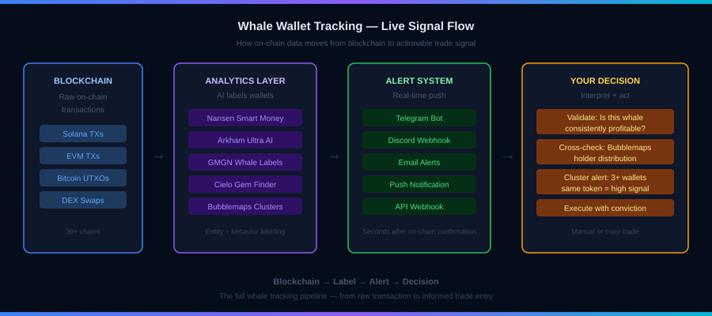
The complete whale tracking signal pipeline from raw blockchain data through AI-powered labeling, to real-time alerts, to your research and execution decision. Every stage filters noise and adds context.
Exchange Inflows vs. Outflows
When a whale moves tokens from a personal wallet to a centralized exchange, that is typically preparation to sell. Exchange deposits from large wallets are a leading indicator of sell pressure they usually precede public selling by hours. When tokens move from exchanges to private wallets (cold storage or self-custody), that signals long-term confidence coins moving away from exchanges are unavailable for immediate sale.
Accumulation Patterns vs. Single Large Buys
A whale buying $500,000 of a token in a single transaction is interesting. A whale buying $50,000 over 10 separate transactions across 6 hours is significantly more interesting. Systematic accumulation in smaller tranches suggests the wallet is deliberately building a position while minimizing price impact a pattern associated with informed, patient capital.
Cluster Signals: The Highest-Conviction Alert
When three or more independently labeled smart money wallets buy the same token within a short window 10 to 30 minutes that cluster is the strongest signal whale tracking surfaces. It suggests independent actors with different information sources are all reaching the same conclusion simultaneously. This is not random. Cluster alerts carry meaningfully more signal than any single wallet entry.
Step 3: Building Your Alert System
Watching a dashboard manually is not a strategy. The traders who extract real value from whale tracking have alert systems that push notifications the moment something relevant happens while they’re sleeping, working, or doing something else entirely.
Telegram Bot Alerts via Cielo Finance
Cielo’s alert system is the most practical for active memecoin traders. Set custom triggers: alert when a tracked Gem Finder wallet buys any new Solana token above $1,000. Alert when three or more followed wallets enter the same token within 60 minutes. Alert when a tracked wallet sells more than 50% of a token position. These three alert types cover entry signals, high-conviction cluster events, and exit warnings respectively.
The free Cielo tier supports up to 120 alerts per hour with one Telegram bot. The Pro tier at $59/month unlocks 1,000 wallet tracking, two Telegram bots, and full Wallet Discovery access. For most active traders, the Pro tier is where the alert system becomes genuinely useful rather than constrained.
Whalert for Solana-Specific Tracking
Whalert monitors any Solana wallet address in real time and sends instant alerts via Telegram, Discord, WhatsApp, Slack, Microsoft Teams, email, or push notification the moment it transacts on-chain. Solana’s fast finality means alerts arrive within seconds of on-chain confirmation. Setup takes under 60 seconds: paste an address, choose a notification channel, and the system handles the rest. The free plan tracks up to three wallets with no subscription required.
For wallets where you want comprehensive monitoring not just new token buys, but also DEX interactions, SOL movements, and protocol engagements Whalert’s address-level monitoring provides the most granular Solana alert coverage available.
Nansen Custom Alerts for EVM Chains
On Ethereum and EVM chains, Nansen’s Smart Alerts send notifications via Telegram, email, or webhook when tracked conditions are met: unusual Smart Money inflows, exchange balance shifts, Hot Contract interactions. The platform’s AI signals highlight abnormal on-chain activity automatically, reducing the manual filtering required to identify meaningful events in high-volume chains.
Step 4: Validating the Signal Before Acting
Receiving a whale alert is not the same as having a reason to trade. Every alert is the beginning of a 60-second verification process, not a buy button.
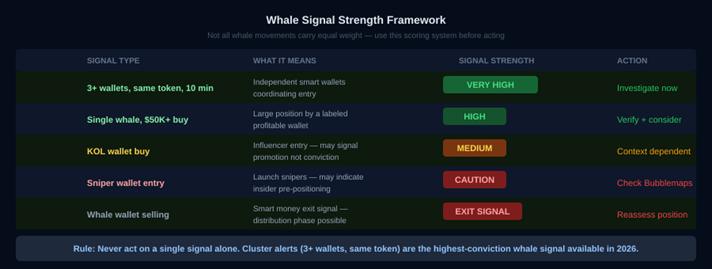
Whale signal strength framework — not all whale movements carry equal weight. Cluster alerts from 3+ independent smart wallets are the highest-conviction signal. Single sniper entries are a caution flag, not a buy signal.
The 60-Second Verification Checklist
- DEXScreener: check liquidity depth. Under $20K, skip. Under $50K, size down.
- GMGN.ai or Bubblemaps: check the security score and bundle percentage. Over 20% bundled, skip.
- Bubblemaps: check holder concentration. Over 30% in a single cluster, skip.
- Cielo or GMGN: is this wallet’s win rate above 60% over at least 20 trades? If not, weight the signal lower.
- Check the time elapsed since the alert. Anything more than 5 minutes old on Solana may already be late.
The goal isn’t to copy every whale trade. It’s to identify the subset of whale moves that pass every validation check and size into those with appropriate conviction.
Building Deeper On-Chain Context
Whale wallet tracking is one layer of on-chain analysis and a powerful one. But it works best when it sits inside a broader understanding of how capital flows on-chain, how to distinguish genuine accumulation from manufactured volume, and how to read the difference between a token gaining real traction and one being temporarily propped up.
The analytical framework for all of that how smart money actually moves, what whale accumulation patterns look like across different market conditions, how to track memecoins systematically from launch through to exit, and how to combine multiple tools into a coherent research process is exactly what the guide below covers end-to-end. It is the essential complement to everything in this walkthrough:
On-Chain Analysis: The Complete Guide to Tracking Memecoins, Whales and Smart Money in 2026
Common Mistakes and How to Avoid Them
The most frequent errors in whale tracking are not technical they’re behavioral.
- Following too many wallets. A feed of 30 whale wallets generates constant noise. 5-10 carefully selected, consistently profitable wallets generate signal. Quality of selection matters far more than volume.
- Ignoring exit alerts. Most traders set buy alerts but not sell alerts on tracked wallets. When the whale you’re copying exits, you want to know immediately not when you happen to check the dashboard.
- Acting on stale alerts. A Solana whale alert that is 10 minutes old is often a different market than when it fired. Always check current price against alert price before executing.
- Conflating correlation with causation. A whale buying doesn’t guarantee the price goes up. It raises the probability, given a track record, that the trade has edge. Risk management still applies.
- Not verifying win rates periodically. A wallet with a 70% win rate in January 2026 may have a 48% win rate by April. Track record is a living data point, not a permanent credential.
The Complete Whale Tracking Stack, Free to Start
You do not need to spend anything to build a functional whale tracking setup. The following stack covers discovery, validation, monitoring, and alerts at zero cost:
- Discovery: Cielo Finance free tier (250 wallets, basic Wallet Discovery) or GMGN.ai smart money feed
- Validation: Bubblemaps bundle checker + holder visualization (free), Etherscan or Solscan forensics (free)
- Alerts: Whalert free plan (3 Solana wallets), Cielo free Telegram bot (120 alerts/hour)
- Context: DEXScreener screener (free), DeFiLlama TVL and flow data (fully free), Coinglass liquidation maps (free)
When your trading volume justifies it when a single well-timed entry informed by better data covers several months of subscription cost that’s when upgrading to Cielo Pro or Nansen Standard makes financial sense. Until then, the free stack described above is not a compromise. It is the right starting point.