


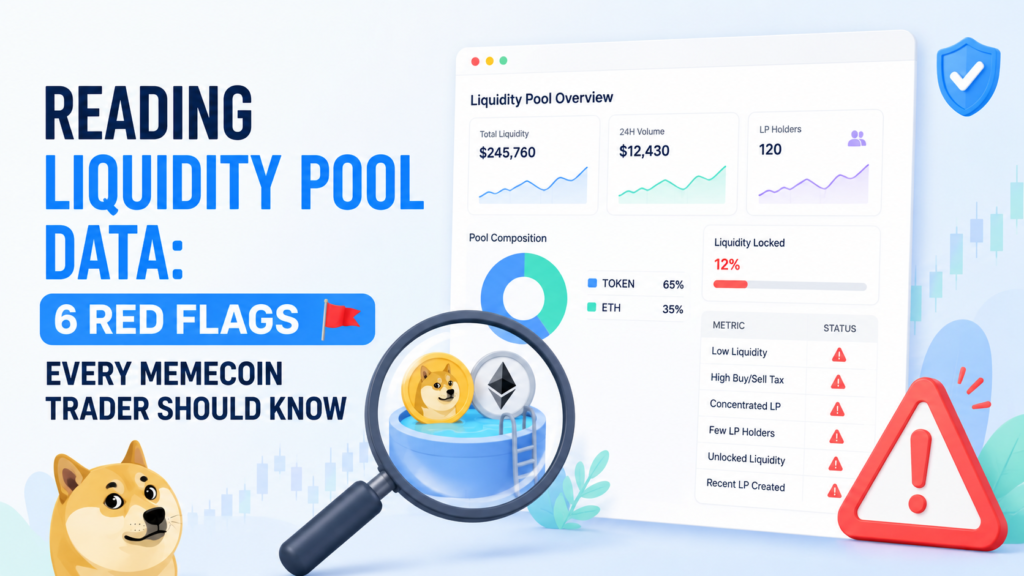
The promise of micro-cap memecoins is undeniably alluring. Driven by viral social media momentum, explosive community sentiment, and instant trading avenues, the right token can experience astronomical percentage gains in a matter of hours. But beneath the shiny outer layer of internet culture lies a highly speculative and adversarial trading environment.
For every token that achieves a sustained market presence, hundreds of others are engineered solely to extract capital from unsuspecting retail investors.
If you want to survive the memecoin landscape, you have to look past the price candles and social media hype. Your safest line of defense is learning how to read liquidity pool (LP) data. The liquidity pool is the underlying smart contract holding the actual cash reserves that allow a token to be bought and sold. If the liquidity pool is structurally compromised, the project is a ticking time bomb.
Before you click “swap” on your decentralized exchange (DEX) interface, audit the contract address on platforms like DEX Screener, GeckoTerminal, or native block explorers to scan for these six critical liquidity pool red flags.
1. The Liquidity Pool is Unlocked or Unburned
When a developer launches a new memecoin, they typically seed the initial pool with a pairing of their new token and a baseline asset like native SOL, ETH, or a stablecoin. In exchange for setting up this pair, the developer receives Liquidity Provider (LP) tokens, which act as a claim check to withdraw those underlying assets at any moment.
- The Red Flag: If those LP tokens remain sitting passively in the developer’s deployment wallet, you are exposed to a classic rug pull risk. The moment the project attracts substantial retail capital, the creator can trigger a function to reclaim their LP tokens, drain the real base asset from the smart contract, and leave buyers holding a completely un-tradable, worthless token.
- The Safe Standard: Legitimate or community-driven projects will permanently neutralize this risk by either burning the LP tokens (sending them to an un-spendable null address) or securing them inside a verified third-party locking protocol (like Unicrypt or Team Finance) for a fixed, multi-month duration. Always verify that the pool status reads 100% burned or locked before committing funds.
2. A Critically Low Liquidity-to-Market-Cap Ratio
A token’s market capitalization can easily be artificially inflated through low circulating supply or intense wash trading. True stability, however, is measured strictly by the depth of its liquidity pool.
- The Red Flag: Watch out for tokens with massive paper valuations but incredibly shallow pools for example, a token boasting a $20 million market cap supported by a meager $45,000 in total value locked (TVL).
- Why It Traps You: This imbalance results in extreme price slippage. Because the pool lacks depth, even moderate sell orders will rapidly devalue the asset. More importantly, if you manage to accumulate a larger position, you will find it virtually impossible to cash out at your target price because there simply isn’t enough underlying cash in the contract to facilitate your exit. Aim for pairs where the total liquidity represents at least 10% to 20% of the overall market cap.
3. Disproportionate Initial LP Funding Sources
On-chain analysis allows you to trace where a liquidity pool’s initial seed money originated. A healthy project typically sees its deployment funded transparently from a mainstream centralized exchange withdrawal or an established personal wallet.
- The Red Flag: If you track the deployer address back to its very first transaction and find that it was funded anonymously by a privacy mixer (like Tornado Cash) or via a complex web of internal wallet-to-wallet transfers, you should immediately exercise caution.
- The Strategic Threat: While privacy isn’t inherently criminal, serial scammers deploy multiple automated tokens daily using hidden gas funding sources to hide their identities. If the funder address is linked to previous failed tokens, compromised pools, or historic rug pulls on-chain, the current project is highly likely to repeat that exact lifecycle.
4. Unbalanced Token Ratios (The One-Sided Pool)
Automated Market Makers (AMMs) rely on mathematical token ratios to maintain equilibrium within a dual-asset pool. For a healthy trade environment, the value of the memecoin supply should be mirrored 1:1 by the value of the paired base asset (e.g., SOL or ETH).
  Balanced Pool Structure               Unbalanced (One-Sided) Pool
   ┌───────────────────────┐             ┌───────────────────────┐
   │ 50% Paired Asset (SOL)│             │ 5% Paired Asset (SOL) │◄── Low Reserve
   ├───────────────────────┤             ├───────────────────────┤
   │ 50% Created Memecoin  │             │ 95% Created Memecoin  │◄── Hyper Inflation
   └───────────────────────┘             └───────────────────────┘
- The Red Flag: When you analyze the pool depth breakdown, notice if the paired reserve asset has been severely hollowed out, leaving the pool composed of 95% memecoins and only 5% base currency.
- The Mechanics: This structural skewing usually happens when early insiders, snipers, or developers aggressively dump their supply into the pool simultaneously. They pull the real cash reserves out, tilting the ratio until the pool is completely dried up. Buying into a heavily lopsided pool means you are paying a premium for an asset that has already had its underlying financial floor completely hollowed out.
5. High-Risk “Tax” Functions and Dynamic Liquidity Control
Many modern memecoins include a built-in transaction tax (e.g., a 5% fee on every buy or sell order) designed to fund project marketing or development. However, the smart contract logic governing these taxes can easily be weaponized.
- The Red Flag: Look closely at automated contract audit summaries on your tracking platform. If the contract features a mutable tax authority or a hidden “honeypot” mechanism, the creator retains the ability to alter code parameters on the fly.
- The Danger: A malicious developer will launch a token with a standard 0% tax to encourage maximum buying volume. Once a substantial amount of capital is locked inside the liquidity pool, they will alter the contract settings to raise the sell tax to 100%. This traps your funds completely: your portfolio balance may appear to be skyrocketing, but any attempt to interact with the liquidity pool to execute a sell order will fail, allowing the creator to slowly bleed the pool dry.
6. Sudden, Unexplained Drops in Total Value Locked (TVL)
Monitoring a token at launch isn’t a one-time check; you must keep a close eye on the ongoing trajectory of the pool’s health over time.
- The Red Flag: A sudden, steep decline in the pool’s TVL while the nominal token price remains relatively stable or goes up.
- The Hidden Flow: This occurs when multi-signature wallets or larger institutional liquidity providers quietly begin un-staking or removing their portions of the pool in phases. It is often a sign of a “soft rug,” where the internal team slowly diminishes the project’s exit liquidity behind the scenes before formally abandoning their social channels. If the foundation supporting the trades starts shrinking, you need to step away from the position.
The On-Chain Checklist for Traders
Before deploying capital into any new memecoin opportunity, run the contract through this rapid, data-centric safety checklist:
| Step | Target Parameter | Optimal Status | Red Flag Status |
| 1 | LP Token Status | 100% Burned or Locked | Unlocked in Creator Wallet |
| 2 | Liquidity-to-Market-Cap Ratio | Above 10% Minimum | Under 2% (Thin/Slippage Risk) |
| 3 | Funding Origin | Clear Exchange / Clean Wallet | Anonymized Privacy Mixer |
| 4 | Pool Composition Ratio | Balanced (Approx. 50/50 Value) | Heavily One-Sided (>90% Memecoin) |
| 5 | Sell Tax Logic | Fixed / Immutable Structure | Mutable / Scalable to 100% |
Final Thoughts
Memecoin trading will always remain a high-stakes, highly volatile sector of the crypto market. While you cannot control broader market sentiment or sudden social media shifts, you can completely protect yourself from structural fraud.
By cultivating the habit of reading liquidity pool data, tracking contract constraints, and recognizing these six red flags, you transition from a trader guessing on random trends to an analyst reading real market health. Let data guide your entries, maintain strict capital preservation strategies, and never let FOMO cloud your technical due diligence.