Blockchain networks are no longer judged solely by their native cryptocurrencies. Instead, their long-term success increasingly depends on the strength of the ecosystems built around them.
Among today’s leading blockchain platforms, Solana has established one of the fastest-growing ecosystems, attracting developers, startups, institutional participants, creators, and millions of users worldwide.
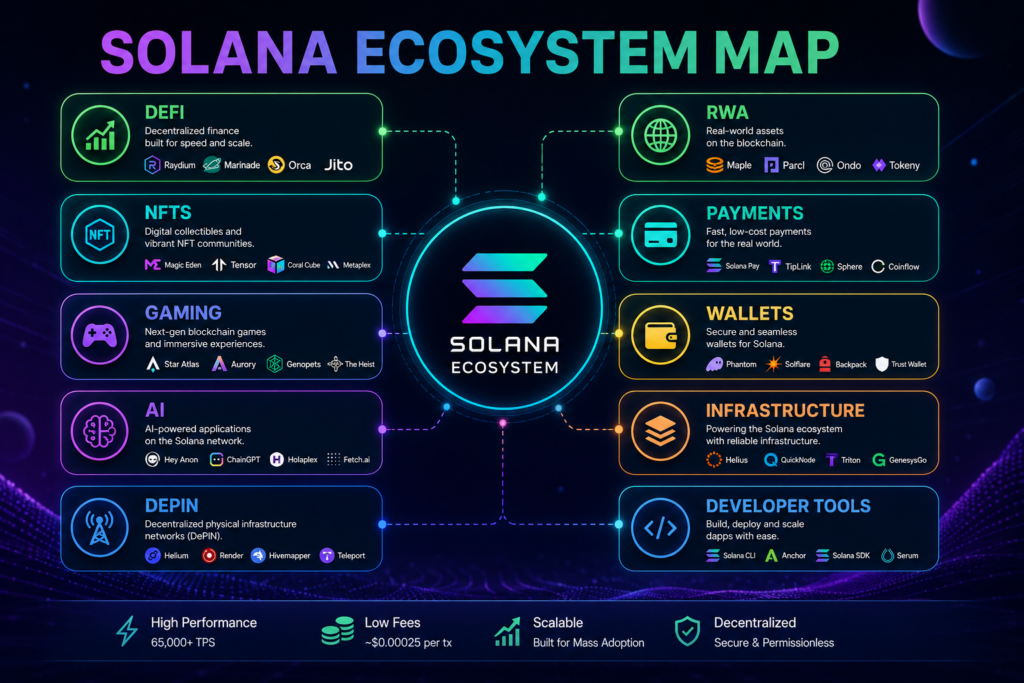
From decentralized finance (DeFi) and NFT marketplaces to blockchain gaming, artificial intelligence, decentralized physical infrastructure networks (DePIN), payments, and real-world asset (RWA) tokenization, the Solana ecosystem supports a wide range of applications beyond simple cryptocurrency transactions.
Unlike traditional financial systems that often rely on centralized intermediaries, the Solana ecosystem enables developers to build decentralized applications (dApps) capable of operating through smart contracts while maintaining transparency, efficiency, and interoperability.
Whether you’re an investor researching blockchain networks, a developer exploring Web3 infrastructure, or simply curious about Solana, understanding its ecosystem provides valuable insight into how modern blockchain technology is evolving.
In this guide, you’ll learn how the Solana ecosystem works, the infrastructure that powers it, the most important categories of projects, real-world applications, and the technologies shaping one of the industry’s most active blockchain communities.
What Is the Solana Ecosystem?
The Solana ecosystem refers to the complete network of decentralized applications, protocols, wallets, infrastructure providers, developer tools, validators, and communities built on the Solana blockchain.
Rather than functioning as a single application, the ecosystem is made up of hundreds of independent projects that interact through shared blockchain infrastructure.
These projects cover a wide variety of sectors, including:
Each category contributes to the overall functionality of the network while expanding the ways users interact with blockchain technology.
Why the Solana Ecosystem Matters
Every blockchain network competes for developers, users, liquidity, and innovation.
The ecosystem determines whether a blockchain becomes a niche technology or a widely adopted platform.
A healthy ecosystem generally includes:
Active developers
Diverse decentralized applications
Strong infrastructure
Reliable wallets
Liquidity providers
Educational resources
Security services
Enterprise participation
The more interconnected these components become, the more valuable the ecosystem can be for users and developers alike.
Rather than evaluating Solana solely by transaction speed or technical specifications, many analysts consider ecosystem growth one of the strongest indicators of long-term development.
The Evolution of the Solana Ecosystem
Since launching its mainnet, Solana has evolved from a high-performance blockchain into a diverse Web3 ecosystem.
Initially, most activity centered around decentralized exchanges and token transfers.
Over time, the ecosystem expanded into areas such as:
NFT marketplaces
Liquid staking
Decentralized lending
Blockchain gaming
Payment infrastructure
Stablecoin settlements
Artificial intelligence
Decentralized wireless networks
Tokenized assets
Consumer applications
This diversification has encouraged developers to build applications serving both crypto-native users and broader digital audiences.
How the Solana Ecosystem Works
Although individual applications differ, they all rely on the same underlying blockchain infrastructure.
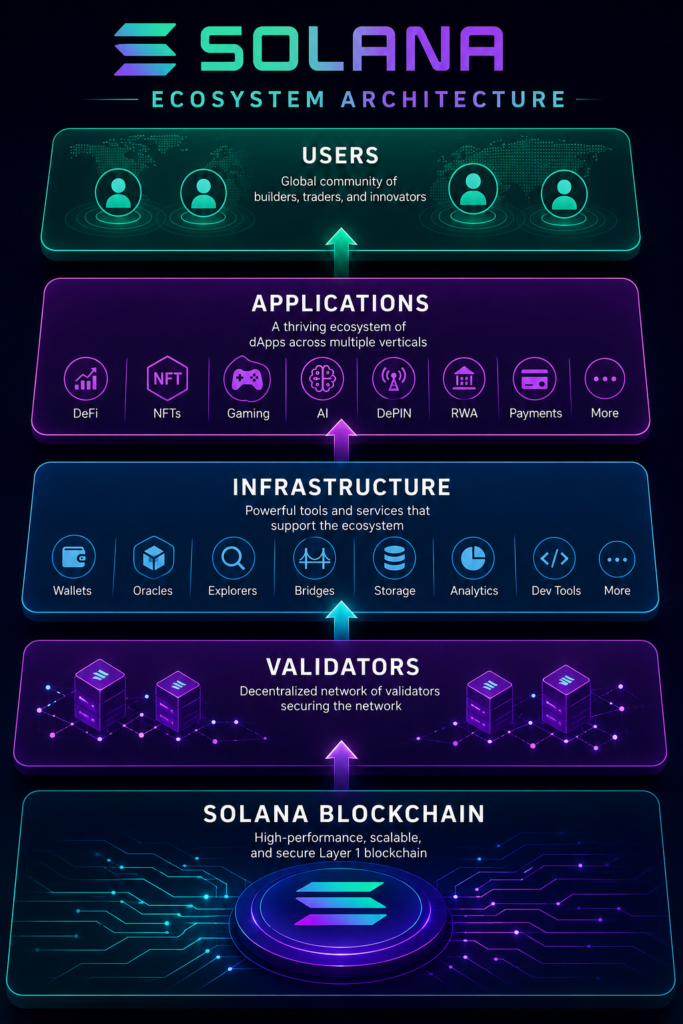
The ecosystem operates through several interconnected layers.
Layer 1 – Solana Blockchain
At the foundation is the Solana blockchain itself.
It provides:
Transaction processing
Smart contract execution
Network security
Consensus
Digital asset ownership
Every decentralized application ultimately depends on this base layer.
Layer 2 – Infrastructure Providers
Infrastructure companies support developers by providing services such as:
RPC nodes
APIs
Blockchain indexing
Data analytics
Developer tools
Cloud infrastructure
Without these services, building scalable decentralized applications would be significantly more difficult.
Layer 3 – Applications
Developers build decentralized applications on top of the infrastructure layer.
These include:
Exchanges
Lending platforms
Wallets
NFT marketplaces
AI applications
Payment systems
Gaming platforms
Most users interact primarily with this application layer.
Layer 4 – End Users
The final layer consists of users interacting with applications through compatible wallets.
Users can:
Trade tokens
Purchase NFTs
Stake SOL
Play blockchain games
Access DeFi
Send payments
Participate in governance
Each interaction is ultimately recorded on the Solana blockchain.
Core Components of the Solana Ecosystem
Although hundreds of applications exist, they generally fall into several major categories.
Decentralized Finance (DeFi)
DeFi applications provide blockchain-based financial services.
Examples include:
Decentralized exchanges
Lending
Borrowing
Yield optimization
Liquid staking
Perpetual trading
This sector represents one of the largest areas within the Solana ecosystem.
DePIN projects coordinate physical infrastructure using blockchain incentives.
Examples include:
Wireless networks
GPU sharing
Cloud computing
Mapping services
Environmental monitoring
This category has grown significantly across the broader Web3 ecosystem.
Payments
Payment applications enable users to:
Send digital assets
Accept merchant payments
Process international transfers
Support e-commerce
Fast settlement times make blockchain payments increasingly practical for many use cases.
Real-World Assets (RWAs)
Tokenization allows traditional assets to be represented digitally on blockchain networks.
Potential examples include:
Bonds
Treasury products
Real estate
Commodities
Investment funds
While still developing, tokenization represents one of blockchain’s fastest-growing sectors.
Who Builds on Solana?
One of the ecosystem’s greatest strengths is its diverse community.
Participants include:
Developers
Creating decentralized applications.
Validators
Maintaining network security.
Infrastructure Providers
Supporting developers through APIs, RPCs, indexing, analytics, and cloud services.
Businesses
Integrating blockchain into products and services.
Creators
Publishing NFT collections, games, and digital experiences.
Researchers
Exploring blockchain scalability, cryptography, and decentralized systems.
Users
Participating through wallets, decentralized applications, staking, and governance.
Why Developers Choose Solana
Developers evaluate blockchain networks using multiple criteria.
Common reasons for building on Solana include:
High transaction throughput
Efficient smart contract execution
Growing developer community
Expanding user base
Mature tooling
Active infrastructure providers
Broad application diversity
Ultimately, the choice of blockchain depends on each project’s technical requirements, goals, and target audience.
Key Takeaways
The Solana ecosystem includes decentralized applications, infrastructure providers, wallets, validators, and developer tools built on the Solana blockchain.
Its major sectors include DeFi, NFTs, gaming, AI, DePIN, payments, and tokenized real-world assets.
A healthy ecosystem depends on developers, users, infrastructure, and active communities not just blockchain performance.
The ecosystem operates through multiple interconnected layers, from blockchain infrastructure to end-user applications.
Solana’s expanding ecosystem continues to support innovation across financial services, digital ownership, intelligent applications, and Web3 technologies.
Solana DeFi Ecosystem – Understanding Decentralized Finance on Solana
After exploring how the Solana ecosystem is structured, it’s time to examine its largest and most active sector Decentralized Finance (DeFi).
DeFi has become one of the primary drivers of blockchain adoption by enabling users to access financial services without relying entirely on traditional intermediaries such as banks or centralized exchanges.
On Solana, DeFi applications benefit from the blockchain’s high throughput and relatively low transaction costs, allowing developers to create financial products ranging from decentralized exchanges and lending markets to liquid staking, perpetual futures, and on-chain payment solutions.
Rather than replacing traditional finance, these applications provide alternative ways for users to interact with digital assets through programmable smart contracts.
What Is DeFi?
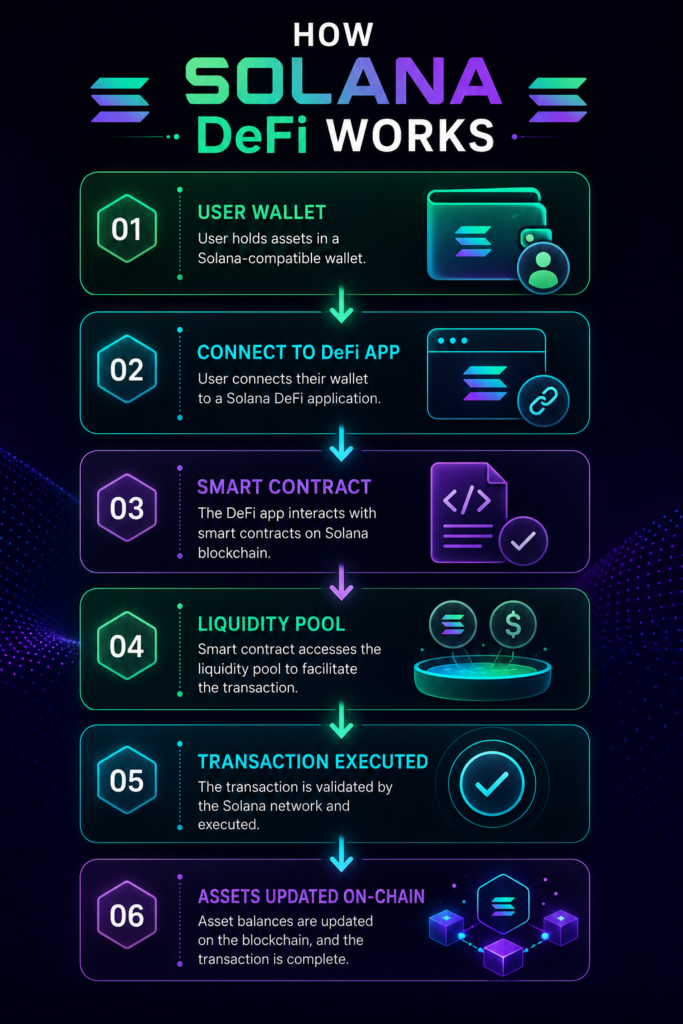
Decentralized Finance (DeFi) refers to blockchain-based financial applications that use smart contracts to automate services traditionally offered by financial institutions.
Instead of opening an account with a bank or brokerage, users interact directly with decentralized protocols using a compatible crypto wallet.
Common DeFi services include:
Token swapping
Lending
Borrowing
Yield generation
Liquid staking
Stablecoin transfers
Perpetual trading
Liquidity provision
Transactions are executed automatically according to protocol rules, with blockchain technology recording each interaction.
Why Solana Has Become a Popular Blockchain for DeFi
Developers evaluate blockchain networks based on technical capabilities, infrastructure, user adoption, and developer experience.
Several characteristics have contributed to Solana’s growing DeFi ecosystem.
High Throughput
Many DeFi applications require users to submit multiple transactions within short periods.
Examples include:
Token swaps
Arbitrage
Liquidations
Automated trading
Yield optimization
A blockchain capable of processing many transactions efficiently helps support these activities.
Efficient Transaction Costs
Transaction costs influence how users interact with decentralized applications.
Lower costs can make smaller transactions more practical, particularly for activities such as:
Yield farming
Portfolio rebalancing
NFT trading
Frequent token swaps
While transaction costs may vary depending on network conditions, efficient fee structures remain one reason many users explore Solana-based applications.
Growing Developer Community
An expanding developer ecosystem often leads to:
New protocols
Better user experiences
Improved security
More infrastructure tools
Increased innovation
A strong developer community also encourages interoperability between projects.
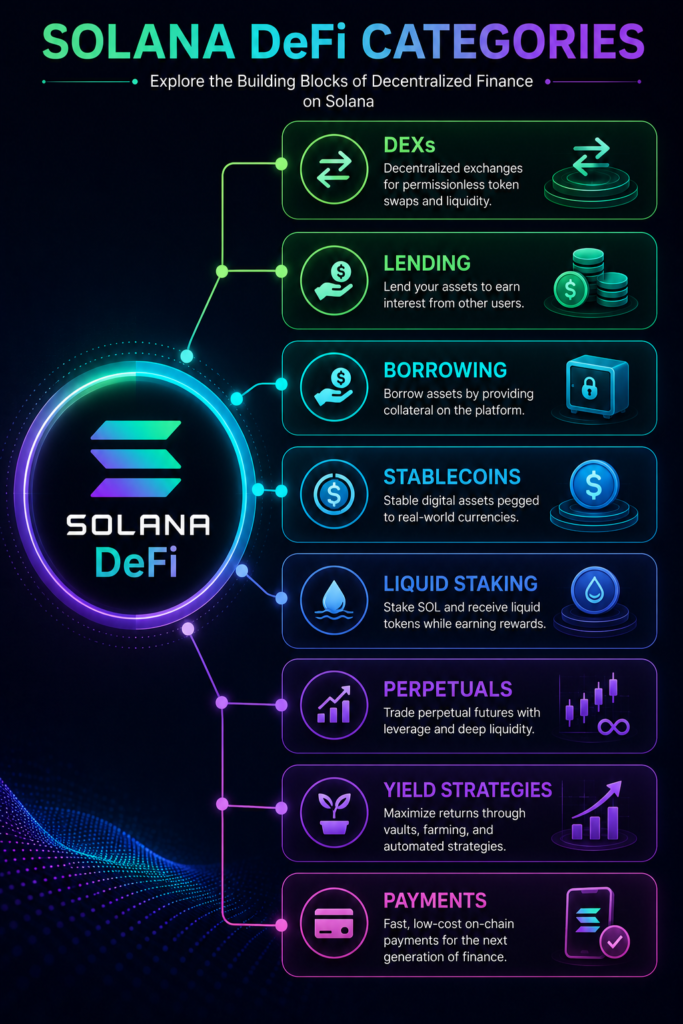
Core Components of Solana DeFi
Although hundreds of decentralized applications exist, most fall into several major categories.
1. Decentralized Exchanges (DEXs)
Decentralized exchanges allow users to swap cryptocurrencies directly through smart contracts instead of relying on centralized order books managed by a company.
Unlike centralized exchanges, users generally maintain control of their assets throughout the transaction process.
DEXs support:
Token swaps
Liquidity pools
Market making
Price discovery
Permissionless trading
Popular Examples
Educational examples include:
Jupiter
Raydium
Orca
Meteora
Each project offers different features and liquidity sources while serving similar purposes within the ecosystem.
2. Liquidity Pools
Traditional exchanges match buyers and sellers.
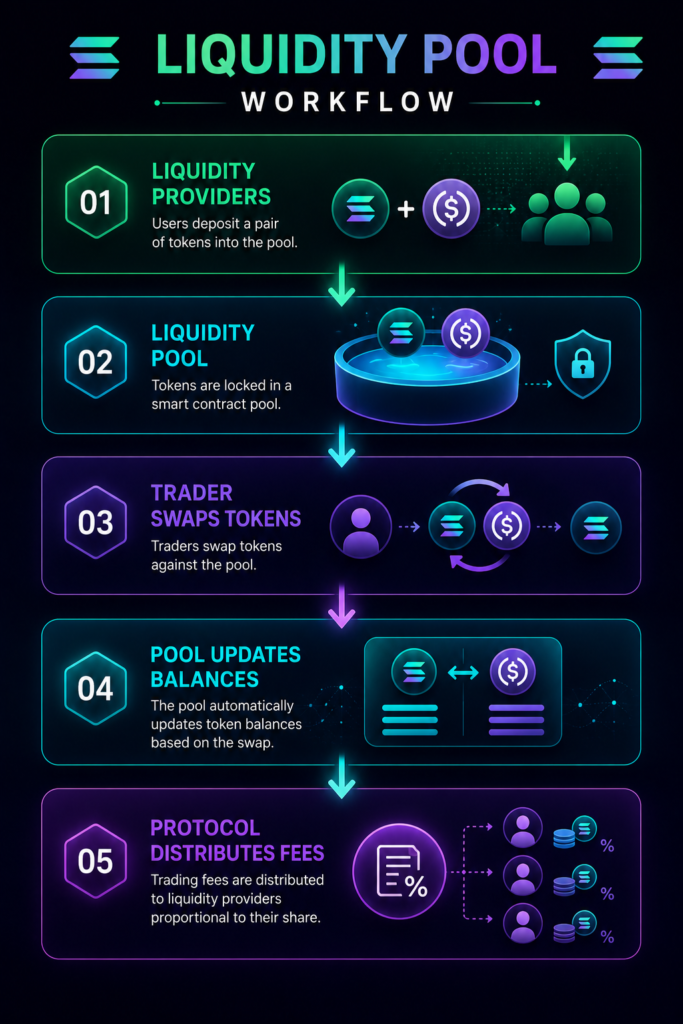
Many decentralized exchanges instead rely on liquidity pools, where users contribute digital assets that facilitate trading.
Participants providing assets to these pools are commonly referred to as liquidity providers.
Liquidity pools help enable:
Faster token swaps
Continuous market access
Automated pricing
Decentralized trading
Participation may involve risks such as impermanent loss, which users should understand before contributing assets.
3. Lending and Borrowing
Decentralized lending protocols allow users to supply digital assets or borrow against collateral using smart contracts.
Unlike traditional lending systems, blockchain protocols automate many operational processes.
Typical lending ecosystems include:
Depositors
Borrowers
Collateral management
Interest calculations
Liquidation mechanisms
Participation requirements vary depending on each protocol.
Educational Examples
Examples within the Solana ecosystem include:
Kamino Finance
Save (formerly Solend)
MarginFi
These protocols illustrate different approaches to decentralized lending rather than representing recommendations.
4. Liquid Staking
Staking helps secure blockchain networks.
Traditional staking generally locks assets while they participate in network validation.
Liquid staking introduces tokenized representations of staked assets that may remain usable across decentralized applications.
Potential benefits include:
Continued ecosystem participation
DeFi integration
Increased capital efficiency
Liquid staking models differ between protocols.
Examples
Educational examples include:
Marinade Finance
Jito
Sanctum
5. Yield Optimization
Yield optimization protocols aim to simplify participation in decentralized finance by automating strategies such as:
Asset allocation
Liquidity management
Reward reinvestment
Portfolio balancing
Automation reduces the need for users to manually manage every interaction.
Different protocols employ different optimization methods.
6. Perpetual Trading
Perpetual trading platforms allow users to access derivative markets using blockchain infrastructure.
Unlike spot trading, perpetual contracts represent derivative products that operate according to protocol-defined rules.
Potential features include:
Long positions
Short positions
Collateral management
Risk controls
Funding mechanisms
These products involve additional complexity and may not be suitable for all users.
Educational Examples
Examples include:
Drift Protocol
Zeta Markets
These examples are provided solely for educational purposes.
7. Stablecoins
Stablecoins serve as one of the most important components of decentralized finance.
Rather than experiencing the same degree of price volatility as many cryptocurrencies, stablecoins aim to maintain relatively stable values through different mechanisms.
Within the Solana ecosystem, stablecoins support:
Trading
Payments
Lending
Cross-border transfers
Treasury management
Liquidity provision
Stablecoins help provide liquidity across many decentralized applications.
8. Payment Infrastructure
Beyond financial trading, blockchain networks increasingly support payment applications.
Solana-based payment solutions enable users to:
Send digital assets
Accept merchant payments
Transfer funds internationally
Support e-commerce
Process peer-to-peer transactions
As payment infrastructure matures, blockchain continues expanding into consumer and business applications.
Risks Within DeFi
While decentralized finance introduces new opportunities, it also involves risks.
Common considerations include:
Smart Contract Risk
Software vulnerabilities may affect protocol functionality.
Market Volatility
Digital asset prices may fluctuate significantly.
Liquidity Risk
Some markets may experience changing liquidity conditions.
Oracle Risk
Protocols relying on external data feeds depend on accurate information.
User Error
Incorrect wallet interactions or transaction approvals may result in unintended outcomes.
Education and careful research remain essential before interacting with decentralized financial applications.
How DeFi Connects the Solana Ecosystem
Although decentralized finance represents its own sector, it also supports many other ecosystem categories.
Examples include:
Sector
Relationship with DeFi
NFTs
NFT collateral and marketplaces
Gaming
In-game token economies
AI
Automated portfolio tools
Payments
Stablecoin settlements
RWAs
Tokenized financial products
Wallets
User access to DeFi protocols
Rather than operating independently, these sectors often reinforce one another through shared blockchain infrastructure.
Key Takeaways
DeFi is one of the largest sectors within the Solana ecosystem, providing decentralized financial services through smart contracts.
Major DeFi categories include decentralized exchanges, liquidity pools, lending, liquid staking, stablecoins, perpetual trading, and payment infrastructure.
Solana’s blockchain architecture supports applications requiring efficient transaction processing and active user participation.
DeFi protocols are interconnected with other ecosystem sectors, including NFTs, gaming, AI, payments, and tokenized assets.
Understanding the benefits and risks of decentralized finance is essential before interacting with blockchain-based financial applications.
The strength of Solana’s DeFi ecosystem contributes significantly to the growth and adoption of the broader Solana network.
Solana NFTs, Gaming, AI, DePIN, Real-World Assets, and the Memecoin Ecosystem
While decentralized finance remains one of the largest sectors on Solana, it represents only one part of a much broader ecosystem.
Over the past few years, developers have expanded Solana into a platform supporting digital ownership, gaming, artificial intelligence, decentralized infrastructure, tokenized assets, and consumer-focused applications.
These sectors demonstrate how blockchain technology can extend beyond financial transactions to support entirely new digital experiences.
Solana NFT Ecosystem
Non-Fungible Tokens (NFTs) represent unique digital assets recorded on a blockchain.
Although NFTs initially gained popularity through digital artwork, today’s NFT ecosystem supports a much wider range of applications.
On Solana, NFTs are increasingly used for:
Digital art
Gaming assets
Event tickets
Membership passes
Digital identity
Intellectual property
Music royalties
Brand loyalty programs
Community access
Because Solana can process transactions efficiently, NFT creators and collectors can interact with marketplaces without the high transaction costs historically associated with some blockchain networks.
How Solana NFTs Work
Every NFT contains blockchain-based metadata that proves ownership and authenticity.
The general process follows these steps:
Creator mints an NFT.
Metadata is recorded.
Ownership is assigned to a wallet.
NFT becomes tradable.
Ownership updates whenever transferred.
The blockchain maintains an immutable ownership history.
NFT Marketplaces
NFT marketplaces enable creators and collectors to:
Buy NFTs
Sell NFTs
Launch collections
Participate in auctions
Verify ownership
Discover creators
Educational examples include:
Magic Eden
Tensor
Each marketplace offers different tools while supporting the broader creator economy.
Why NFTs Matter Beyond Digital Art
Today’s NFT ecosystem extends into industries such as:
Gaming
Characters
Weapons
Land
Collectibles
Education
Certificates
Achievements
Digital credentials
Entertainment
VIP access
Fan memberships
Exclusive content
Business
Digital licenses
Membership programs
Brand engagement
As blockchain technology evolves, NFTs continue expanding into practical applications beyond collectibles.
Solana Gaming Ecosystem
Gaming has become one of blockchain’s fastest-growing sectors.
Traditional online games usually store digital assets on centralized servers.
Blockchain gaming introduces the possibility of player-owned digital assets recorded directly on-chain.
Potential benefits include:
Digital ownership
Tradable assets
Cross-platform economies
Transparent marketplaces
Community participation
Developers continue experimenting with different approaches to blockchain gaming while balancing gameplay, accessibility, and digital ownership.
Components of Blockchain Games
Many blockchain games combine several technologies.
These may include:
NFTs
Utility tokens
Smart contracts
Digital marketplaces
AI-powered characters
Community governance
Not every game includes every component, but these technologies often work together.
Artificial Intelligence on Solana
Artificial intelligence is becoming an increasingly active area within the Solana ecosystem.
Developers are exploring AI-powered applications that combine blockchain infrastructure with intelligent software.
Examples include:
AI agents
Research assistants
Autonomous workflows
Decentralized compute
AI marketplaces
Intelligent analytics
Although the sector remains relatively young, AI continues attracting developer interest across Web3.
AI Agents
AI agents are software systems capable of performing tasks with varying levels of autonomy.
Potential blockchain applications include:
Wallet monitoring
Portfolio analysis
Customer support
Governance summarization
Workflow automation
Rather than replacing human decision-making, these systems assist users by automating repetitive tasks.
AI Infrastructure
Artificial intelligence requires:
Computing resources
Data
Storage
Networking
Some Solana-based projects explore decentralized methods for coordinating these resources through blockchain infrastructure.
DePIN has become one of the most innovative sectors across blockchain.
Instead of coordinating purely digital assets, DePIN projects connect real-world infrastructure through blockchain incentives.
Examples include:
Wireless networks
GPU marketplaces
Cloud computing
Environmental sensors
Mapping services
Energy infrastructure
Participants contribute physical resources while blockchain coordinates participation and rewards.
Why DePIN Matters
Traditional infrastructure is often owned by centralized organizations.
DePIN explores alternative coordination models where communities contribute infrastructure collectively.
Potential benefits include:
Broader participation
Resource sharing
Transparent incentives
Geographic distribution
Implementation varies significantly between projects.
Real-World Assets (RWAs)
Real-world asset tokenization represents one of blockchain’s fastest-growing sectors.
Instead of existing only in traditional financial systems, assets can be represented digitally through blockchain tokens.
Examples include:
Government bonds
Treasury products
Real estate
Commodities
Investment funds
Carbon credits
Tokenization may improve transparency, settlement efficiency, and accessibility depending on the underlying asset and regulatory framework.
Why RWAs Matter
Tokenization may support:
Faster settlement
Fractional ownership
Transparent ownership records
Global accessibility
Improved operational efficiency
Adoption continues to evolve as regulatory frameworks develop worldwide.
The Solana Memecoin Ecosystem
Memecoins have become one of the most active categories on Solana.
Unlike utility-focused blockchain projects, memecoins often originate from internet culture, humor, or online communities.
Although some projects evolve into broader ecosystems, many remain highly speculative.
Common characteristics include:
Community-driven growth
High trading activity
Rapid token launches
Social media engagement
Because of their volatility, users should carefully research token distribution, liquidity, project transparency, and smart contract security before participating.
Memecoin Infrastructure
The memecoin ecosystem also supports a variety of surrounding services.
These services help users better understand blockchain activity beyond simple price charts.
How These Sectors Connect
One of Solana’s greatest strengths is interoperability.
Projects rarely operate in isolation.
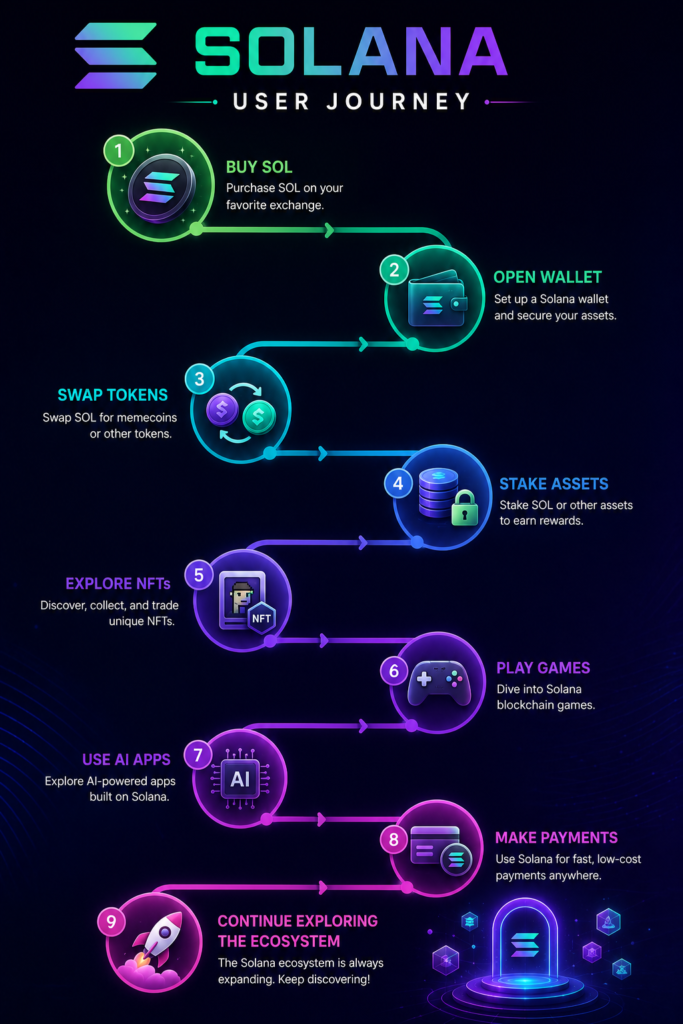
For example:
A user may:
Store SOL in a wallet
Swap tokens through a DEX
Purchase an NFT
Stake SOL
Play a blockchain game
Use AI-powered analytics
Participate in a DePIN project
all while interacting with the same blockchain infrastructure.
This interconnected design encourages innovation while improving the overall user experience.
Comparison of Solana Ecosystem Sectors
Sector
Primary Purpose
Typical Users
DeFi
Financial services
Investors, traders
NFTs
Digital ownership
Creators, collectors
Gaming
Interactive entertainment
Gamers
AI
Intelligent automation
Developers, businesses
DePIN
Physical infrastructure
Infrastructure providers
RWAs
Asset tokenization
Financial institutions
Memecoins
Community tokens
Retail users
Key Takeaways
The Solana ecosystem extends far beyond DeFi, supporting NFTs, gaming, AI, DePIN, real-world assets, and community-driven applications.
NFTs on Solana increasingly serve practical purposes such as gaming assets, memberships, digital identity, and intellectual property.
Blockchain gaming combines digital ownership with interactive experiences through smart contracts and tokenized assets.
AI and DePIN represent rapidly growing sectors that expand blockchain beyond traditional financial applications.
Real-world asset tokenization and decentralized infrastructure illustrate how blockchain technology continues entering mainstream industries.
The interoperability between these sectors enables users to access multiple services through a single blockchain ecosystem, strengthening Solana’s role as a comprehensive Web3 platform.
Every successful blockchain ecosystem depends on more than decentralized applications.
Behind every token swap, NFT purchase, blockchain game, AI application, or payment lies a sophisticated infrastructure that enables developers to build and users to interact with the network.
Although infrastructure often receives less attention than consumer-facing applications, it forms the backbone of the Solana ecosystem.
Without validators, wallets, RPC providers, blockchain explorers, APIs, and developer tools, decentralized applications would be unable to function efficiently.
Understanding this infrastructure provides valuable insight into how the Solana ecosystem operates behind the scenes.
What Is Blockchain Infrastructure?
Blockchain infrastructure refers to the collection of services that support the operation of decentralized applications and blockchain networks.
Rather than interacting directly with validators or raw blockchain data, most users access Solana through infrastructure providers that simplify communication with the network.
Infrastructure includes:
Wallets
Validators
RPC Nodes
Blockchain Explorers
APIs
Indexing Services
Developer SDKs
Bridges
Analytics Platforms
Security Services
Each component performs a specialized role while working together to support the broader ecosystem.
Wallets: The User’s Gateway to Solana
For most users, a wallet is the first interaction with the Solana ecosystem.
A crypto wallet does not actually store cryptocurrencies. Instead, it securely manages the private keys that provide access to blockchain assets.
Through a wallet, users can:
Send and receive SOL
Manage SPL tokens
Connect to decentralized applications
Stake SOL
Purchase NFTs
Participate in governance
Sign blockchain transactions
Wallets act as the bridge between users and decentralized applications.
Types of Solana Wallets
Software Wallets
Installed as browser extensions or mobile applications.
Advantages:
Easy to use
Quick access
Supports most dApps
Examples include:
Phantom
Backpack
Solflare
Hardware Wallets
Physical devices designed to protect private keys offline.
Often preferred for long-term asset storage because they reduce exposure to online threats.
Custodial Wallets
Managed by centralized service providers.
Suitable for users who prefer convenience but involve trusting a third party with asset custody.
Validators: Securing the Network
Validators are independent computers responsible for maintaining the Solana blockchain.
They perform essential functions such as:
Verifying transactions
Producing blocks
Participating in consensus
Securing the network
Maintaining blockchain history
Validators collectively ensure that blockchain data remains consistent across the network.
Rather than relying on one central authority, Solana distributes these responsibilities among independent participants.
Why Validators Matter
A strong validator network contributes to:
Network security
Decentralization
Reliability
Fault tolerance
Continuous availability
The distribution and performance of validators are often considered important indicators of blockchain health.
RPC Providers
One of the most important but least understood parts of blockchain infrastructure is the Remote Procedure Call (RPC) provider.
When users open a wallet or interact with a decentralized application, the application must communicate with the blockchain.
Rather than connecting directly to validators, most applications use RPC providers.
RPC providers enable applications to:
Read blockchain data
Submit transactions
Query wallet balances
Retrieve NFT metadata
Access smart contract information
Without RPC services, many decentralized applications would be significantly more difficult to operate.
Why RPC Infrastructure Matters
Reliable RPC services improve:
Application performance
User experience
Scalability
Data availability
As blockchain ecosystems grow, demand for high-performance RPC infrastructure continues to increase.
Blockchain Explorers
Blockchain explorers help users inspect on-chain activity.
They provide transparent access to blockchain records.
Users can search:
Wallet addresses
Transactions
Tokens
NFTs
Validators
Blocks
Smart contracts
Explorers make blockchain data accessible without requiring technical expertise.
Common Uses
Blockchain explorers assist users by allowing them to:
Verify payments
Track transaction confirmations
Investigate wallet activity
Review token information
Analyze blockchain history
They are valuable tools for both beginners and experienced researchers.
APIs and Developer Services
Building decentralized applications requires access to blockchain data.
Application Programming Interfaces (APIs) simplify this process by allowing software to communicate with blockchain infrastructure.
Developers use APIs for:
Wallet integration
NFT metadata
Token information
Transaction history
Portfolio tracking
Analytics
Reliable APIs reduce development complexity while improving application performance.
Indexing Services
Raw blockchain data is extensive and continuously growing.
Indexing services organize blockchain information so developers can retrieve it efficiently.
Rather than scanning every block individually, applications query indexed databases.
Common indexed information includes:
Token transfers
Wallet balances
NFT ownership
Transaction history
Program interactions
Indexing improves both developer productivity and user experience.
Bridges
Different blockchains operate independently.
Bridges facilitate asset movement or interoperability between separate blockchain ecosystems.
Bridge technology may support:
Cross-chain asset transfers
Liquidity movement
Multi-chain applications
Interoperability
Bridge designs vary significantly, and each approach involves its own security considerations.
Developer Tools
Developer adoption is one of the strongest indicators of ecosystem growth.
Solana provides a wide range of tools supporting application development.
These include:
Software Development Kits (SDKs)
Command-line tools
Testing environments
Documentation
Local development networks
Debugging tools
These resources reduce barriers for developers entering the ecosystem.
Why Developer Tools Matter
Better tooling generally leads to:
Faster development
More secure applications
Improved user experiences
Lower development costs
Greater innovation
Healthy developer ecosystems often contribute to long-term blockchain growth.
Analytics Platforms
Blockchain data becomes more valuable when transformed into meaningful insights.
Analytics platforms help users monitor:
Transaction volume
Network activity
Wallet behavior
Token movements
Liquidity
Ecosystem growth
Researchers, businesses, developers, and investors frequently rely on analytics to understand ecosystem trends.
Security Infrastructure
Security is essential for every blockchain ecosystem.
Security-focused services help identify:
Smart contract vulnerabilities
Suspicious wallet activity
Scam tokens
Phishing websites
Protocol risks
Many projects also conduct independent security audits before deploying major protocol upgrades.
While audits improve confidence, users should still conduct independent research before interacting with decentralized applications.
Infrastructure Supporting Enterprise Adoption
As businesses explore blockchain technology, infrastructure becomes increasingly important.
Enterprise-focused services may include:
Identity management
Compliance tools
Payment gateways
Data integrations
Analytics dashboards
Custody solutions
These services help organizations integrate blockchain into existing business processes.
How Infrastructure Connects the Ecosystem
Every ecosystem sector depends on infrastructure.
Ecosystem Sector
Infrastructure Required
DeFi
Wallets, RPCs, Validators
NFTs
Wallets, Metadata APIs, Storage
Gaming
Wallets, Smart Contracts, APIs
AI
Compute, RPC, Storage
Payments
Wallets, Validators, Stablecoins
DePIN
Validators, Node Networks, Analytics
This interconnected architecture allows applications across different sectors to operate seamlessly.
Key Takeaways
Blockchain infrastructure forms the foundation of every decentralized application built on Solana.
Wallets, validators, RPC providers, blockchain explorers, APIs, and indexing services each perform essential roles within the ecosystem.
Reliable infrastructure improves developer productivity, user experience, scalability, and network resilience.
Developer tools and analytics platforms continue to strengthen Solana’s position as a leading blockchain for Web3 innovation.
Understanding infrastructure provides a deeper appreciation of how decentralized applications function beyond their user interfaces.
A mature infrastructure ecosystem is one of the strongest indicators of long-term blockchain adoption and ecosystem growth.
Popular Solana Projects, Ecosystem Benefits, Challenges, and Growth Metrics
Every successful blockchain ecosystem is defined by the quality of the projects built on top of it.
While Solana provides the underlying infrastructure, it is the decentralized applications, developer tools, wallets, marketplaces, and financial protocols that bring the network to life.
Today, the Solana ecosystem includes hundreds of projects across decentralized finance, NFTs, payments, infrastructure, gaming, artificial intelligence, analytics, and developer services.
Rather than evaluating these projects based on market performance, it’s more valuable to understand the role they play within the ecosystem and how they contribute to the overall growth of the network.
Understanding the Solana Project Landscape
Projects within the Solana ecosystem generally fall into several categories.
Category
Purpose
DeFi
Trading, lending, liquidity, staking
Wallets
Asset management and dApp access
NFT Marketplaces
Digital asset trading
Infrastructure
RPCs, APIs, indexing, analytics
Gaming
Blockchain-based entertainment
AI
Intelligent applications and automation
DePIN
Physical infrastructure coordination
Developer Tools
Building and deploying applications
Each category contributes to making Solana a complete Web3 ecosystem rather than simply a blockchain network.
Jupiter
What It Does
Jupiter is one of the best-known swap aggregation platforms within the Solana ecosystem.
Instead of acting as a single exchange, it helps users discover available trading routes across multiple decentralized liquidity sources.
Its primary objective is improving swap efficiency by routing transactions through different liquidity pools.
Primary Functions
Token swaps
Liquidity aggregation
Price discovery
Trade routing
Raydium
Raydium is a decentralized exchange supporting token trading and liquidity provision.
It allows users to exchange digital assets while enabling liquidity providers to contribute assets to trading pools.
The platform has become an important component of Solana’s decentralized finance ecosystem.
Kamino Finance
Kamino focuses on decentralized financial services.
Its platform supports advanced financial products built on blockchain technology.
Examples include:
Perpetual markets
Margin management
Risk controls
These services demonstrate the expanding sophistication of decentralized financial applications.
Marinade Finance
Marinade is one of the leading liquid staking platforms within the Solana ecosystem.
Instead of locking staked assets without flexibility, liquid staking introduces tokenized representations that may remain usable across decentralized applications.
This approach increases capital efficiency while supporting network security.
Jito
Jito develops infrastructure focused on staking and validator efficiency.
Its work contributes to improving network participation while supporting the broader staking ecosystem.
Infrastructure-focused projects like Jito often receive less public attention despite playing an important role behind the scenes.
Phantom Wallet
For many users, Phantom serves as their primary gateway into the Solana ecosystem.
The wallet enables users to:
Store SOL
Manage SPL tokens
Purchase NFTs
Connect to decentralized applications
Stake digital assets
Approve blockchain transactions
Wallets remain one of the most important components of the user experience.
Backpack
Backpack is another wallet focused on Web3 interactions.
Its ecosystem supports digital asset management while enabling users to interact with decentralized applications across supported blockchain networks.
Wallet competition continues encouraging improvements in usability, security, and developer integration.
Magic Eden
Magic Eden has become one of the most recognized NFT marketplaces associated with Solana.
Creators use marketplaces like Magic Eden to launch collections, while collectors discover, purchase, and trade digital assets.
NFT marketplaces also contribute to creator economies by supporting royalties, community engagement, and digital ownership.
Tensor
Tensor focuses on NFT trading infrastructure.
Rather than serving only casual collectors, it offers advanced marketplace functionality designed for active NFT participants.
Its presence illustrates the growing maturity of Solana’s NFT ecosystem.
Sanctum
Sanctum contributes to Solana’s liquid staking ecosystem by developing infrastructure that supports staking-related innovation.
As staking solutions continue evolving, specialized infrastructure projects increasingly support ecosystem efficiency and user flexibility.
Its focus on liquidity management demonstrates how ecosystem growth increasingly depends on specialized infrastructure providers rather than only consumer-facing applications.
Helius
Helius provides developer infrastructure.
Its services help applications access blockchain data through APIs, RPC infrastructure, indexing, and developer tools.
Infrastructure companies such as Helius play an important role in reducing development complexity for Web3 builders.
Dialect
Dialect focuses on blockchain communication infrastructure.
Its tools enable decentralized applications to interact with users through messaging and notifications.
Communication layers continue becoming increasingly important as decentralized applications grow more sophisticated.
Helium’s Integration with Solana
Helium originally developed decentralized wireless infrastructure before integrating with the Solana blockchain.
This integration demonstrates how blockchain ecosystems increasingly support physical infrastructure alongside digital applications.
It also highlights the growing relationship between Solana and the broader DePIN sector.
How These Projects Work Together
One of Solana’s greatest strengths is interoperability.
For example, a user might:
Open Phantom Wallet
Swap tokens through Jupiter
Provide liquidity using Raydium
Stake SOL through Marinade
Purchase NFTs on Magic Eden
Track activity using blockchain analytics
Interact with AI-powered tools
all within a single blockchain ecosystem.
This seamless experience encourages user engagement while strengthening the network effect across applications.
Benefits of the Solana Ecosystem
Several characteristics contribute to the ecosystem’s continued growth.
Developer Activity
An active developer community helps produce:
New decentralized applications
Infrastructure improvements
Better documentation
Security enhancements
Ecosystem innovation
Developer participation remains one of the strongest indicators of blockchain health.
Diverse Applications
The ecosystem now includes projects across:
Finance
Gaming
NFTs
AI
Payments
Infrastructure
Consumer applications
Diversity reduces dependence on any single use case.
Interoperability
Projects increasingly integrate with one another.
Wallets connect to marketplaces.
Marketplaces integrate payment systems.
Payment systems interact with DeFi.
Infrastructure supports every category.
This interoperability strengthens the overall user experience.
Digital asset regulation continues developing worldwide.
Future regulatory frameworks may influence how blockchain ecosystems evolve across different jurisdictions.
Ecosystem Metrics
Researchers often evaluate blockchain ecosystems using measurable indicators rather than market narratives.
Common metrics include:
Active wallet addresses
Daily transactions
Total Value Locked (TVL)
Stablecoin supply
Developer activity
Validator count
NFT trading volume
Ecosystem funding
Application growth
User retention
No single metric provides a complete picture.
Instead, multiple indicators together help researchers better understand ecosystem development.
How to Evaluate Solana Projects
Before interacting with any project, consider asking:
What problem does it solve?
Who are its primary users?
Is the project actively maintained?
Does it have a clear purpose?
What role does the token play?
Is documentation publicly available?
Has the project undergone security reviews?
Does it contribute meaningful utility to the ecosystem?
A technology-first approach often provides more useful insights than focusing solely on market trends.
Key Takeaways
Solana’s ecosystem includes hundreds of interconnected projects spanning finance, NFTs, gaming, AI, infrastructure, and developer tools.
Projects such as Jupiter, Raydium, Kamino, Phantom, Magic Eden, Helius, and Marinade each play specialized roles within the ecosystem.
The network’s strength comes from interoperability, active developers, diverse applications, and growing infrastructure.
Blockchain ecosystems should be evaluated using multiple indicators, including developer activity, user adoption, infrastructure maturity, and ecosystem growth.
Understanding how projects fit together provides a clearer picture than evaluating them individually.
Sustainable ecosystem development depends on continuous innovation, security, infrastructure improvements, and community participation.
Frequently Asked Questions, Common Myths, Future Trends, and Conclusion
After exploring the architecture, infrastructure, decentralized finance, NFTs, gaming, artificial intelligence, DePIN, and the leading projects built on Solana, one question remains:
Where is the Solana ecosystem heading, and what should beginners understand before participating?
Like every blockchain ecosystem, Solana continues to evolve. New applications, developer tools, enterprise integrations, and consumer experiences are being introduced regularly, making continuous learning one of the most valuable skills for anyone interested in Web3.
This final section addresses common misconceptions, answers frequently asked questions, highlights future trends, and summarizes the key concepts discussed throughout this guide.
Common Misconceptions About the Solana Ecosystem
Myth 1: Solana Is Only Used for Memecoins
Memecoins have received significant attention because of their active communities and trading activity.
Reality
The Solana ecosystem supports far more than community tokens.
Major sectors include:
Decentralized Finance (DeFi)
NFTs
Gaming
Artificial Intelligence
DePIN
Payments
Stablecoins
Real-World Asset Tokenization
Developer Infrastructure
Consumer Applications
The ecosystem continues expanding into enterprise and institutional use cases as well.
Myth 2: Solana Is Only for Traders
Many newcomers assume blockchain ecosystems exist primarily for cryptocurrency trading.
Reality
Trading represents only one part of the ecosystem.
Developers, creators, businesses, researchers, educators, and infrastructure providers all contribute to Solana through applications that extend beyond financial markets.
Myth 3: Every Solana Project Is Connected
Projects share blockchain infrastructure, but they remain independent organizations.
Each project has its own:
Development team
Governance model
Security practices
Business objectives
Roadmap
Understanding these differences is essential when researching ecosystem projects.
Myth 4: Fast Transactions Alone Guarantee Success
High performance is important, but blockchain adoption depends on many factors.
Reality
Long-term ecosystem growth also requires:
Strong infrastructure
Active developers
Security
Reliable documentation
User-friendly applications
Community participation
Sustainable innovation
Technology alone does not guarantee adoption.
Myth 5: The Ecosystem Is Finished
Some readers assume today’s ecosystem represents the final stage of Solana’s development.
Reality
Blockchain ecosystems continuously evolve.
New applications, infrastructure providers, developer tools, and enterprise integrations are introduced regularly.
The ecosystem remains an active area of innovation.
How Beginners Can Explore the Solana Ecosystem Safely
For readers new to Solana, the ecosystem may initially seem overwhelming.
A gradual learning approach is often the most effective.
Step 1: Learn the Basics
Before interacting with applications, understand:
Blockchain fundamentals
Wallets
Smart contracts
Public and private keys
Transaction fees
Step 2: Understand Solana
Learn how the blockchain itself operates before exploring individual applications.
Step 3: Set Up a Wallet
Choose a reputable wallet.
Learn how to:
Secure recovery phrases
Verify transactions
Connect to decentralized applications
Step 4: Explore DeFi
Begin by understanding:
Token swaps
Liquidity pools
Staking
Stablecoins
Rather than participating immediately, observe how protocols function.
Step 5: Research Projects
Before interacting with any application, review:
Documentation
Community resources
Security information
Development activity
Independent research remains essential.
Step 6: Continue Learning
Blockchain technology evolves rapidly.
Educational resources help users understand new technologies as the ecosystem expands.
Future Trends in the Solana Ecosystem
While no one can predict how blockchain technology will evolve, several areas continue attracting significant developer attention.
Artificial Intelligence
Developers are exploring:
AI agents
Intelligent automation
Decentralized compute
AI-powered developer tools
Blockchain analytics
AI is expected to remain an important area of ecosystem experimentation.
Institutional participation may contribute to broader ecosystem development over time.
Frequently Asked Questions
What is the Solana ecosystem?
The Solana ecosystem is the collection of decentralized applications, wallets, infrastructure providers, validators, developer tools, and communities built on the Solana blockchain.
What types of applications are built on Solana?
Applications include decentralized finance (DeFi), NFT marketplaces, blockchain games, AI tools, payment platforms, DePIN projects, tokenized assets, and developer infrastructure.
What is DeFi on Solana?
DeFi refers to decentralized financial applications that enable activities such as token swaps, lending, borrowing, staking, and liquidity provision using smart contracts.
What are NFTs on Solana used for?
Beyond digital art, NFTs on Solana are used for gaming assets, memberships, event tickets, digital identity, collectibles, and creator royalties.
Why do developers build on Solana?
Developers often choose Solana for its growing ecosystem, active community, mature tooling, efficient transaction processing, and expanding infrastructure.
What is a Solana wallet?
A Solana wallet manages private keys, allowing users to store digital assets and interact with decentralized applications.
What are validators?
Validators maintain the blockchain by verifying transactions, participating in consensus, and helping secure the network.
What are RPC providers?
RPC providers allow wallets and decentralized applications to communicate with the blockchain without connecting directly to validators.
What is liquid staking?
Liquid staking allows users to stake assets while receiving tokenized representations that may remain usable across other decentralized applications.
Can businesses use Solana?
Yes. Businesses continue exploring blockchain for payments, asset tokenization, digital identity, customer engagement, and infrastructure services.
What is DePIN?
Decentralized Physical Infrastructure Networks coordinate real-world infrastructure using blockchain incentives.
How can beginners start learning?
Start by understanding blockchain fundamentals, setting up a wallet, learning about Solana, and gradually exploring decentralized applications.
Are all Solana projects the same?
No. Each project has different objectives, development teams, governance structures, and technical approaches.
Is Solana only for cryptocurrency trading?
No. The ecosystem supports finance, gaming, AI, NFTs, infrastructure, payments, education, and enterprise applications.
How can I research Solana projects?
Review official documentation, development activity, security practices, community engagement, and real-world utility before interacting with any application.
Conclusion
The Solana ecosystem has evolved into one of the most active and diverse blockchain environments in the Web3 industry. What began as a high-performance Layer-1 blockchain now supports a wide range of decentralized applications spanning finance, digital ownership, gaming, artificial intelligence, infrastructure, payments, and tokenized real-world assets.
Throughout this guide, we’ve explored the ecosystem from multiple perspectives, including its architecture, DeFi protocols, NFT marketplaces, gaming applications, AI initiatives, infrastructure services, developer tools, and major projects. We’ve also examined the technologies that connect these components and the factors that contribute to long-term ecosystem growth.
One of the defining characteristics of the Solana ecosystem is its interoperability. Wallets, decentralized exchanges, NFT platforms, analytics services, infrastructure providers, and developer tools work together to create an integrated experience for users and builders alike.
Like all blockchain ecosystems, Solana continues to evolve. New technologies, regulatory developments, infrastructure improvements, and innovative applications will shape its future over time. Understanding how the ecosystem functions today provides a strong foundation for following these developments in the years ahead.
Whether you’re a beginner exploring blockchain for the first time, a developer building decentralized applications, or an investor researching Web3 infrastructure, continued learning and independent research remain essential. By focusing on technology, utility, and real-world adoption rather than short-term narratives, readers can develop a deeper understanding of how the Solana ecosystem contributes to the broader evolution of blockchain technology.
Disclaimer
Content on this website is for informational purposes only and does not constitute financial advice.
Investments carry risk. Always conduct your own research before investing.