


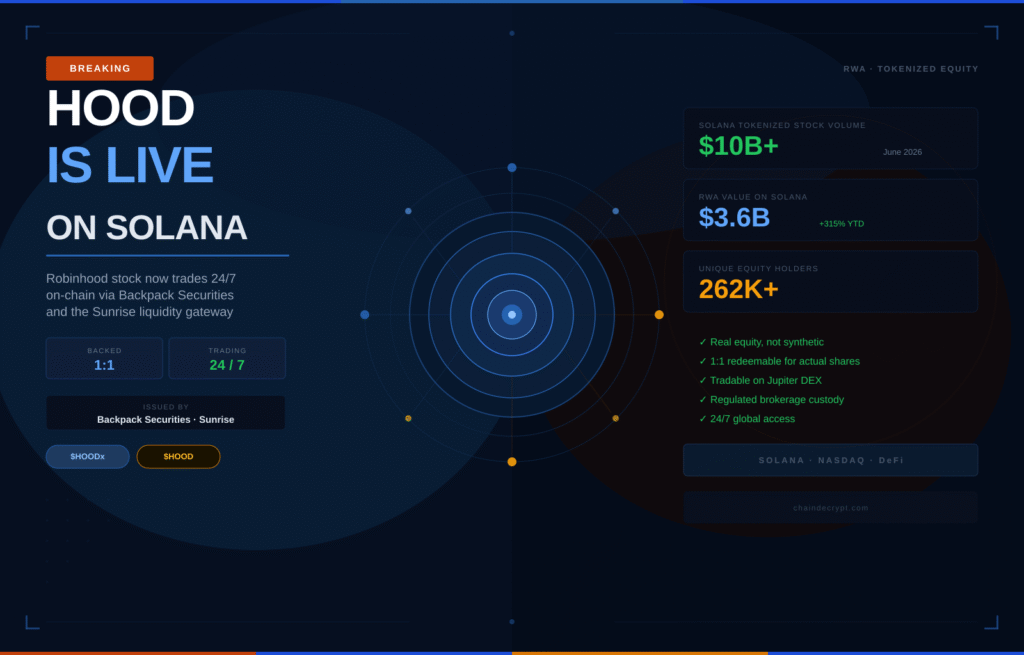
Sometime in the early hours of July 16, a post from the official Solana account landed on X with two words that summarised a major moment for on-chain finance: HOOD is live.
Backpack Securities, the regulated brokerage arm of the Backpack exchange, has listed HOODx a tokenized version of Robinhood Markets’ $HOOD stock – on Solana via Sunrise, a Wormhole Labs-backed liquidity gateway. The result: for the first time, traders anywhere in the world can buy, sell, and hold exposure to Robinhood’s equity on a public blockchain, 24 hours a day, seven days a week.
This is not a synthetic product or a price-tracking derivative. HOODx is redeemable 1:1 for the underlying Robinhood shares, which means each token is backed by real equity held through regulated infrastructure. That distinction matters enormously and it’s what separates this from earlier attempts at on-chain equity exposure that have come and gone.
What Is HOODx and How Does It Work?
HOODx is a tokenized equity a blockchain-native representation of Robinhood Markets’ HOOD stock traded on Nasdaq. Each HOODx token corresponds directly to one share of the underlying equity and can be redeemed for it through Backpack Securities’ regulated brokerage system.
The mechanics work like this: Backpack Securities holds real Robinhood shares in custody. For each share held, a corresponding HOODx token is issued on Solana. Traders can then swap HOODx using Solana’s DEX infrastructure including Jupiter, the chain’s primary liquidity aggregator at any hour of the day, not just during Nasdaq’s 9:30 AM to 4:00 PM ET window.
Why Solana? Why Now?
Solana’s tokenized real-world asset ecosystem has quietly become one of the most active in blockchain. Solana’s June 2026 recap confirmed $10 billion in tokenized stock volume, a 95% global on-chain equity share, and $3.6 billion in RWA value a gain of 315% since January.
The chain’s combination of low transaction fees, sub-second finality, and deep DEX liquidity through Jupiter makes it a practical venue for real-asset trading in a way that slower, more expensive chains simply cannot match. Where earlier tokenized equity attempts on other blockchains struggled with liquidity fragmentation and poor price execution, Solana’s architecture handles the throughput that active equity trading demands.
HOODx is not the first tokenized equity on Solana. SPCX, a tokenized representation of SpaceX stock, debuted on June 12, 2026, timed to coincide with SpaceX’s actual Nasdaq IPO. Micron’s tokenized stock, MU, was introduced around the same timeframe. Backed Finance’s xStocks platform crossed a market cap exceeding $1 billion by early 2026.
But Robinhood’s stock carries a symbolic weight the others don’t. The company that originally democratised brokerage access for retail America is now itself the subject of a tokenized product issued by a crypto-native platform. There is an irony in that, and also a signal about where markets are headed.
Backpack Securities: The Regulated Bridge Between TradFi and DeFi
Backpack Securities is not a typical DeFi protocol. It is a regulated brokerage that uses established custody and compliance infrastructure to support equity ownership and then connects that traditional infrastructure to Solana’s on-chain financial ecosystem.
The platform links real equity ownership with blockchain-based stock transfers, giving users a route to buy, hold, and sell real U.S. stocks through regulated infrastructure. The model connects brokerage access with blockchain distribution instead of treating them as separate products an approach that allows real securities to move between traditional market infrastructure and on-chain financial networks.
This is a meaningful structural difference from purely synthetic on-chain products. HOODx holders are not exposed to counterparty risk from a protocol that holds no real assets. They hold a claim on actual Robinhood shares held in regulated custody.
The 24/7 Angle: Why It Changes the Access Equation
Nasdaq operates Monday through Friday during market hours. News about Robinhood earnings, regulatory announcements, product launches does not respect that schedule. A trader in Singapore can now react to after-hours news about Robinhood without waiting for the Nasdaq opening bell.
This temporal freedom is one of the most practically significant advantages of tokenized equities over their traditional counterparts. Major announcements frequently move stock prices dramatically but retail traders outside the US often cannot act until markets open the following day, by which point the most significant price movement has already occurred.
HOODx removes that constraint entirely for on-chain participants.
What Traders Should Watch
Three things are worth monitoring as HOODx trading matures:
Price deviation risk. When the same underlying asset trades on Nasdaq, on Arbitrum through Robinhood, and on Solana through Sunrise, liquidity gets split across multiple venues. Traders should watch for significant price deviations between HOODx and its Nasdaq equivalent, which could signal liquidity stress or create short-term arbitrage windows.</cite>
Regulatory landscape. Tokenized equities sit at the intersection of securities law and crypto regulation. The fact that Robinhood launched its own tokenized offerings specifically for EU customers, not US ones, indicates where regulators currently stand on US access to these products. Availability of HOODx and similar products for US-based users remains subject to jurisdictional restrictions.
Robinhood’s own blockchain ambitions. Robinhood launched the public mainnet for Robinhood Chain on July 1, 2026 its own Layer 2 blockchain built on Arbitrum bringing tokenized stock trading live in more than 120 countries and introducing Robinhood Earn, a decentralised lending product offering an estimated 7% yield on USDG. The company is now competing in the same tokenized equity arena where its own stock is being listed by third parties a dynamic with no real precedent in traditional markets.
The Bigger Picture
HOODx going live on Solana is a data point in a trend that has accelerated faster than most traditional finance participants anticipated. Tokenized equities are no longer a proof-of-concept they are live products with meaningful volume, regulated infrastructure, and real holders.
Solana’s 30-day RWA metrics show distributed asset value up 36%, transfer volume up 100%, and 262,000-plus unique equity holders. Those are not speculative projections. They are current figures that reflect genuine adoption.
The question from here is whether regulatory frameworks expand to match the technical capability that already exists and whether the liquidity fragmentation challenge of multi-venue trading gets solved before it limits the utility of tokenized equities for mainstream users.
For now, HOOD is live on Solana. And that sentence would have sounded like speculation eighteen months ago.
Frequently Asked Questions
What is HOODx? HOODx is a tokenized version of Robinhood Markets’ $HOOD stock issued by Backpack Securities on Solana via the Sunrise liquidity gateway. Each token is backed 1:1 by real Robinhood shares held in regulated custody.
Can US users trade HOODx? Regulatory availability varies by jurisdiction. US access to tokenized equity products remains restricted in most cases. Always verify availability in your country before trading.
Is HOODx the same as buying HOOD on Nasdaq? It tracks the same underlying share and is redeemable for it. However, it trades on a different venue with different liquidity conditions. Price deviations between HOODx and the Nasdaq price are possible, particularly outside trading hours.
Where can I trade HOODx? HOODx is tradable on Solana’s DEX ecosystem, including Jupiter, and through Backpack Securities’ platform.
What other tokenized stocks are on Solana? As of July 2026, tokenized equities on Solana include SpaceX (SPCX), Micron (MU), SK Hynix (SKHY), and others through platforms including Sunrise and Backpack Securities.