



The Bitcoin 4 year cycle has long served as one of the most closely followed frameworks for understanding cryptocurrency market trends. Built around Bitcoin’s halving schedule, the cycle has historically influenced bull markets, corrections, and long-term investor sentiment.
However, the market entering 2026 looks very different from previous cycles. Institutional participation has increased significantly, spot Bitcoin ETFs have introduced new sources of demand, and global regulation continues to evolve. These changes have prompted investors to ask whether the traditional four-year pattern still provides reliable guidance or whether Bitcoin is entering a more mature market phase.
Key Highlights
- The Bitcoin 4 year cycle is closely linked to Bitcoin halving events.
- Previous cycles have produced distinct bull and bear market phases.
- Institutional investors and spot ETFs are reshaping market dynamics.
- On-chain indicators remain valuable but should not be viewed in isolation.
- Investors increasingly combine cycle analysis with macroeconomic trends.
What Is the Bitcoin 4 Year Cycle?
The Bitcoin 4 year cycle refers to the recurring market pattern observed after each Bitcoin halving. Approximately every four years, the Bitcoin network reduces the reward paid to miners by half, lowering the rate at which new coins enter circulation.
Historically, reduced supply has coincided with stronger long-term demand, creating conditions that have often preceded significant price appreciation. While every cycle differs, investors frequently identify four broad phases:
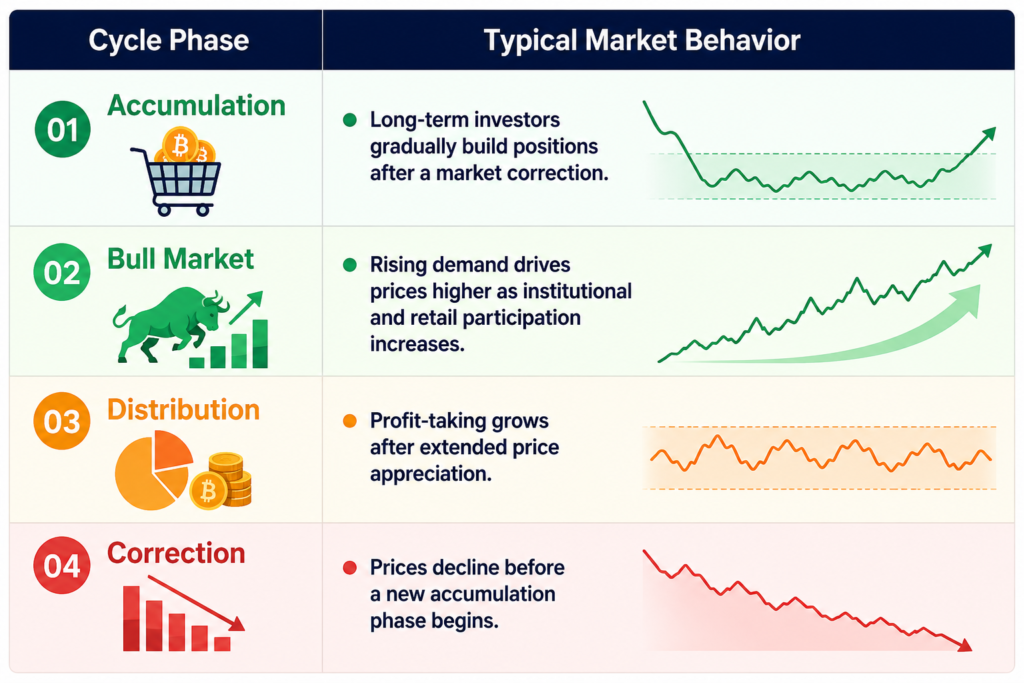
Why the Four-Year Pattern Exists
Bitcoin’s predictable monetary policy is unique among financial assets. Because the total supply is capped at 21 million coins, each halving reduces new issuance and alters the supply-demand balance.
Earlier cycles largely depended on retail participation. Today, institutional investors, exchange-traded funds, and corporate treasury strategies contribute a growing share of market activity.
This broader investor base has made the market more liquid while also introducing new variables that were largely absent during previous cycles.
How Institutions Are Changing the Cycle
One of the biggest differences in recent years is the arrival of regulated investment products.
Spot Bitcoin ETFs have expanded access for pension funds, wealth managers, and institutional investors that previously faced operational or regulatory barriers to holding digital assets directly.
Corporate treasury adoption has also increased. Several publicly listed companies now hold Bitcoin as part of their balance sheet strategy, adding a more consistent source of long-term demand.
These developments may reduce some of the volatility traditionally associated with the Bitcoin 4 year cycle, although they are unlikely to eliminate market corrections entirely.
On-Chain Metrics Still Matter
While the cycle provides a useful framework, experienced investors increasingly rely on blockchain data to confirm broader market trends.
Some of the most closely watched indicators include:
- Long-term holder accumulation
- Exchange inflows and outflows
- Miner reserves
- Network activity
- Whale wallet movements
- Realized price metrics
When combined with macroeconomic conditions, these indicators provide a more complete picture than the halving cycle alone.
Factors That Could Influence the Next Cycle
Several external developments now play an important role alongside Bitcoin’s fixed issuance schedule.
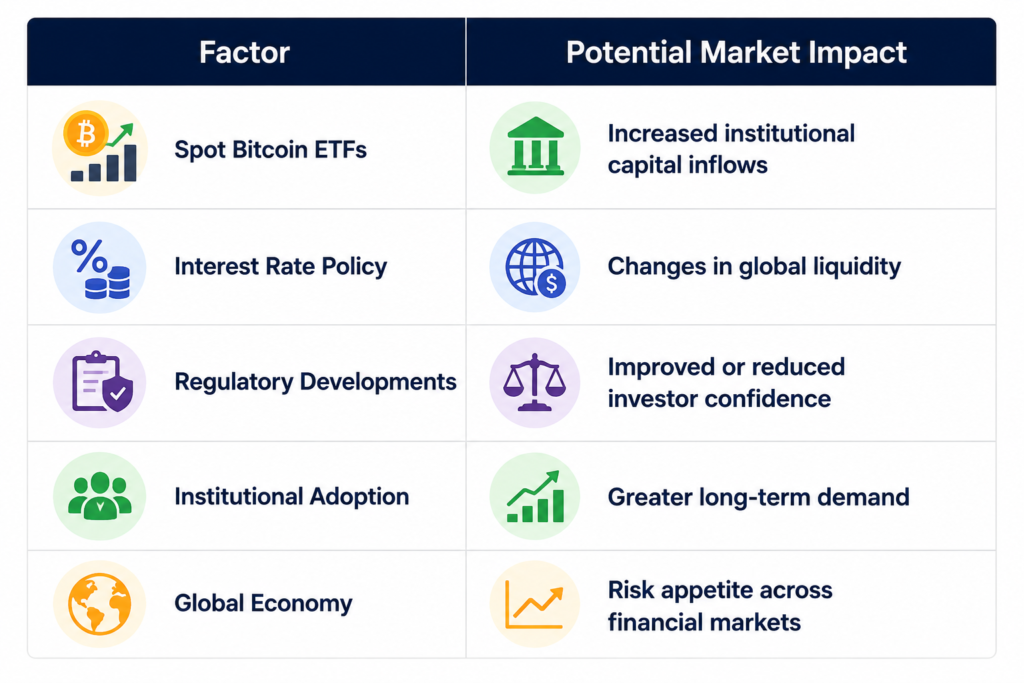
These variables demonstrate why many analysts no longer rely exclusively on historical cycle timing.
Potential Risks
Although previous cycles have produced strong long-term returns, history does not guarantee future performance.
Unexpected regulatory changes, economic recessions, geopolitical uncertainty, and declining investor confidence could influence Bitcoin independently of its halving schedule.
Similarly, rapid institutional inflows may accelerate price movements, while equally significant outflows could increase volatility.
What Should Investors Watch?
Investors following the Bitcoin 4 year cycle should monitor several indicators together rather than relying on a single metric.
Important areas include:
- ETF inflows
- On-chain activity
- Long-term holder behavior
- Bitcoin dominance
- Macroeconomic policy
- Institutional buying
- Network security
- Global regulatory developments
Combining these signals can provide a more balanced assessment of market conditions.
Conclusion
The Bitcoin 4 year cycle remains one of the most useful frameworks for understanding long-term cryptocurrency market behavior. Its connection to Bitcoin’s programmed halving schedule continues to shape investor expectations and supply dynamics.
However, today’s market is significantly more mature than in previous cycles. Institutional investment, regulated financial products, and evolving macroeconomic conditions mean investors should use the four-year cycle alongside on-chain analysis, market fundamentals, and broader economic trends. Rather than treating it as a prediction tool, the cycle is best viewed as one component of a comprehensive investment strategy.
FAQs
What is the Bitcoin 4 year cycle?
The Bitcoin 4 year cycle is a market pattern linked to Bitcoin halving events. Every four years, mining rewards are reduced, affecting supply and often influencing long-term price trends.
Why does Bitcoin follow a four-year cycle?
The cycle is driven by Bitcoin’s programmed halving mechanism, which reduces new coin issuance. Lower supply combined with increasing demand has historically contributed to major market cycles.
Does the Bitcoin 4 year cycle always repeat?
No. While historical patterns provide useful insights, institutional adoption, ETFs, regulations, and macroeconomic factors can influence future market behavior differently.
How do Bitcoin ETFs affect the cycle?
Spot Bitcoin ETFs increase institutional participation by making Bitcoin more accessible through traditional financial markets. This additional demand may influence future cycle dynamics.
Should investors rely only on the Bitcoin 4 year cycle?
No. Investors should also monitor on-chain metrics, macroeconomic conditions, regulatory developments, liquidity, and institutional activity before making investment decisions.