



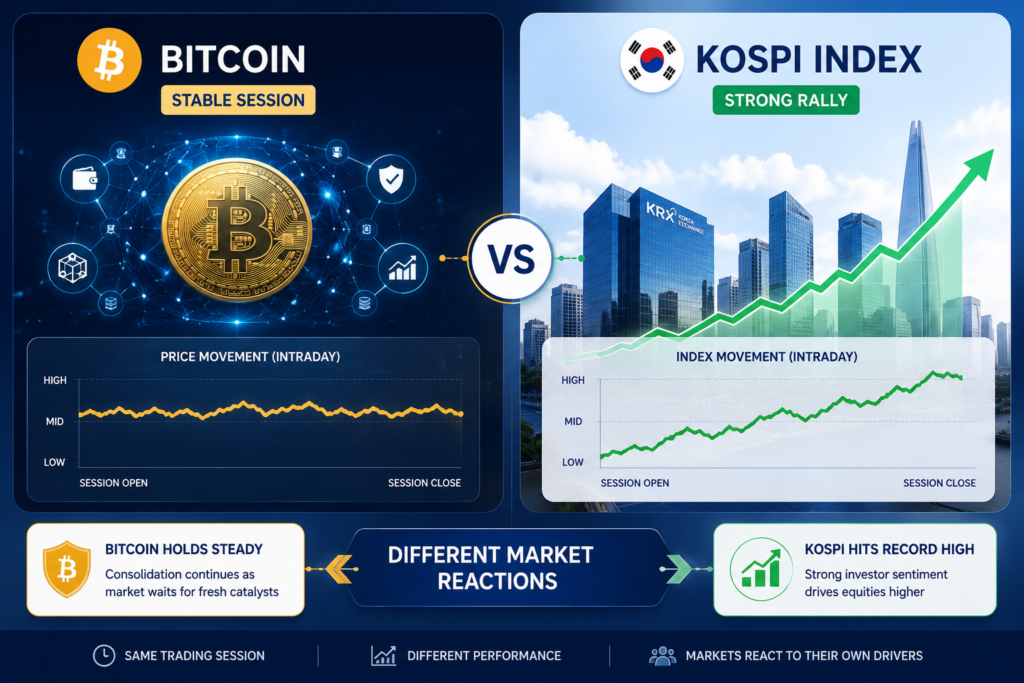
Bitcoin traded in a relatively narrow range on Friday, showing little reaction even as South Korea’s benchmark KOSPI index climbed to a record high. The contrasting market performance has sparked fresh discussion among investors about whether cryptocurrency is beginning to decouple from traditional equity markets.
The latest session saw Bitcoin price holds steady become one of the defining themes, with the world’s largest cryptocurrency maintaining stability while equity investors aggressively pushed Korean stocks higher. Analysts believe the muted response highlights a period in which crypto traders are focusing more on digital asset-specific catalysts than regional stock market movements.
KOSPI Reaches New Highs
South Korea’s KOSPI index recorded another strong session, extending its recent momentum as investor confidence improved across technology and manufacturing stocks.
Historically, rallies in Asian equity markets have occasionally supported sentiment across other risk assets, including cryptocurrencies. However, Friday’s trading presented a different picture.
While Korean equities gained momentum, Bitcoin remained largely unchanged, suggesting that market participants were reluctant to take on additional risk before upcoming macroeconomic events and policy developments.
Why Bitcoin Stayed Rangebound
Several factors may explain Bitcoin’s limited movement despite strong gains in traditional markets.
First, cryptocurrency investors continue monitoring macroeconomic developments, including central bank policy expectations and global liquidity conditions.
Second, institutional participants appear to be waiting for stronger catalysts before committing to larger positions.
Finally, the crypto market has recently experienced periods where digital asset prices respond more to blockchain-related developments, ETF flows, and regulatory news than to movements in regional equity markets.
This behavior suggests Bitcoin is increasingly developing its own set of market drivers rather than simply following broader risk assets.
Decoupling or Temporary Pause?
The relationship between Bitcoin and traditional financial markets has shifted several times over the past few years.
During periods of heightened uncertainty, Bitcoin often moves alongside technology stocks as investors reduce exposure to higher-risk assets.
At other times, cryptocurrency demonstrates independent price action driven by adoption, institutional demand, or blockchain-specific developments.
Friday’s market performance does not necessarily confirm a permanent separation between crypto and equities, but it does illustrate that Bitcoin is capable of maintaining stability even when major stock indices experience significant gains.
What Investors Are Watching Next
Market participants are now turning their attention toward upcoming economic data and monetary policy signals that could influence both traditional and digital asset markets.
Interest rate expectations remain an important driver of liquidity, while institutional activity continues to shape sentiment across the cryptocurrency sector.
Analysts also expect investors to monitor spot Bitcoin ETF activity, blockchain network metrics, and global regulatory developments for clues about the next major move.
Until a stronger catalyst emerges, Bitcoin may continue trading within a defined range even as equity markets experience greater volatility.
Broader Implications for Crypto
Bitcoin’s stability during a strong equity rally reflects the growing maturity of the digital asset market.
Rather than reacting immediately to every movement in global stock indices, cryptocurrency increasingly responds to factors unique to its own ecosystem.
This shift may appeal to long-term investors seeking assets with differentiated market behavior, although correlations between Bitcoin and traditional markets are still likely to fluctuate during periods of significant economic stress.
Final Thoughts
The latest trading session demonstrated that Bitcoin price holds steady even as South Korea’s KOSPI reached record levels. While equities benefited from renewed investor optimism, cryptocurrency markets adopted a more cautious stance.
Whether this represents the beginning of a longer period of market independence or simply a temporary pause remains uncertain. For now, investors appear focused on macroeconomic conditions, institutional activity, and digital asset-specific developments that could determine Bitcoin’s next direction.