


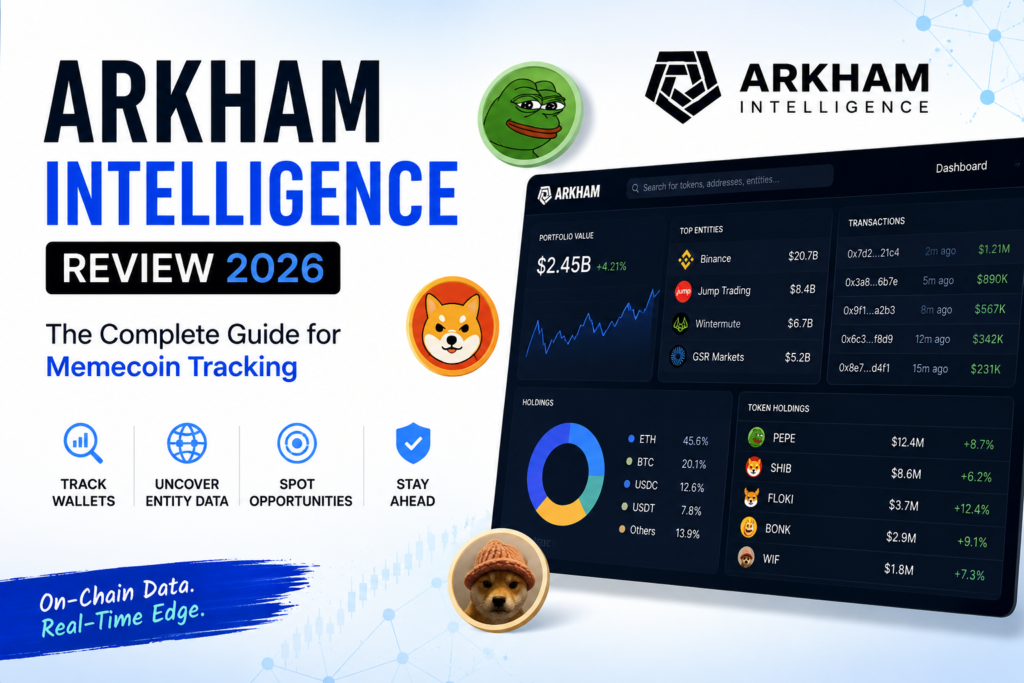
Here’s the uncomfortable truth about memecoin trading: most people lose not because they lack conviction, they lose because they’re flying blind. They’re chasing Twitter trends, aping into Telegram calls, and reacting to price moves that were already priced in by wallets that knew what was coming hours earlier.
The traders who consistently get in early aren’t lucky. They’re reading the blockchain. And in 2026, one of the sharpest tools available for doing that is Arkham Intelligence.
This guide breaks down everything you need to know – what Arkham actually does, how it applies specifically to memecoin hunting, what’s changed in 2026, and whether it deserves a permanent spot in your research stack.
What Is Arkham Intelligence?
Arkham Intelligence is a blockchain analytics platform built around one core mission: de-anonymizing the blockchain. That’s a bold goal, and Arkham pursues it more aggressively than any other platform in the space.
Three million users now rely on Arkham for on-chain intelligence. The platform tracks wallets across 12+ blockchains, runs an AI engine called Ultra for entity matching, and operates the world’s first intelligence marketplace where anyone can post a bounty for blockchain data.
The founding philosophy is simple but powerful: blockchain data is public, but raw transaction strings are useless without context. Arkham converts that raw data into a map of who owns what and where their money is going in real time.
Founded in 2020 by Miguel Morel, Arkham has the trust of top-tier investors including Sam Altman, Tim Draper, and the co-founders of Palantir. The platform has labeled over 300 million addresses and maintains more than 150,000 entity pages.
That institutional backing isn’t just a credibility signal it reflects the seriousness of what Arkham is building. This isn’t a hobbyist project.
The Ultra AI Engine: The Brain Behind Everything
Every feature Arkham offers flows from one core technology: Ultra AI. Understanding what Ultra does and how well is essential to understanding the platform’s real-world value.
Arkham’s Ultra AI sets a new benchmark. Instead of showing random wallet addresses, it sorts them into meaningful clusters think “Tesla Treasury,” “German Government” or “Lazarus Group.” The January 2026 update especially improved tracking of institutional actors within Bitcoin’s UTXO framework, including BlackRock and Fidelity ETF movements.
For memecoin hunters, this matters in a very specific way. When a new token launches on Pump.fun or Raydium, the early buyers are often anonymous wallet addresses. Ultra’s job is to cross-reference those wallets against its entity database and determine whether any of them carry meaningful labels a known whale, a historically profitable trader, a fund’s known accumulation wallet.
The Ultra AI’s new “Intent Detection” function is a major leap. If large amounts of tokens are sent from cold wallets to exchanges, Ultra now attempts to determine whether it’s preparing for a sale or being used as loan collateral giving users a clear “Sentiment Score.” Previously, only expensive institutional clients could access this type of intelligence.
That shift from institutional only to retail accessible is arguably the most important thing Arkham has done in 2026.
By 2026, Arkham’s accuracy in identifying exchange wallet types like “sweep” or “deposit” wallets has surpassed 99%. When funds are deposited on a major exchange, Arkham instantly tags the movement as an “Exchange Deposit,” making it straightforward for traders to track impending sell pressure.
How Arkham Applies Specifically to Memecoin Tracking
Here’s where the rubber meets the road. Memecoins have no fundamentals no revenue, no roadmap, no team to analyze. What they do have is on-chain behavior, and that behavior tells a story if you know how to read it.
Arkham gives memecoin hunters three distinct edges:
1. Entity-Level Wallet Tracking
Rather than tracking anonymous address strings, Arkham lets you track entities named, labeled actors whose behavior carries real signal. Arkham’s wallet tracking has identified holdings of known figures like Justin Sun (TRX, BTT, BTC, and a wide range of altcoins and memecoins) and CZ (BNB, BTC, and several memecoins), whose on-chain activity you can now follow in real time.
When a wallet flagged as a known early memecoin buyer starts accumulating a new token, that’s not noise, that’s a pattern with a track record.
2. Token-Level Intelligence Pages
Every token on Arkham gets its own analytics page showing holder rankings, transaction history, exchange flow data, and a breakdown of ownership distribution. Arkham’s Token Analytics feature provides dedicated pages for individual tokens showing holder rankings, transaction filters, exchange flows, and detailed breakdown of ownership distribution.
For memecoins specifically, the concentration data is critical. A token where the top 10 wallets hold 60%+ of supply is a potential rugpull waiting to happen. A token where smart money is spread across dozens of independently labeled wallets and that spread is growing is something worth paying attention to.
3. Real-Time Alerts for Whale Activity
Arkham lets you set alerts for token-specific activity: when a certain whale moves a memecoin, Arkham pings you. Entity tagging turns randomness into real signals you’re not following addresses, you’re following who’s behind them.
This is the memecoin hunter’s version of an early warning system. Instead of watching a chart hoping for a signal, you get notified the moment a wallet with a track record starts interacting with a token you’re watching or a token you haven’t even looked at yet.
The Intel Exchange: A Genuinely Unique Feature
No other analytics platform has anything quite like the Arkham Intel Exchange. The Intel Exchange is a marketplace where users can buy and sell on-chain intelligence using ARKM tokens, creating a community-driven ecosystem for sharing specialized insights.
In practice, this means the following: if you discover that a specific anonymous wallet is connected to a known entity say, a well-known VC fund or a serial memecoin deployer, you can post that intelligence on the exchange and earn ARKM tokens when someone buys it.
The flip side is equally valuable. You can buy intelligence posted by others. If someone has done the forensic work to connect a cluster of wallets to a known actor, you can access that data without having to do the detective work yourself.
Arkham launched its “Intel-to-Earn” model powered by the ARKM token, which creates a decentralized marketplace for blockchain data. Anyone can spot significant flows into or out of exchanges and act fast, making data-driven decisions rather than relying on guesswork.
For memecoin research specifically, the Intel Exchange is a way to crowdsource the hardest part of on-chain analysis entity identification across a community of thousands of contributors.
What’s New in Arkham 2026
The platform has not stood still. Several notable updates have changed how useful it is in practice:
New Intel API (February 2026): Arkham unveiled its full-fledged Intel API in February 2026, focused on advanced fund-flow tracking and entity labeling. Described as the most advanced on-chain data API in the world, it allows developers and institutions to query data and build custom integrations. For advanced traders, this means you can pull Arkham data directly into custom dashboards or automated alerts without being limited to the web interface.
DEX Pivot: Arkham shut down its centralized exchange and pivoted to a DEX in 2026. This is a meaningful shift, it aligns the platform more tightly with on-chain transparency and reduces the conflict of interest that came with running both an intelligence platform and a centralized trading venue.
Ultra AI UTXO Improvements: The January 2026 update brought much-improved Bitcoin tracking, which has historically been harder than EVM-chain tracking due to Bitcoin’s UTXO model. This matters because significant capital still flows through Bitcoin before rotating into altcoins and memecoins.
Arkham Oracle: What sets Arkham apart is its combination of automated AI labeling, visual network analysis tools, and natural language querying through the Arkham Oracle chatbot, which allows users to query entity balances, holdings, and wallet activity through conversational commands. For users who aren’t comfortable building custom queries, Oracle makes Arkham significantly more accessible.
Arkham Pricing: What You Actually Pay
Arkham offers a free tier alongside paid plans gated by ARKM token holdings. This is fundamentally different from Nansen’s flat subscription model and for most retail users, it’s more flexible.
The free tier gives you access to entity pages, basic wallet tracking, token analytics, and the Intel Exchange. For someone just starting to explore on-chain analysis, this is genuinely sufficient to get meaningful signals.
Paid access unlocked by holding ARKM tokens gives you higher alert volumes, API access, deeper historical data, and premium Intel Exchange features. The exact amount of ARKM required scales with the feature tier you want, meaning your access level adjusts dynamically with the token price.
This token-gated model is a double-edged sword. When ARKM is cheap, premium access is cheap. When ARKM rallies, the cost of access rises. It’s worth factoring that volatility into any comparison against flat-rate tools.
Arkham vs. Nansen: Which One Is Right for You?
Both platforms are serious tools. The honest comparison looks like this:
Arkham’s advantages:
- Stronger entity identification via Ultra AI names, not just labels
- The Intel Exchange has no equivalent on any other platform
- Free tier is more capable for individual wallet and entity research
- Token-gated pricing can be cheaper than Nansen’s flat rate in some market conditions
- Investigative and forensic research is a genuine strength
Nansen’s advantages:
- Deeper “Smart Money” performance-based labeling (wallets ranked by profitability, not just identity)
- More established EVM DeFi coverage
- Flat subscription is more predictable in cost
- Better for systematic token screening across many assets simultaneously
The practical answer for memecoin hunters: Arkham is stronger when your question is who is behind this wallet entity identification, whale forensics, and connecting dots across wallets. Nansen is stronger when your question is which wallets have the best track record of entering early performance-based smart money filtering.
The most effective on-chain traders use both.
What Arkham Does Not Do Well
Honest reviews include the limitations:
Solana coverage is still developing. Most memecoins in 2026 launch on Solana. Arkham’s entity coverage is deepest on Ethereum and EVM chains. For dedicated Solana memecoin hunting, it’s less effective than Nansen’s Solana-specific labeling.
Privacy concerns are real. Arkham’s mission de-anonymizing the blockchain has attracted genuine controversy. The Intel Exchange, which rewards users for doxxing wallets, has faced criticism from privacy advocates. If you’re using Arkham as a research tool, be aware that your own wallets are also visible.
Learning curve exists. The platform’s entity graph and network visualizations are powerful but not intuitive out of the box. New users should expect to spend time learning how to use the dashboards before they become efficient at extracting signals.
Final Verdict: Is Arkham Worth Using for Memecoin Tracking?
Yes, with a specific caveat about how you use it.
Arkham’s Ultra AI entity labeling is the best in the industry for connecting wallet addresses to real-world actors. For memecoin hunters, that means being able to see not just that a large wallet is accumulating a new token, but who that wallet belongs to and whether they have a track record of being early on winning plays.
The Intel Exchange adds a layer no competitor offers: crowdsourced intelligence that continuously improves the quality of wallet attribution over time.
The platform’s free tier is generous enough for serious retail research. The ARKM-gated premium access offers an upgrade path that scales with your needs.
If you’re serious about memecoin trading and want to operate with on-chain intelligence rather than social media sentiment, Arkham deserves to be in your research stack alongside your exchange of choice. It won’t tell you what to buy, but it will show you what the wallets with the best track records are doing, and in memecoin markets, that’s often the only edge that actually holds up over time.