


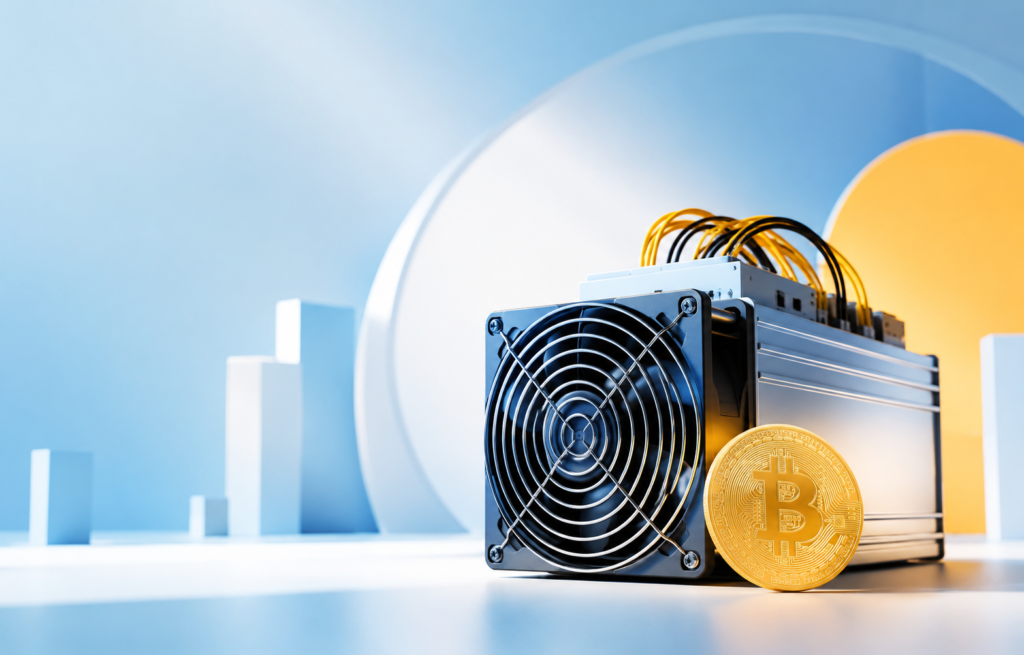
Bitcoin is often described as digital gold, but unlike traditional currencies, it isn’t issued by a central bank or controlled by a single organization. Instead, the world’s largest cryptocurrency relies on a decentralized network of computers to process transactions, maintain security, and ensure that every Bitcoin in circulation is genuine. This process is known as Bitcoin mining.
For many newcomers, mining can seem overly technical. Terms like hash rate, Proof of Work, ASIC miners, and mining difficulty often make the topic appear complicated. In reality, the core concept is much easier to understand than most people think. Bitcoin mining is simply the mechanism that keeps the Bitcoin network running securely while introducing new coins into circulation according to a fixed schedule.
Mining has evolved significantly since Bitcoin’s launch in 2009. In the early days, anyone with a personal computer could participate. As Bitcoin gained value and more miners joined the network, competition increased dramatically. Today, mining is powered by highly specialized hardware, large-scale mining farms, and global mining pools that collectively contribute enormous computing power to secure the blockchain.
Whether you’re interested in learning how Bitcoin works, considering mining as a hobby, or evaluating it as a business opportunity, understanding the mining process is essential. This guide explains the fundamentals in clear language, helping you understand not only how mining works but also why it remains one of the most important components of the Bitcoin ecosystem.
What Is Bitcoin Mining?
Bitcoin mining is the process of verifying Bitcoin transactions, grouping them into blocks, and adding those blocks to the blockchain. In return for performing this work, miners receive Bitcoin rewards along with transaction fees paid by users.
Unlike traditional payment systems that rely on banks or payment processors to verify transfers, Bitcoin uses thousands of independent computers spread across the globe. These computers, known as miners, work together to ensure that every transaction is legitimate and that no one can spend the same Bitcoin twice.
Think of Bitcoin mining as a global accounting system. Every transaction made on the network needs to be checked, recorded, and permanently stored. Instead of trusting one company to maintain these records, Bitcoin distributes this responsibility across a decentralized network of participants.
Mining also introduces new Bitcoin into circulation. However, unlike fiat currencies that governments can print whenever necessary, Bitcoin follows a predetermined issuance schedule. The maximum supply is permanently capped at 21 million BTC, making scarcity one of its defining characteristics.
Why Does Bitcoin Need Mining?
Without mining, Bitcoin simply wouldn’t function.
Traditional financial systems rely on trusted intermediaries to verify balances, approve payments, and prevent fraud. Banks maintain centralized databases that determine who owns what.
Bitcoin removes this central authority. Since no single organization controls the network, there must be another way to establish trust between strangers.
Mining solves this problem.
Every miner independently verifies transactions according to Bitcoin’s consensus rules. Once enough computational work has been completed, the network agrees on a single version of the blockchain that everyone accepts as valid.
This process provides several important benefits:
Prevents Double Spending
Digital files can usually be copied infinitely. Without a verification mechanism, someone could theoretically spend the same Bitcoin multiple times.
Mining prevents this by ensuring every transaction is confirmed only once and permanently recorded on the blockchain.
Secures the Network
Each confirmed block is linked cryptographically to the previous block, creating a chain that becomes increasingly difficult to alter.
Changing historical data would require redoing an enormous amount of computational work while simultaneously outperforming the rest of the global mining network—a task considered economically and technically impractical.
Enables Decentralization
Instead of relying on one institution, Bitcoin distributes trust among thousands of independent participants operating across different countries.
No single miner controls the network, and consensus emerges through collective participation.
Maintains Transparency
Every confirmed transaction becomes part of Bitcoin’s public ledger, allowing anyone to independently verify balances and transaction history.
This transparency improves trust while preserving the pseudonymous nature of Bitcoin addresses.
How Bitcoin Mining Works
Although mining involves advanced cryptography behind the scenes, the overall process can be understood through a series of straightforward steps.
Step 1: Users Broadcast Transactions
Whenever someone sends Bitcoin, the transaction is broadcast to the network.
The transaction includes details such as:
- Sender’s wallet
- Recipient’s wallet
- Amount transferred
- Digital signature
- Transaction fee
Before it becomes permanent, the transaction waits in an area commonly referred to as the mempool, where it awaits confirmation.
Step 2: Miners Collect Pending Transactions
Miners continuously monitor the mempool.
They select transactions to include in the next block, usually prioritizing those offering higher transaction fees since these increase the miner’s potential reward.
Each block has limited capacity, meaning not every pending transaction can be included immediately.
Step 3: Building a Candidate Block
The miner organizes selected transactions into a candidate block.
In addition to transaction data, the block contains important information including:
- Timestamp
- Previous block hash
- Block version
- Merkle root
- Nonce
- Difficulty target
These components help identify the block uniquely while connecting it to the existing blockchain.
Step 4: Solving the Mathematical Puzzle
This is where mining actually begins.
Miners repeatedly perform trillions of cryptographic calculations using the SHA-256 hashing algorithm.
Their objective is simple:
Find a block hash that falls below the difficulty target established by the Bitcoin protocol.
The only practical way to achieve this is through trial and error.
Miners continuously modify a value called the nonce, generate a new hash, and check whether it satisfies the required target.
Most attempts fail.
They simply try again.
Modern mining machines perform this process trillions of times every second.
Step 5: Finding the Correct Hash
Eventually, one miner discovers a valid solution.
That miner immediately broadcasts the completed block to the rest of the network.
Other nodes independently verify:
- Every transaction
- Digital signatures
- Block structure
- Proof of Work
- Consensus rules
Verification usually takes only a few moments.
If everything is valid, the block is accepted.
Step 6: The Blockchain Grows
Once approved, the block becomes part of Bitcoin’s permanent transaction history.
The successful miner receives:
- Newly created Bitcoin (block subsidy)
- Transaction fees from included transactions
The network then begins working on the next block, repeating the entire process approximately every ten minutes.
Understanding Proof of Work
Proof of Work (PoW) is the consensus mechanism that secures Bitcoin.
Rather than asking participants to trust each other, Proof of Work requires miners to demonstrate that they have invested real computational effort before earning the right to add a new block.
This requirement makes attacking the network extremely expensive.
Imagine entering a lottery where every ticket requires solving a complex puzzle. Buying more tickets improves your chances but never guarantees victory.
Bitcoin mining works similarly.
Each hash generated by a miner acts like another lottery ticket. The more computing power a miner contributes, the greater the probability of discovering the next valid block.
Importantly, the puzzle itself isn’t intellectually difficult. The challenge lies in the sheer number of attempts required before finding the correct solution.
This design keeps block production predictable while making fraud prohibitively expensive.
Why Proof of Work Makes Bitcoin Secure
Bitcoin’s security comes from economics as much as mathematics.
To rewrite the blockchain, an attacker would need to control an enormous amount of computing power, consume massive amounts of electricity, and outcompete the honest mining network for an extended period.
Even if such an attack were technically possible, the financial cost would likely outweigh any potential benefit.
As a result, miners are financially incentivized to follow the protocol honestly rather than undermine the network they have invested heavily in.
This alignment of incentives has helped Bitcoin operate securely for more than a decade despite processing billions of dollars in value.
A Simple Real-World Analogy
Imagine a giant public notebook placed in the center of a town.
Anyone can write down new transactions, but before a page is officially added, participants compete to solve a difficult puzzle.
The first person to solve it earns the right to add the page and receives a reward.
Everyone else quickly checks the work. If it’s correct, the page becomes permanent, and the competition starts again for the next page.
Bitcoin mining follows the same principle except instead of people solving puzzles manually, specialized computers perform trillions of calculations every second to secure a digital ledger shared across the world.
Bitcoin Mining Hardware: From Home Computers to ASIC Machines
When Bitcoin launched in 2009, mining was accessible to almost anyone with a standard desktop computer. Early adopters could mine Bitcoin using their computer’s processor and earn significant rewards because there was very little competition. As Bitcoin’s popularity and value increased, however, mining became far more competitive, driving the need for increasingly powerful hardware.
Today, Bitcoin mining is dominated by specialized machines designed exclusively for one purpose: solving Bitcoin’s cryptographic puzzles as efficiently as possible. Understanding the evolution of mining hardware helps explain why Bitcoin mining has transformed from a hobby into a highly competitive global industry.
CPU Mining: The Beginning of Bitcoin
The earliest Bitcoin miners used a computer’s Central Processing Unit (CPU). CPUs are designed to handle a wide range of computing tasks, making them ideal for everyday activities such as web browsing, office work, and gaming.
During Bitcoin’s first year, CPU mining was sufficient because very few people were participating in the network. As more miners joined, the total computing power securing Bitcoin increased, making CPU mining increasingly ineffective.
Today, mining Bitcoin with a CPU is no longer practical. A modern processor simply cannot compete with specialized mining equipment, and the electricity costs would almost always exceed any potential rewards.
Although CPU mining has become obsolete for Bitcoin, some smaller cryptocurrencies with different consensus mechanisms still allow CPU mining.
GPU Mining: A Significant Leap Forward
As mining difficulty increased, enthusiasts discovered that Graphics Processing Units (GPUs) could perform Bitcoin’s repetitive hashing calculations much faster than CPUs.
Originally designed to render graphics for video games and professional applications, GPUs contain hundreds or even thousands of smaller processing cores capable of handling many calculations simultaneously.
This parallel processing capability made GPUs far more efficient for Bitcoin mining during the early 2010s. Mining farms began replacing CPUs with multiple high-performance graphics cards, dramatically increasing their hash rates.
However, GPU mining also had limitations. As competition intensified, even the most powerful graphics cards struggled to remain profitable against newer technologies.
Today, GPUs are widely used for artificial intelligence, scientific computing, and gaming, but they are no longer a practical choice for Bitcoin mining. They continue to play an important role in mining certain cryptocurrencies that use algorithms designed to resist ASIC dominance.
FPGA Mining: A Transitional Technology
Between GPUs and ASICs came Field-Programmable Gate Arrays (FPGAs).
Unlike CPUs and GPUs, FPGAs can be programmed to perform specific computational tasks much more efficiently. This flexibility allowed miners to optimize hardware for Bitcoin’s SHA-256 algorithm without manufacturing entirely new chips.
FPGA miners consumed less electricity than GPUs while delivering higher performance, making them an attractive option for a brief period.
Despite these advantages, FPGA mining never became mainstream. The arrival of Application-Specific Integrated Circuits (ASICs) quickly made FPGAs economically uncompetitive for Bitcoin mining.
Today, FPGA devices are more commonly found in telecommunications, aerospace, research, and industrial computing rather than cryptocurrency mining.
ASIC Mining: The Industry Standard
Modern Bitcoin mining relies almost entirely on Application-Specific Integrated Circuits (ASICs).
Unlike CPUs or GPUs, ASIC miners are built for one purpose only: calculating SHA-256 hashes as quickly and efficiently as possible.
Because every component is optimized for a single task, ASICs dramatically outperform general-purpose hardware in both speed and energy efficiency.
A single modern ASIC miner can perform hundreds of trillions of hash calculations every second while consuming far less electricity per unit of computing power than older technologies.
This efficiency has made ASICs the backbone of today’s Bitcoin mining industry.
Large-scale mining companies often operate thousands of ASIC machines housed in dedicated facilities with advanced cooling systems, industrial-grade electrical infrastructure, and continuous monitoring.
Although ASIC miners represent a significant investment, they remain the only realistic option for anyone considering Bitcoin mining on a commercial scale.
Comparing Different Types of Mining Hardware
| Hardware | Performance | Energy Efficiency | Current Suitability |
| CPU | Very Low | Poor | Not suitable |
| GPU | Moderate | Moderate | Mostly obsolete for Bitcoin |
| FPGA | High | Good | Rarely used |
| ASIC | Extremely High | Excellent | Industry standard |
The progression from CPU to ASIC mining reflects Bitcoin’s growing security. As more computing power joins the network, successfully attacking Bitcoin becomes increasingly difficult and expensive.
What Is Hash Rate?
One of the most frequently used terms in Bitcoin mining is hash rate.
Hash rate measures how many cryptographic calculations a mining machine can perform every second while attempting to discover a valid block.
The higher the hash rate, the greater a miner’s probability of successfully mining the next block.
Hash rate is typically measured using the following units:
- KH/s – Thousands of hashes per second
- MH/s – Millions of hashes per second
- GH/s – Billions of hashes per second
- TH/s – Trillions of hashes per second
- PH/s – Quadrillions of hashes per second
- EH/s – Quintillions of hashes per second
Modern Bitcoin ASIC miners commonly operate in the range of hundreds of terahashes per second (TH/s), while the entire Bitcoin network collectively measures its computational power in exahashes per second (EH/s).
A higher hash rate generally improves mining potential, but profitability also depends on electricity costs, mining difficulty, and hardware efficiency.
Bitcoin Mining Software
Powerful hardware alone is not enough to mine Bitcoin. Every mining machine also requires software that connects it to the Bitcoin network or a mining pool.
Mining software performs several essential tasks:
- Communicates with mining pools.
- Receives new block templates.
- Submits completed work.
- Monitors hardware performance.
- Tracks temperature and power consumption.
- Reports errors and system status.
Many ASIC manufacturers provide their own management software, while experienced miners often install custom firmware that offers additional features such as performance tuning, improved monitoring, or energy optimization.
Regardless of the software used, miners should regularly update firmware and security settings to protect their equipment from vulnerabilities and ensure stable operation.
Setting Up a Bitcoin Mining Operation
Launching a mining operation involves much more than purchasing hardware. Before mining begins, several practical considerations need to be addressed.
Reliable Electricity
Electricity is one of the largest ongoing expenses for any mining operation. Lower energy costs generally improve long-term profitability, which is why many industrial miners establish facilities in regions with access to affordable power.
Cooling Systems
ASIC miners generate substantial heat during continuous operation. Without adequate ventilation or cooling, excessive temperatures can reduce efficiency, shorten equipment lifespan, or lead to unexpected shutdowns.
Stable Internet Connection
Although Bitcoin mining does not require high internet bandwidth, it does depend on a reliable connection. Frequent interruptions can prevent miners from submitting valid work on time, reducing potential earnings.
Secure Storage
Successfully mined Bitcoin should be transferred to a secure wallet. Many miners choose hardware wallets for long-term storage because they keep private keys offline, reducing exposure to online threats.
Key Takeaways
Bitcoin mining hardware has evolved dramatically over the years, reflecting the network’s increasing scale and security. What once required only a home computer now depends on specialized ASIC machines capable of performing trillions of calculations every second.
However, powerful hardware alone does not guarantee success. Efficient software, reliable infrastructure, affordable electricity, and proper cooling all play a critical role in running a successful mining operation.
Solo Mining vs. Mining Pools: Which Approach Works Best?
Owning powerful mining hardware doesn’t automatically mean you’ll earn a steady income. The next decision every miner faces is whether to mine independently or join a mining pool.
Both approaches contribute to securing the Bitcoin network, but they differ significantly in terms of reward frequency, risk, and earning consistency.
What Is Solo Mining?
Solo mining means a miner attempts to discover new Bitcoin blocks without collaborating with anyone else. If the miner successfully solves the cryptographic puzzle before the rest of the network, they receive the entire block reward and all associated transaction fees.
While this may sound appealing, the odds of success are extremely low for individual miners.
Today, the Bitcoin network is protected by an enormous amount of computing power distributed across the globe. Unless a miner operates a large number of high-performance ASIC machines, finding a block independently could take months—or even years.
Solo mining is best suited for large industrial operations with substantial hash power and the financial resources to withstand long periods without rewards.
What Is a Mining Pool?
A mining pool is a group of miners who combine their computing power to increase their chances of finding new blocks.
Instead of competing individually, participants work together. When the pool successfully mines a block, the reward is divided among members based on the amount of computing power each contributed.
This approach doesn’t increase the total amount of Bitcoin earned over time, but it does provide smaller, more frequent payouts, making income far more predictable.
For most small and medium-sized miners, joining a reputable mining pool is the preferred option.
How Mining Pools Distribute Rewards
Every mining pool uses a payout system to calculate how rewards are shared among participants.
Two of the most common methods are:
Pay-Per-Share (PPS)
In a PPS model, miners receive a fixed payment for every valid share of work they submit, regardless of whether the pool actually finds a block.
This system provides consistent income and reduces uncertainty, but pools generally charge slightly higher fees because they assume more financial risk.
Pay-Per-Last-N-Shares (PPLNS)
Under the PPLNS model, rewards are distributed only after the pool successfully mines a block.
Payments depend on the number of valid shares submitted during a specific time window before the block was found.
Although payouts can fluctuate, this method often offers better long-term returns for miners who participate consistently.
Solo Mining vs. Mining Pools
| Feature | Solo Mining | Mining Pool |
| Reward Size | Entire block reward | Shared among participants |
| Payment Frequency | Rare | Regular |
| Income Stability | Low | High |
| Risk | High | Lower |
| Best For | Large mining farms | Most individual miners |
For the vast majority of miners, mining pools provide a practical balance between risk and reward.
Understanding Bitcoin Block Rewards
Bitcoin miners are financially rewarded for securing the network.
Whenever a miner successfully adds a new block to the blockchain, they receive two sources of income:
- Block subsidy (newly created Bitcoin)
- Transaction fees paid by users whose transactions are included in the block
The block subsidy introduces new Bitcoin into circulation, while transaction fees compensate miners for processing network activity.
This reward system incentivizes miners to continue investing in hardware and electricity while maintaining the security of the blockchain.
How the Block Reward Has Changed Over Time
Bitcoin was designed with a fixed monetary policy.
Approximately every four years, the block subsidy is reduced by half through an event known as the Bitcoin halving.
This gradual reduction controls Bitcoin’s issuance rate and reinforces its scarcity.
| Period | Block Reward |
| 2009–2012 | 50 BTC |
| 2012–2016 | 25 BTC |
| 2016–2020 | 12.5 BTC |
| 2020–2024 | 6.25 BTC |
| 2024 onward | 3.125 BTC |
Eventually, all 21 million Bitcoin will be mined. At that point, miners will rely primarily on transaction fees rather than newly created coins.
What Is Bitcoin Halving?
Bitcoin halving is one of the network’s most important economic mechanisms.
Every 210,000 blocks—roughly every four years—the amount of newly created Bitcoin awarded to miners is reduced by 50%.
This process continues automatically according to Bitcoin’s code and does not require approval from governments, companies, or developers.
The primary purpose of halving is to control Bitcoin’s supply and maintain its predictable issuance schedule.
Unlike traditional currencies, whose supply can change based on monetary policy, Bitcoin’s inflation rate decreases over time until no new coins remain to be issued.
Why Halving Matters to Miners
A halving event immediately reduces mining revenue from newly minted Bitcoin.
If all other factors remain unchanged, miners earn half as many new coins for successfully mining a block.
To remain profitable after a halving, miners often need one or more of the following:
- More efficient mining hardware
- Lower electricity costs
- Higher Bitcoin prices
- Increased transaction fee revenue
Less efficient mining operations may shut down if operating costs exceed mining income.
This natural market adjustment encourages continuous improvements in mining technology and energy efficiency.
Mining Difficulty: Keeping Bitcoin on Schedule
One remarkable feature of Bitcoin is that new blocks are produced approximately every ten minutes, regardless of how many miners are participating.
This consistency is achieved through mining difficulty.
Mining difficulty measures how challenging it is to discover a valid block hash.
Every 2,016 blocks (approximately every two weeks), the Bitcoin protocol automatically adjusts the difficulty based on how quickly recent blocks were mined.
If miners collectively discover blocks too quickly, difficulty increases.
If blocks are taking longer than expected, difficulty decreases.
This automatic adjustment helps maintain Bitcoin’s predictable issuance schedule without requiring any central authority.
Why Difficulty Changes
Several factors influence mining difficulty, including:
- More miners joining the network
- Existing miners upgrading to faster ASIC machines
- Changes in electricity prices
- Hardware failures
- Regulatory actions affecting mining operations
- Large mining farms entering or exiting the network
Difficulty does not determine Bitcoin’s price. Instead, it reflects the total computing power actively securing the blockchain.
The Relationship Between Hash Rate and Difficulty
Hash rate and mining difficulty are closely connected, but they are not the same.
The network hash rate represents the combined computing power of all miners participating in Bitcoin.
Mining difficulty determines how hard it is for that computing power to discover a valid block.
As more hash power joins the network, blocks would naturally be mined faster. To prevent this, Bitcoin increases the difficulty.
Conversely, if significant mining power leaves the network, difficulty is reduced so that blocks continue to be produced at roughly ten-minute intervals.
This self-adjusting mechanism has allowed Bitcoin to operate reliably for more than a decade despite enormous changes in mining participation.
Key Takeaways
Bitcoin mining is about more than owning powerful hardware. Success also depends on understanding how rewards are distributed, how mining pools operate, and how Bitcoin’s economic design influences long-term profitability.
Mining pools allow participants to earn steadier income, while Bitcoin’s halving events gradually reduce new coin issuance to preserve scarcity. At the same time, the network continuously adjusts mining difficulty to ensure blocks are created at a consistent pace, regardless of changes in global mining power.
These mechanisms work together to create a secure, decentralized, and self-regulating network that has remained operational since Bitcoin’s launch in 2009.
Is Bitcoin Mining Still Profitable?
One of the first questions aspiring miners ask is whether Bitcoin mining is still profitable. The answer isn’t a simple yes or no, it depends on several factors that directly influence both revenue and operating costs.
Unlike the early days of Bitcoin, when individuals could mine using home computers and earn substantial rewards, today’s mining landscape is highly competitive. Specialized hardware, rising electricity prices, and periodic Bitcoin halvings mean profitability varies significantly from one miner to another.
A miner operating the latest ASIC hardware in a region with low electricity costs may generate consistent profits, while someone using older equipment with expensive power could struggle to break even.
Rather than focusing solely on Bitcoin’s market price, miners should evaluate the complete economic picture before investing in equipment.
Factors That Affect Mining Profitability
1. Electricity Costs
Electricity is typically the largest recurring expense for Bitcoin miners.
ASIC miners run continuously, consuming significant amounts of power every day. Even highly efficient machines can become unprofitable if electricity rates are too high.
This is one reason many industrial mining companies establish operations near hydroelectric dams, wind farms, solar facilities, or regions with relatively inexpensive energy.
2. Mining Hardware Efficiency
Not all ASIC miners deliver the same performance.
Newer models generally produce more hash power while consuming less electricity, making them more profitable over the long term.
Although high-end ASICs often require a larger upfront investment, improved efficiency can reduce operating costs over time.
3. Bitcoin Price
Mining revenue is ultimately paid in Bitcoin.
When Bitcoin’s price rises, the value of mining rewards increases. Conversely, prolonged market downturns can reduce profitability, particularly for miners with high operating expenses.
Because cryptocurrency markets are volatile, miners often plan for both bullish and bearish conditions rather than relying on short-term price movements.
4. Mining Difficulty
Mining difficulty adjusts approximately every two weeks to maintain Bitcoin’s average block time of ten minutes.
As more miners join the network and total hash power increases, discovering a new block becomes more challenging. This means individual miners may earn fewer rewards unless they upgrade their equipment or increase their computing power.
5. Mining Pool Fees
Most miners participate in mining pools to receive more consistent payouts.
Pools typically charge a small service fee in exchange for managing infrastructure and distributing rewards. While these fees reduce overall earnings slightly, they provide greater income stability for smaller miners.
6. Cooling and Maintenance
Mining equipment operates continuously under heavy workloads, generating substantial heat.
Proper cooling systems, regular maintenance, and occasional hardware replacements should all be considered when calculating long-term mining costs.
Ignoring these expenses can significantly overestimate expected profits.
Bitcoin Mining and Energy Consumption
Bitcoin mining has become a frequent topic of discussion due to its energy requirements.
Because Proof of Work relies on computational power, miners consume electricity while competing to validate new blocks. Critics argue that this energy usage is excessive, while supporters believe the picture is more nuanced.
In reality, Bitcoin mining’s environmental impact depends largely on the source of electricity being used.
Many large mining operations intentionally locate near renewable energy sources such as hydroelectric, wind, geothermal, or solar power, where electricity is both affordable and abundant.
Some mining companies also utilize surplus energy that would otherwise go unused or support power grids by reducing consumption during periods of peak demand.
At the same time, concerns remain about mining operations that rely heavily on fossil fuels.
Rather than viewing Bitcoin mining as universally harmful or entirely sustainable, it is more accurate to recognize that its environmental footprint varies depending on local energy infrastructure and mining practices.
Risks of Bitcoin Mining
Like any investment, Bitcoin mining carries risks that should be carefully evaluated.
High Initial Investment
Professional mining equipment can be expensive, and additional costs such as cooling systems, electrical upgrades, and facility preparation can significantly increase startup expenses.
Hardware Obsolescence
Mining technology evolves rapidly.
ASIC miners that are considered efficient today may become less competitive as newer models enter the market.
Market Volatility
Bitcoin prices can fluctuate dramatically.
A decline in market value may temporarily reduce mining profitability, especially for operators with high electricity costs.
Regulatory Changes
Cryptocurrency regulations differ widely across jurisdictions.
Some countries encourage mining, while others impose restrictions or prohibit certain mining activities altogether.
Anyone considering mining should understand the laws applicable in their region before making significant investments.
Operational Challenges
Mining equipment produces heat, noise, and dust, requiring ongoing maintenance to operate efficiently.
Unexpected hardware failures can interrupt operations and reduce profitability.
Can You Mine Bitcoin at Home?
Technically, yes.
Practically, it depends.
Modern ASIC miners can be installed at home, but several challenges should be considered.
First, these machines generate significant noise—often comparable to industrial equipment.
Second, they produce considerable heat, requiring adequate ventilation or cooling systems.
Finally, residential electricity rates are often higher than those available to commercial mining facilities, reducing profitability.
For enthusiasts interested in learning about mining, operating a single ASIC at home can provide valuable hands-on experience. However, generating substantial profits from home mining has become increasingly difficult in many regions.
Is Bitcoin Mining Legal?
Bitcoin mining is legal in many countries, but regulations vary considerably around the world.
Some governments actively support mining by encouraging investment in energy infrastructure and digital asset industries.
Others have introduced licensing requirements, environmental regulations, or restrictions related to electricity consumption.
Before purchasing mining equipment or launching a mining operation, individuals should review the regulations applicable in their jurisdiction and remain aware of any future policy changes.
The Future of Bitcoin Mining
Bitcoin mining continues to evolve as technology advances and market conditions change.
Future developments are likely to include:
- More energy-efficient ASIC miners.
- Greater adoption of renewable energy sources.
- Improved cooling technologies.
- Increased automation and remote management.
- Larger institutional mining operations.
- Greater reliance on transaction fees as block subsidies continue to decrease through future halvings.
Although mining economics will continue to change, the fundamental role of miners remains the same: securing the Bitcoin network and validating transactions in a decentralized manner.
As long as Bitcoin exists, mining will remain one of its most essential components.
Frequently Asked Questions
Can I mine Bitcoin using a laptop?
While it is technically possible, modern laptops lack the computing power needed for profitable Bitcoin mining and may overheat during continuous operation.
How long does it take to mine one Bitcoin?
Individual miners rarely mine an entire Bitcoin directly. Earnings depend on hardware performance, mining pool participation, network difficulty, and Bitcoin’s block rewards.
What is an ASIC miner?
An ASIC (Application-Specific Integrated Circuit) is specialized hardware built specifically for Bitcoin mining, offering significantly higher performance and energy efficiency than CPUs or GPUs.
What is a mining pool?
A mining pool combines the computing power of multiple miners, allowing participants to receive smaller but more frequent payouts.
Why does Bitcoin use Proof of Work?
Proof of Work helps secure the network by requiring miners to perform computational work before adding new blocks to the blockchain, making fraudulent activity extremely costly.
Does Bitcoin mining damage hardware?
Mining places continuous stress on equipment. With proper cooling and maintenance, ASIC miners are designed to operate for extended periods, but all hardware experiences wear over time.
Is Bitcoin mining environmentally harmful?
The environmental impact depends largely on the energy sources used. Mining powered by renewable or surplus energy has a different footprint than mining powered primarily by fossil fuels.
Can solar energy power a mining operation?
Yes. Some miners use solar systems to reduce electricity costs, though system size, battery storage, and local weather conditions affect overall feasibility.
What happens after all 21 million Bitcoin are mined?
Once Bitcoin’s maximum supply is reached, miners will continue securing the network and will earn revenue primarily through transaction fees.
Can beginners start mining Bitcoin?
Yes, but beginners should first understand equipment costs, electricity expenses, mining pools, and profitability before investing.
Conclusion
Bitcoin mining is far more than a method of earning cryptocurrency it is the foundation of Bitcoin’s decentralized security model. By validating transactions, preventing double spending, and maintaining the blockchain, miners play a vital role in ensuring the network remains secure and trustworthy.
Although mining has become increasingly competitive, it continues to attract individuals and organizations willing to invest in efficient hardware, affordable energy, and long-term infrastructure. Success depends not only on owning powerful ASIC machines but also on understanding mining economics, operational costs, and the broader dynamics of the Bitcoin ecosystem.
For beginners, learning how mining works provides valuable insight into why Bitcoin has remained secure for more than a decade. For prospective miners, careful planning, realistic expectations, and continuous research are essential before committing significant resources.
As Bitcoin adoption continues to expand worldwide, mining will remain one of the key technologies supporting the world’s first decentralized digital currency.