


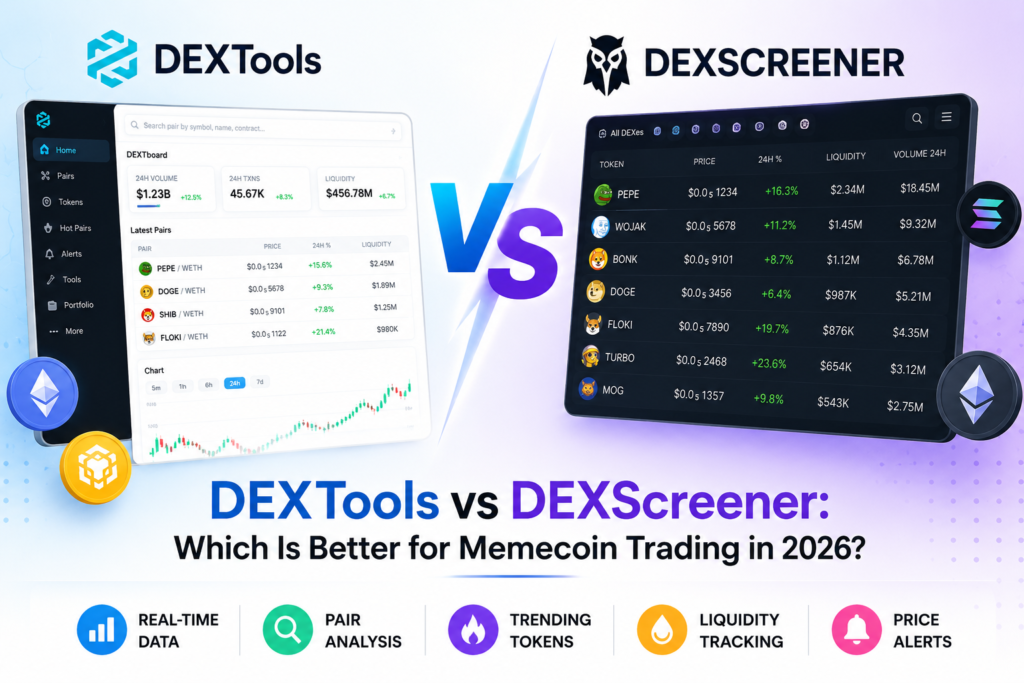
Every serious memecoin trader eventually hits the same wall: two browser tabs open, one showing DEXScreener, one showing DEXTools, and a nagging feeling that they’re not actually sure which one they should be trusting more.
It’s a fair question. Both platforms are genuinely useful. Both are free at the basic level. Both track DEX activity in real time. But they are not interchangeable and the traders who try to use them that way are leaving real edge on the table.
This guide cuts through the tribal debate and gives you a clear, honest answer: what each platform is actually built for, where each one wins, where each one falls short, and most importantly which one to reach for depending on what you’re trying to do in the next five minutes.
The Core Philosophy: Two Different Tools for Two Different Jobs
Before comparing features, you need to understand the fundamental philosophy behind each platform. Because once you see it, the comparison clicks into place immediately.
DEXScreener is built for speed and discovery. Its entire design philosophy is about getting you to the data as fast as possible, with as little friction as possible. No account required. No paywall to start. Just open the URL and you’re looking at live DEX activity across 80+ chains in real time. For traders who spend more time rejecting tokens than actually trading them, which is every good memecoin hunter DEXScreener wins on pure velocity.
DEXTools is built for depth and verification. Its design assumes you’ve already found something worth looking at, and now you need to know whether it’s actually worth trading. The DEXT Score, contract audit functionality, whale wallet tracking, and social sentiment indicators are all oriented around answering one question: is this token real, or is it a trap?
The cleanest summary: DEXScreener finds the token first. DEXTools tells you whether you should actually buy it.
Most active traders don’t stay loyal to one tool. They use each where it helps most.
DEXScreener: Speed, Discovery, and the New Pairs Edge
What It Does Best
DEXScreener’s crown jewel for memecoin hunters is the New Pairs feed a real-time stream of every token the moment its first DEX liquidity pool is created. On Solana, where the fastest and most explosive memecoin launches happen, DEXScreener has the pair live within seconds of the pool being created.
Filter the New Pairs feed by chain, sort by volume or transaction count, and you have a live scanner of every token gaining early traction often before it appears anywhere else. That speed advantage is real. DEXScreener pulls data directly from on-chain DEX smart contracts, making it as accurate as the blockchain itself, with no oracle lag or aggregation delay.
The Advanced Screener adds serious filtering power: minimum liquidity thresholds, market cap ranges, token age filters, and volume spike sorting. Pro traders set minimum liquidity at $20K–$50K, market cap between $70K and $3M, and token age under 24 hours to surface early opportunities with enough traction to be tradeable.
DEXScreener also has the cleaner interface and that matters more than it sounds. When you’re scanning dozens of pairs per hour, interface friction adds up. DEXScreener feels quick and lightweight. You can reject a token in 10 seconds and move to the next one without any cognitive load. That efficiency is the platform’s hidden superpower.
DEXScreener Weaknesses
The platform tells you a token is moving. It doesn’t tell you why it’s moving, or whether the wallets behind that movement are trustworthy.
DEXScreener shows no security scoring. It has no contract audit capability. There’s no whale wallet intelligence built in. The Trending feed can be influenced by paid boosts, tokens marked with a lightning bolt have paid for visibility, which means trending position reflects marketing spend, not necessarily organic momentum.
For memecoin trading, where the majority of new tokens are scams, rugpulls, or insider-controlled launches, DEXScreener alone gives you momentum signals without safety signals. That’s a dangerous combination without something else layered on top.
DEXTools: Depth, Safety, and the DEXT Score Advantage
What It Does Best
DEXTools’ standout feature for memecoin research is the DEXT Score a proprietary token reliability rating on a scale of 0 to 99. In 2026, the DEXT Score has evolved from a simple algorithmic checklist into a sophisticated, multi-layered security audit that evaluates contract code, liquidity lock status, holder distribution, developer reputation, and honeypot detection simultaneously.
The practical interpretation: scores above 80 are generally considered reliable; scores below 40 suggest serious caution. The score doesn’t guarantee safety high scores can still slow-rug but it filters out the lowest-quality tokens fast. Running a token through the DEXT Score takes about 10 seconds and eliminates the most obvious traps without any manual contract reading.
The Pair Explorer is DEXTools’ version of a full token page, and it goes considerably deeper than DEXScreener’s equivalent. You get full transaction history with wallet addresses, liquidity depth charts over time, top traders ranked by profit and loss, and whale accumulation data. DEXTools excels in wallet intelligence, enabling users to monitor wallet activity and analyze Top Traders, whale accumulations, and smart money movements.
For memecoin research specifically, the Top Traders view is invaluable. It shows you which wallets have made the most profit on a given token and if any of those wallets are consistently profitable across multiple tokens, that’s a genuine signal that something more than luck is at play.
Custom alerts with Telegram integration mean DEXTools functions as a passive monitoring system rather than a screen you have to actively watch. Set an alert for a price or volume condition, connect your Telegram, and you get pinged the moment it triggers whether you’re at the desk or not.
DEXTools Weaknesses
DEXTools has a more complex interface than DEXScreener, and that complexity has a cost. New users face a steeper learning curve. For simple tasks “what’s this token doing right now?” DEXTools feels heavier than it needs to be.
The premium features are gated behind DEXT token holdings, not a flat subscription. DEXT’s current price sits around $0.12, making tier access reasonably affordable but it’s still a token-gated model, which introduces volatility into your access cost. The Free tier allows basic charting but includes ads and slower data updates; the Basic Tier requires 1,000 DEXT.
DEXTools’ New Pairs discovery is also slightly slower than DEXScreener’s. If the absolute first-mover advantage on a new launch is your primary goal, DEXScreener wins on raw speed.
Head-to-Head: Feature-by-Feature Breakdown
Here’s the honest comparison across the dimensions that matter most for memecoin trading:
Speed of Token Discovery
Winner: DEXScreener. New pairs appear faster, the interface loads quicker, and no account is needed to start. For the first-scan workflow where you’re deciding within seconds whether a new token deserves attention, DEXScreener is the sharper tool.
Security and Rug Detection
Winner: DEXTools. The DEXT Score, automated contract audits, honeypot detection, and developer reputation tracking give DEXTools a clear advantage for safety vetting. DEXScreener has no equivalent.
Chart Quality and Technical Analysis
Winner: DEXTools. Both platforms offer TradingView-grade charts, but DEXTools provides more depth: transaction-level overlays, whale activity markers, and a richer indicator suite for traders who use technical analysis seriously.
Wallet Intelligence and Smart Money Tracking
Winner: DEXTools. The Top Traders feature, whale accumulation data, and wallet P&L analysis have no direct equivalent on DEXScreener. For understanding who is behind the volume, DEXTools is the better tool.
Multi-Chain Coverage
Tie. DEXScreener supports 80+ chains; DEXTools covers Ethereum, Solana, BSC, Base, and the other major chains where meaningful memecoin activity lives. Both cover what matters.
Ease of Use for Beginners
Winner: DEXScreener. No account, no paywall, clean interface. The learning curve is almost flat. New memecoin traders should start here.
Alert and Monitoring System
Winner: DEXTools. Telegram integration, custom alert parameters, and API access make DEXTools a more capable passive monitoring system for traders watching multiple positions simultaneously.
Cost
DEXScreener is entirely free for core functionality (watchlists and alerts require a free account). DEXTools has a free tier with ads and limited features; premium access requires holding DEXT tokens (1,000 DEXT for Basic, scaling up from there).
The Workflow That Uses Both Together
The real insight here isn’t which tool is better, it’s understanding how they fit into the same workflow at different stages.
Stage 1. Discovery (DEXScreener): Open the New Pairs feed filtered to Solana, sorted by volume, and scan for tokens under 6 hours old showing positive momentum. Reject anything with a buy/sell ratio below 60% buys or under $20K liquidity. This stage takes 1–2 minutes per scan cycle.
Stage 2. Safety Check (DEXTools): For any token that passes the DEXScreener first filter, pull up the DEXT Score and run the contract audit. Anything below 40 is out. Check honeypot detection. Verify liquidity lock status. This takes about 60 seconds per token.
Stage 3. Depth Analysis (DEXTools): If the DEXT Score clears 60 and the contract looks clean, go into the Pair Explorer. Check the Top Traders view — are the profitable wallets here consistent winners or one-time participants? Look at the transaction history for any signs of coordinated insider activity.
Stage 4. On-Chain Verification: Before entering any position of meaningful size, cross-reference the token’s holder distribution on Bubblemaps to check for insider clusters, and validate whether any smart money wallets with a track record of early entries are present. This is where the deeper layer of on-chain intelligence comes in the methodology behind tracking smart money, capital flows, and whale behavior systematically is exactly what this complete guide to on-chain analysis covers end-to-end. It’s the essential next layer on top of what DEXScreener and DEXTools show you.
Most experienced traders run this entire four-stage workflow in 3–5 minutes per token. DEXScreener and DEXTools each handle specific stages neither replaces the other.
So Which One Should You Start With?
If you’re new to memecoin trading: Start with DEXScreener. It requires no setup, no investment in a platform token, and the interface won’t overwhelm you. Learn to read the New Pairs feed, build your filter stack, and develop the habit of checking tokens before they go viral.
If you’re already comfortable with DEXScreener: Add DEXTools for the DEXT Score and wallet intelligence. Even at the free tier, the security scoring alone prevents most of the rugpulls that new traders fall into. Once you hold a Basic tier’s worth of DEXT, the Top Traders feature becomes one of the most useful things in your research toolkit.
If you’re trading seriously with real size: Use both, every time, on every token. DEXScreener for discovery speed. DEXTools for depth and safety. They take less than five minutes together and they cover fundamentally different blind spots.
The question was never which platform is better. The question is always: what are you trying to find out right now? Answer that first, and the right tool becomes obvious.