


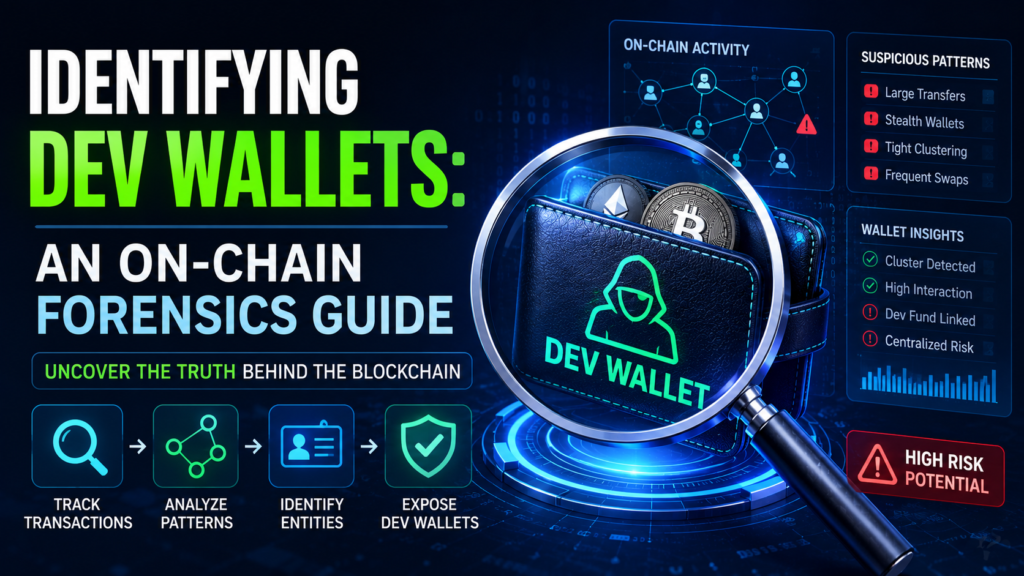
Every memecoin has a deployer. That deployer has a wallet. That wallet has a history. And if you know how to read that history, you already know more about a token’s risk profile than 95% of the traders buying it.
Developer wallet identification is one of the most practical on-chain skills a crypto trader can develop. It doesn’t require writing code. It doesn’t require premium subscriptions. It requires knowing where to look, what patterns mean danger, and how to connect the dots that a deployer hopes you won’t bother to find.
This guide walks through the complete forensic process from locating a deployer address to tracing its funding history, mapping linked wallets, checking its deployment track record, and arriving at a clear risk score before a single dollar is committed.
Why Dev Wallet Analysis Matters More Than Price Action
Price action is the last piece of information to move. By the time a chart shows you something useful, the dev wallet has already told you the full story. A token can be climbing 200% on a chart while its deployer is quietly distributing tokens into that very rally through three wallets that Bubblemaps already connected to the deployer address.
The fundamental insight is this: the deployer controls the origin of the token, and whoever controls the origin controls a structural information advantage over every retail buyer who follows. Dev wallet analysis is how you close that gap.
In 2026’s Solana memecoin market, where thousands of tokens launch daily on Pump.fun and Raydium, the majority are designed to extract value from retail buyers. Serial deployers operate repeat playbooks same tactics, different token names and their on-chain fingerprints are consistent and traceable if you know where to look.
The deployer doesn’t need to hold the token to be dangerous. Wallets funded by the deployer that appear as independent top holders represent the same risk as direct deployer holdings and they’re harder to spot without proper cluster analysis.
Step 1: Finding the Deployer Address
Every token contract has a creation transaction. That transaction is signed by the deployer wallet. Finding it takes under 60 seconds.
On Solana
Open Solscan and search the token’s mint address. Navigate to the token overview page. The ‘Mint Authority’ field, if not yet revoked, shows the deployer’s public key. Even if mint authority has been renounced, the program authority or the first transaction in the token’s history will still point back to the creating wallet. Alternatively, GMGN.ai and Birdeye both surface the deployer address on every token page without requiring you to navigate the raw blockchain data manually.
On Ethereum and EVM Chains
On Etherscan, search the contract address. The contract’s ‘Contract Creator’ field on the overview page shows the deployer address and the specific transaction hash of the deployment. One click on that address opens the full transaction history of the deployer wallet every contract deployment, every token interaction, and every fund movement that address has ever made.
What to Check First
Before anything else, check one question: does the deployer wallet currently hold any of the token? If the answer is yes and the percentage is above 2–3%, that is your most immediate risk signal. A deployer holding 5% or more of a token’s supply has a financial incentive to sell into any rally. That incentive doesn’t disappear because the chart looks healthy.
Step 2: Tracing the Funding Source
The deployer wallet had to receive funds from somewhere before it could deploy the token. Tracing where those funds came from is the second layer of forensic work, and it is where the most revealing information often hides.
On Solana, a brand-new deployer wallet funded from a fresh address the same day as the launch is a yellow flag. It suggests the operator is deliberately avoiding the use of an identifiable wallet either because they’re privacy-conscious (legitimate) or because the address has a history they don’t want associated with this launch (not legitimate).
The more damaging discovery is when a deployer wallet was funded from the same source address as several of the token’s top holders. This is the clearest possible evidence that the “independent” holders in the top 10 list are actually the same entity as the deployer controlled through a common funding source to create the appearance of organic distribution.
Arkham Intelligence is particularly effective for this trace. Enter the deployer address and look at the ‘Inflows’ section. If the same address that funded the deployer also funded wallets appearing as top holders, you have found a coordinated insider network.
On Ethereum, this analysis is slightly more complex because of mixer services and cross-chain bridges that can obscure origins. But most memecoin deployers on EVM chains are not sophisticated enough to use multi-hop obfuscation a simple one or two-hop trace on Etherscan reveals the funding relationship in the majority of cases.
Step 3: Mapping Linked Wallets with Bubblemaps
Once you have the deployer address, Bubblemaps does the cluster work for you. The platform’s visual map draws connecting lines between wallets that have transferred tokens to each other and its Magic Nodes feature uses AI to surface hidden connections between wallets that don’t have obvious on-chain links but share behavioral patterns suggesting common control.
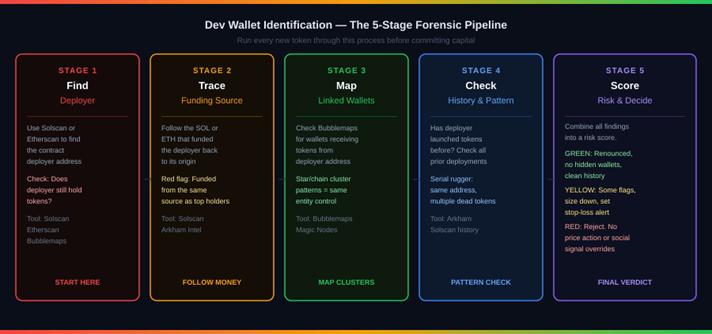
The complete 5-stage dev wallet forensic pipeline: Find Deployer → Trace Funding Source → Map Linked Wallets → Check Deployment History → Score Risk and Decide. Running all five stages takes under five minutes per token.
The two cluster patterns that indicate dev-controlled wallets:
- Star cluster: a central address (the deployer or a hub wallet) with transfer lines radiating outward to multiple surrounding wallets. Each of those outer wallets appears as an independent holder on the token list but received its tokens through the central hub. This is one entity presenting as many.
- Chain cluster: tokens passed from wallet A to wallet B to wallet C in a sequence, often to create distance between the deployer and the final holding address. The chain structure is designed to obscure origin, but Bubblemaps surfaces it by following the transfer history.
The total percentage held by a connected cluster is the true insider concentration figure not the individual wallet percentages that appear on a standard holder list. When Bubblemaps reveals that 10 wallets appearing as separate “top holders” are actually all connected to the deployer, their combined 45% holding is a single entity position, not 10 independent positions.
Step 4: Checking Deployment History
A deployer address that has launched tokens before has a track record. That track record is fully public and permanently readable on the blockchain.
On Solscan, navigate to the deployer address and look at its full transaction history filtered to contract creation events. Each prior token deployment is listed with its mint address, creation date, and current status. Follow each of those mint addresses to their token pages. What is the current market cap of each prior token? Are those tokens still trading or abandoned at near-zero? Did the deployer wallet sell its holdings in each case?
A deployer with a history of launching tokens that pump, then die with the deployer’s own wallet showing exits during the pump phases is a serial operator with a documented playbook. That playbook will almost certainly be applied again to the current token. Knowing this before entering is the difference between being the exit liquidity and finding the exit liquidity elsewhere.
DeFade.org provides deployer history lookup as a free feature: input any deployer address and it returns all tokens created by that address alongside their outcomes. This is the fastest way to check a deployer’s track record without manually tracing each prior deployment.
Step 5: Scoring Risk and Making the Decision
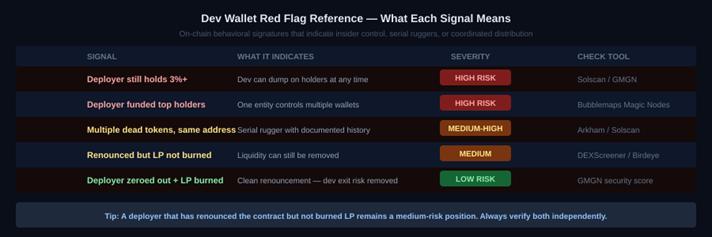
Dev wallet red flag reference table five key signals with severity ratings and the specific tool to use for each check. A token triggering the top two signals (deployer holds 3%+ and deployer funded top holders) should be rejected outright.
After running all four prior stages, the final step is converting the findings into a clear risk score. Here is the framework:
- Green (trade with normal sizing): deployer holds zero tokens, mint authority renounced, LP burned, no funding links between deployer and top holders, no prior failed deployments from the address
- Yellow (reduced sizing + stop-loss alert): deployer holds under 3%, LP not yet burned but renounced, one or two top holders share a funding source with deployer, one prior failed deployment
- Red (reject outright): deployer holds 5%+, deployer funded multiple top holders, multiple prior failed deployments with documented dev exits, LP withdrawable
A token that scores red should be rejected regardless of what the price chart shows, regardless of which KOLs are promoting it, and regardless of how strong the social narrative is. The on-chain structure is the underlying reality. Everything else is surface.
The Tools Required for This Process
Every stage of this forensic process can be completed with free tools:
- Solscan: deployer address lookup, token holder list, contract creation history on Solana
- Etherscan: same capabilities for Ethereum and EVM chains
- Bubblemaps: cluster visualization, Magic Nodes hidden connection detection, Bundle Checker
- Arkham Intelligence: entity labeling, funding source tracing, inflow/outflow analysis
- GMGN.ai: integrated security scoring with deployer holdings check
- DeFade.org: deployer history lookup across Solana token launches
None of these require a subscription for the core functionality needed to run the five-stage forensic process. The entire workflow can be built and executed at zero cost.
Why This Skill Compounds Over Time
There is something that experienced on-chain researchers notice after months of running this process: deployer patterns repeat. The same address structures, the same funding source relationships, the same cluster shapes appear again and again because the operators behind them are running proven playbooks.
Once you have identified a serial rugger’s address, every future token that wallet deploys is immediately flagged the moment it appears in your scanner. You develop a personal database of known-bad deployers that makes future analysis faster and more accurate.
Building that database and understanding the broader patterns of how capital flows through the memecoin ecosystem, how smart money identifies and avoids insider traps, and how on-chain forensics fits into a complete research methodology is exactly what the resource below covers in depth. It is the analytical context that makes every individual forensic check more meaningful.
The Limits of Dev Wallet Analysis
Complete honesty requires addressing what this process doesn’t catch.
Sophisticated operators use fresh wallets for every deployment, funded through privacy tools, with no prior history to trace. They distribute tokens through enough hops to make Bubblemaps clustering difficult. They time their exits over weeks rather than hours. These operations are harder to detect through standard forensics though they remain detectable with enough depth of analysis.
The five-stage process described here catches the vast majority of memecoin rug operations because most deployers are not that sophisticated. They reuse addresses. They fund their own top holder wallets from the same source. They leave obvious cluster patterns. They have documented histories of prior failed launches.
The forensic process doesn’t make every token safe. It removes the tokens that are obviously unsafe, quickly and reliably, before the price action that precedes a rug gives traders false confidence. That filtering function alone is worth the five minutes it takes to run.