



Introduction
Money has evolved dramatically throughout human history.
From bartering goods and precious metals to paper currencies and digital banking, every major innovation has changed how people store value, exchange wealth, and participate in the global economy.
Today, cryptocurrencies represent the latest chapter in that evolution.
Unlike traditional money issued by governments or managed by banks, cryptocurrencies operate using blockchain technology a decentralized system that enables secure, transparent, and borderless digital transactions.
Since the launch of Bitcoin in 2009, the cryptocurrency industry has expanded far beyond digital payments. Today, crypto powers decentralized finance (DeFi), NFTs, Web3 applications, blockchain gaming, artificial intelligence (AI), real-world asset tokenization (RWA), decentralized physical infrastructure networks (DePIN), and countless other innovations.
Whether you’ve heard about Bitcoin, Ethereum, Solana, or stablecoins, understanding cryptocurrency starts with learning the fundamentals.
This guide explains what crypto is, how it works, why it was created, the different types of cryptocurrencies, their real-world applications, benefits, risks, and the technologies shaping the future of digital finance.
Whether you’re completely new to crypto or looking to strengthen your knowledge, this guide provides a balanced, beginner-friendly introduction without investment advice or market speculation.
What Is Crypto?
Cryptocurrency (often shortened to crypto) is a form of digital money that uses cryptography to secure transactions and blockchain technology to record ownership and transfer value.
Unlike physical cash, cryptocurrencies exist only in digital form.
Instead of being issued or controlled by a central bank, cryptocurrencies typically operate on decentralized blockchain networks maintained by participants around the world.
These networks verify transactions according to predefined rules, helping ensure that digital assets cannot be duplicated or spent twice.
At its core, cryptocurrency enables people to send and receive digital assets directly over the internet.
Crypto Explained in Simple Terms
Imagine sending money to someone in another country.
Traditionally, that transaction may involve:
- A bank
- A payment processor
- Currency conversion
- Processing delays
- Service fees
With cryptocurrency, users can transfer digital assets directly between compatible wallets using blockchain networks.
The blockchain records the transaction, while the network verifies it without requiring a single central authority to approve every payment.
This peer-to-peer model is one of cryptocurrency’s defining characteristics.
Why Was Cryptocurrency Created?
Cryptocurrency was introduced to address some of the limitations associated with traditional financial systems.
Although different blockchain projects pursue different objectives, many share common goals such as improving transparency, accessibility, efficiency, and user control.
Some of the motivations behind cryptocurrency include:
- Reducing dependence on centralized intermediaries
- Enabling peer-to-peer transactions
- Increasing financial accessibility
- Improving transaction transparency
- Supporting programmable digital assets
- Facilitating global value transfer
It is important to note that cryptocurrencies do not seek to replace every aspect of traditional finance. Instead, they offer an alternative financial infrastructure that can coexist with existing systems.
A Brief History of Cryptocurrency
Although digital money concepts existed for decades, the modern cryptocurrency era began in 2009 with the launch of Bitcoin.
Bitcoin introduced a decentralized payment network where transactions could be verified through a distributed blockchain rather than a central institution.
As blockchain technology matured, developers began expanding its capabilities.
The years that followed saw the emergence of platforms supporting:
- Smart contracts
- Decentralized applications (dApps)
- Stablecoins
- NFTs
- DeFi
- Layer-2 scaling
- Web3
- AI-powered blockchain applications
Today, the cryptocurrency ecosystem includes thousands of digital assets and a wide variety of blockchain networks serving different purposes.
Cryptocurrency vs Traditional Money
Although both are used to transfer value, cryptocurrency differs from traditional money in several important ways.
| Feature | Cryptocurrency | Traditional Money |
|---|---|---|
| Form | Digital | Physical & Digital |
| Issuer | Typically decentralized networks | Central banks |
| Transactions | Blockchain | Banking systems |
| Availability | 24/7 | Depends on banking infrastructure |
| Transparency | Public blockchain records | Private institutional records |
| Programmability | Smart contracts | Limited |
Neither system is universally better.
Instead, each offers different advantages depending on the use case.
Common Characteristics of Cryptocurrency
Most cryptocurrencies share several core characteristics.
Digital
Cryptocurrencies exist electronically rather than physically.
Ownership is represented through blockchain records rather than paper notes or coins.
Cryptographically Secured
Advanced cryptographic techniques help secure transactions and protect ownership.
This security model is one reason cryptocurrencies are referred to as cryptographic currencies.
Blockchain-Based
Most cryptocurrencies operate using blockchain technology.
The blockchain records every transaction while maintaining a shared history across participating network nodes.
Decentralized
Many cryptocurrencies operate without relying on a single central authority.
Instead, independent participants help maintain the network through consensus mechanisms.
The degree of decentralization varies between blockchain projects.
Transparent
Public blockchains allow anyone to verify transactions using blockchain explorers.
While wallet addresses are visible, personal identities are generally not embedded directly into blockchain records.
What Can Cryptocurrency Be Used For?
Modern cryptocurrencies support much more than digital payments.
Common applications include:
- Peer-to-peer transfers
- Cross-border payments
- Online commerce
- Decentralized Finance (DeFi)
- NFT ownership
- Blockchain gaming
- AI-powered applications
- Digital identity
- Supply chain management
- Real-world asset tokenization
- Community governance
As blockchain technology evolves, new applications continue emerging across multiple industries.
Why Understanding Crypto Matters
Even if you never purchase cryptocurrency, understanding how it works is becoming increasingly valuable.
Blockchain technology is influencing sectors such as:
- Finance
- Payments
- Healthcare
- Logistics
- Gaming
- Digital identity
- Artificial intelligence
- Asset tokenization
Governments, businesses, startups, and educational institutions continue researching blockchain applications beyond cryptocurrency itself.
Learning the fundamentals helps readers distinguish practical innovation from misinformation or market hype.
Key Takeaways
- Cryptocurrency is digital money secured by cryptography and powered by blockchain technology.
- Unlike traditional currencies, many cryptocurrencies operate through decentralized networks rather than central banks.
- Crypto enables peer-to-peer value transfer, programmable assets, and decentralized applications.
- Since Bitcoin’s launch in 2009, the crypto ecosystem has expanded into DeFi, NFTs, AI, gaming, Web3, and tokenized real-world assets.
- Understanding cryptocurrency begins with understanding blockchain, wallets, transactions, and consensus mechanisms.
How Cryptocurrency Works – Blockchain, Wallets, Mining, and Transactions Explained
Understanding what cryptocurrency is becomes much easier once you know how it actually works behind the scenes.
Although crypto may seem complicated at first, the underlying process follows a logical sequence. Every cryptocurrency transaction relies on blockchain technology, cryptographic security, network participants, and consensus mechanisms working together to verify and record digital transfers.
Unlike traditional banking systems, where a central institution validates transactions, cryptocurrency networks distribute this responsibility across thousands of independent computers around the world.
This decentralized design is one of blockchain’s defining innovations.
How Does Cryptocurrency Work?
At its core, cryptocurrency operates through a decentralized blockchain network.
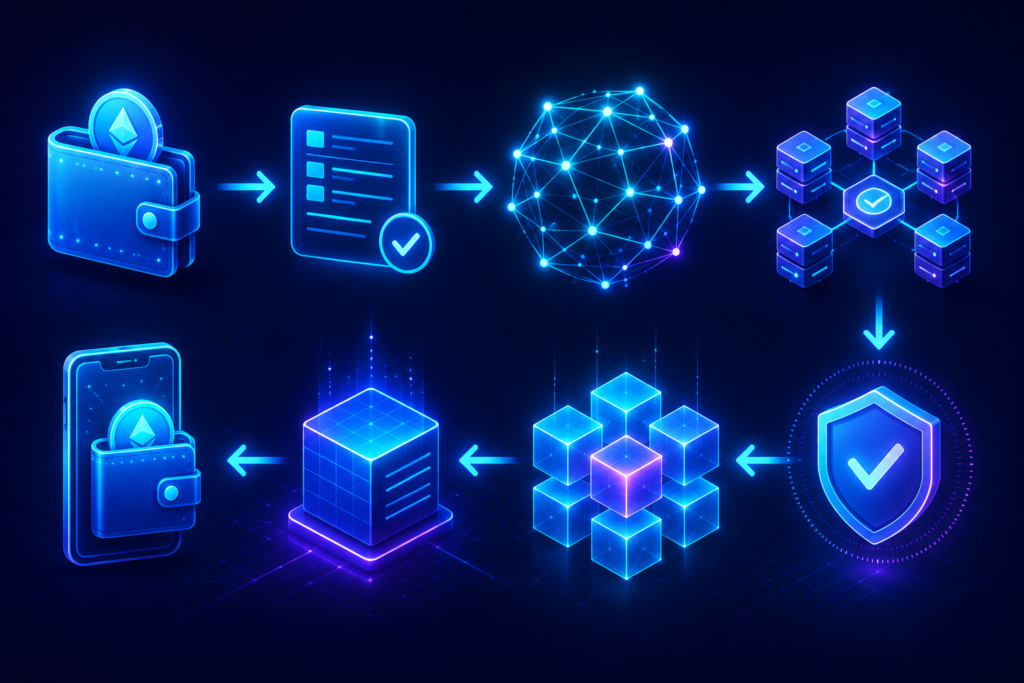
Whenever someone sends cryptocurrency, the transaction follows a series of steps before becoming permanently recorded.
A simplified workflow looks like this:
- The sender creates a transaction.
- The transaction is digitally signed using a private key.
- The blockchain network receives the transaction.
- Network participants verify its validity.
- Once approved, the transaction is added to the blockchain.
- The recipient’s wallet reflects the updated balance.
Unlike traditional financial systems, there is no central organization approving each payment.
What Is Blockchain?
A blockchain is a distributed digital ledger that records transactions in chronological order.
Instead of storing information on a single server, identical copies of the blockchain exist across many computers (known as nodes) worldwide.
Each block contains:
- Transaction data
- Timestamp
- Cryptographic hash
- Reference to the previous block
Because every block links to the one before it, changing historical records becomes extremely difficult.
This chain of connected blocks gives blockchain its name.
Why Is Blockchain Important?
Blockchain provides several key advantages:
- Transparency
- Security
- Tamper resistance
- Decentralization
- Global accessibility
Rather than relying on trust in one institution, blockchain allows participants to verify transactions collectively.
What Are Public and Private Keys?
Cryptocurrency ownership is managed using cryptographic keys.
Every wallet contains two essential components.
Public Key
A public key works similarly to an account number.
It can be shared with others so they can send cryptocurrency to your wallet.
Private Key
A private key is comparable to a digital signature.
It proves ownership of your cryptocurrency and authorizes transactions.
Private keys should never be shared.
Anyone with access to a private key can control the associated assets.
Simple Comparison
| Public Key | Private Key |
|---|---|
| Can be shared | Must remain secret |
| Receives funds | Authorizes spending |
| Similar to an account number | Similar to a password or signature |
What Is a Crypto Wallet?
A cryptocurrency wallet is software or hardware that manages your cryptographic keys.
Contrary to popular belief, wallets do not store cryptocurrencies themselves.
Instead, they allow users to:
- Access blockchain assets
- Sign transactions
- Manage multiple cryptocurrencies
- Connect to decentralized applications
- View balances
- Interact with smart contracts
The blockchain always maintains the official ownership records.
Types of Crypto Wallets
Hot Wallets
Connected to the internet.
Examples include:
- Mobile wallets
- Browser extension wallets
- Desktop wallets
Advantages:
- Easy access
- Convenient for everyday use
- Supports decentralized applications
Cold Wallets
Remain offline until needed.
Examples include:
- Hardware wallets
- Paper backups
Advantages:
- Enhanced security
- Reduced online exposure
- Suitable for long-term storage
Custodial Wallets
Managed by third-party service providers.
Users typically rely on the provider to safeguard their private keys.
Non-Custodial Wallets
Users control their own private keys.
This provides greater control but also greater responsibility.
How Crypto Transactions Work
Whenever cryptocurrency is sent from one wallet to another, the blockchain follows a structured verification process.
Step 1 – Transaction Created
The sender enters the recipient’s wallet address and the amount to transfer.
Step 2 – Digital Signature
The wallet uses the sender’s private key to sign the transaction.
This proves ownership without revealing the private key itself.
Step 3 – Network Broadcast
The signed transaction is broadcast across the blockchain network.
Step 4 – Verification
Validators or miners verify:
- Ownership
- Available balance
- Transaction format
- Network rules
Step 5 – Confirmation
After verification, the transaction becomes part of a newly created block.
Step 6 – Blockchain Update
The recipient’s wallet reflects the updated balance after the transaction is confirmed.
What Are Consensus Mechanisms?
Blockchain networks require a method for agreeing on which transactions are valid.
This process is known as consensus.
Consensus mechanisms prevent fraudulent activity while ensuring every participant shares the same version of the blockchain.
Different blockchain networks use different consensus models.
The two most common are:
- Proof of Work (PoW)
- Proof of Stake (PoS)
Proof of Work (PoW)
Proof of Work relies on specialized computers solving complex mathematical problems.
Participants who perform this work are called miners.
Bitcoin is the most well-known blockchain using Proof of Work.
Characteristics
- High security
- Energy-intensive
- Mining competition
- Strong decentralization
Proof of Stake (PoS)
Proof of Stake selects validators based on the amount of cryptocurrency they commit (or stake) to help secure the network.
Many modern blockchain networks including Ethereum (after its transition to PoS) and Solana—use staking-based consensus models.
Characteristics
- Energy efficient
- Faster block production
- Lower hardware requirements
- Broad validator participation
Mining vs Staking
| Proof of Work | Proof of Stake |
| Uses miners | Uses validators |
| Computational work | Staked assets |
| Higher energy usage | Lower energy usage |
| Example: Bitcoin | Examples: Solana, Ethereum |
What Is Mining?
Mining is the process of verifying blockchain transactions through computational work.
Miners compete to add new blocks to the blockchain.
Successful participants receive protocol-defined rewards according to network rules.
Mining contributes to:
- Network security
- Transaction verification
- Block creation
- Blockchain maintenance
What Is Staking?
Staking allows eligible participants to help secure blockchain networks by committing digital assets.
Validators participate in transaction verification according to the network’s consensus mechanism.
Depending on the blockchain, staking may also support governance and ecosystem participation.
Why Is Cryptocurrency Secure?
Cryptocurrency security depends on several technologies working together.
These include:
- Cryptography
- Distributed blockchain records
- Consensus mechanisms
- Digital signatures
- Network validation
- Public verification
No technology is completely risk-free, but these systems are designed to make unauthorized alterations extremely difficult.
Key Takeaways
- Cryptocurrency transactions are verified by decentralized blockchain networks rather than a central authority.
- Blockchain records transactions in a secure, transparent, and tamper-resistant ledger shared across many computers.
- Public keys receive cryptocurrency, while private keys authorize transactions and must remain confidential.
- Crypto wallets manage cryptographic keys rather than storing digital assets directly.
- Consensus mechanisms such as Proof of Work and Proof of Stake help maintain blockchain security and verify transactions.
- Mining and staking are different approaches to securing blockchain networks, each with its own characteristics.
- Understanding blockchain, wallets, transactions, and consensus provides the foundation for exploring the broader cryptocurrency ecosystem.
Types of Cryptocurrencies – Understanding the Different Categories of Digital Assets
When many people hear the word cryptocurrency, they immediately think of Bitcoin.
While Bitcoin is the world’s first and most recognized cryptocurrency, it represents only one part of a much larger digital asset ecosystem.
Today, thousands of cryptocurrencies exist, each designed with different goals and use cases. Some function as digital money, while others power decentralized applications, enable governance, support blockchain gaming, facilitate cross-border payments, or provide stable value.
Understanding these categories helps beginners better navigate the crypto industry and appreciate how different blockchain networks contribute to the broader Web3 ecosystem.
What Are the Different Types of Cryptocurrencies?
Although thousands of cryptocurrencies exist, most can be grouped into several major categories based on their purpose rather than their popularity.
The primary categories include:
- Payment Cryptocurrencies
- Platform Cryptocurrencies
- Stablecoins
- Utility Tokens
- Governance Tokens
- Meme Coins
- Privacy Coins
- Central Bank Digital Currencies (CBDCs)
Each category plays a different role within the cryptocurrency ecosystem.
1. Payment Cryptocurrencies
Payment cryptocurrencies are designed primarily to transfer value between users.
Their main objective is enabling secure, peer-to-peer digital payments without requiring traditional financial intermediaries.
Characteristics include:
- Digital value transfer
- Borderless payments
- Public blockchain transactions
- Decentralized verification
The most well-known example is Bitcoin, which introduced decentralized digital money through blockchain technology.
Payment-focused cryptocurrencies continue to be used for international transfers, online payments, and digital asset settlements.
Bitcoin: The First Cryptocurrency
Bitcoin was introduced in 2009 and marked the beginning of the modern cryptocurrency industry.
It demonstrated that decentralized digital money could operate without a central bank or payment processor.
Bitcoin is often discussed in relation to:
- Digital scarcity
- Peer-to-peer payments
- Store of value
- Blockchain security
- Decentralized monetary systems
While Bitcoin remains the largest cryptocurrency by market recognition, it represents only one part of today’s blockchain ecosystem.
2. Platform Cryptocurrencies
Platform cryptocurrencies support blockchain ecosystems capable of running decentralized applications (dApps) and smart contracts.
Rather than functioning only as payment systems, these networks provide infrastructure for developers.
Examples include blockchain platforms supporting:
- DeFi
- NFTs
- Gaming
- AI
- Tokenization
- Web3 applications
Well-known examples include Ethereum and Solana, each supporting extensive developer ecosystems.
Why Platform Coins Matter
Platform cryptocurrencies typically serve multiple purposes, such as:
- Paying transaction fees
- Executing smart contracts
- Staking
- Supporting decentralized applications
- Securing blockchain networks
Their value comes from enabling blockchain ecosystems rather than acting solely as digital currencies.
3. Stablecoins
Unlike many cryptocurrencies that experience significant price fluctuations, stablecoins are designed to maintain relatively stable values.
Different stablecoins use different mechanisms, including:
- Fiat-backed reserves
- Crypto-backed collateral
- Algorithmic approaches
Stablecoins are widely used for:
- Trading
- Payments
- International transfers
- Treasury management
- DeFi
- Liquidity
Because they aim to reduce volatility, stablecoins often serve as an important bridge between traditional finance and blockchain ecosystems.
4. Utility Tokens
Utility tokens provide access to specific products or services within blockchain ecosystems.
Rather than representing ownership in a company, they are generally used to interact with decentralized applications.
Examples of utility functions include:
- Paying transaction fees
- Accessing premium features
- Purchasing digital assets
- Using decentralized services
- Participating in blockchain applications
Utility tokens derive their usefulness from the services they enable.
5. Governance Tokens
Governance tokens allow eligible community members to participate in decentralized decision-making.
Depending on the protocol, token holders may vote on matters such as:
- Protocol upgrades
- Treasury allocations
- Governance proposals
- Ecosystem initiatives
Governance models vary significantly across blockchain projects.
These systems illustrate how decentralized communities can collectively participate in protocol development.
6. Meme Coins
Meme coins are cryptocurrencies inspired by internet culture, humor, or online communities.
Many begin as community-driven projects and rely heavily on social engagement.
Characteristics often include:
- Strong online communities
- Viral marketing
- High trading activity
- Community participation
While some meme coin projects continue expanding their ecosystems, others remain primarily community-focused.
Because market conditions can change rapidly, users should carefully research any project before participating.
7. Privacy Coins
Most public blockchains make transaction information visible through blockchain explorers.
Privacy-focused cryptocurrencies aim to provide additional confidentiality features for users.
Potential objectives include:
- Enhanced transaction privacy
- Reduced traceability
- Improved financial confidentiality
Different privacy-focused cryptocurrencies use different cryptographic techniques to achieve these goals.
Regulatory treatment of privacy-focused digital assets varies across jurisdictions.
8. Central Bank Digital Currencies (CBDCs)
Unlike decentralized cryptocurrencies, Central Bank Digital Currencies (CBDCs) are digital forms of national currencies issued by central banks.
Their objectives may include:
- Modernizing payment systems
- Supporting digital transactions
- Improving settlement efficiency
CBDCs differ fundamentally from decentralized cryptocurrencies because they remain centrally managed by government authorities.
Coin vs Token
Many beginners use the terms coin and token interchangeably, but they represent different concepts.
Coins
Coins operate on their own blockchain.
Examples include:
- Bitcoin
- Ethereum
- Solana
They typically help secure their respective blockchain networks and pay transaction fees.
Tokens
Tokens are created on existing blockchains rather than operating independent networks.
They often support:
- DeFi
- NFTs
- Gaming
- Governance
- Utility services
A blockchain may host thousands of different tokens.
Comparison Table
| Coins | Tokens |
|---|---|
| Operate on their own blockchain | Built on an existing blockchain |
| Secure the network | Support applications and ecosystems |
| Used for transaction fees | Often provide utility or governance |
| Examples: Bitcoin, Ethereum, Solana | Thousands of ecosystem-specific tokens |
Which Type of Cryptocurrency Is Right for Beginners?
Every category serves a different purpose.
Beginners should first understand how each category works before focusing on individual projects.
For example:
| Category | Primary Purpose |
| Payment Coins | Digital payments |
| Platform Coins | Blockchain infrastructure |
| Stablecoins | Stable digital value |
| Utility Tokens | Access blockchain services |
| Governance Tokens | Community voting |
| Meme Coins | Community participation |
| Privacy Coins | Transaction confidentiality |
| CBDCs | Government-issued digital currency |
Education provides a stronger foundation than simply recognizing project names.
Key Takeaways
- Cryptocurrencies can be grouped into several categories based on their purpose, including payment coins, platform coins, stablecoins, utility tokens, governance tokens, meme coins, privacy coins, and CBDCs.
- Bitcoin introduced decentralized digital money, while platform blockchains such as Ethereum and Solana enable smart contracts and decentralized applications.
- Stablecoins aim to reduce price volatility, while utility and governance tokens support blockchain ecosystems and community participation.
- Coins operate on their own blockchain, whereas tokens are built on existing blockchain networks.
- Understanding the function of different cryptocurrency categories provides a stronger foundation than focusing solely on individual projects or market trends.
- As the blockchain industry continues to evolve, these categories increasingly work together to support decentralized finance, Web3, digital ownership, and many other real-world applications.
The Crypto Ecosystem – DeFi, NFTs, Web3, AI, Layer-1, Layer-2, RWA, DePIN and Blockchain Gaming
Cryptocurrency is often the first thing people discover when they enter the blockchain industry. However, digital currencies represent only one part of a much larger ecosystem.
Over the past decade, blockchain technology has evolved into an interconnected network of decentralized applications, financial services, digital ownership platforms, developer tools, artificial intelligence, tokenized assets, and entirely new internet experiences collectively known as Web3.
Today, the crypto ecosystem includes thousands of projects working together across different sectors. While each category has its own purpose, they all rely on blockchain technology as their common foundation.
Understanding how these sectors connect helps readers see the bigger picture of cryptocurrency beyond buying and selling digital assets.
What Is the Crypto Ecosystem?
The crypto ecosystem refers to the complete network of blockchain technologies, decentralized applications, infrastructure providers, wallets, developers, businesses, and users that interact across cryptocurrency networks.
Rather than existing as isolated projects, these technologies work together to create decentralized digital economies.
The ecosystem includes:
- Blockchain Networks
- Cryptocurrencies
- Wallets
- DeFi Platforms
- NFT Marketplaces
- Web3 Applications
- AI Crypto
- Gaming
- Stablecoins
- Layer-2 Solutions
- RWA Platforms
- DePIN Networks
- Developer Infrastructure
Each component plays a unique role while supporting the growth of the broader blockchain industry.
What Is Web3?
Web3 refers to the next generation of internet applications powered by blockchain technology.
Traditional websites usually store user data on centralized servers controlled by companies.
Web3 applications explore decentralized alternatives where users interact with blockchain networks through crypto wallets rather than traditional accounts.
Common characteristics include:
- Digital ownership
- Decentralized applications (dApps)
- Smart contracts
- Token-based economies
- Community governance
- Interoperability
Instead of replacing today’s internet, Web3 expands how digital services can be built and accessed.
How Web3 Differs from Earlier Internet Models
| Web1 | Web2 | Web3 |
|---|---|---|
| Read | Read & Write | Read, Write & Own |
| Static websites | Social media & apps | Decentralized applications |
| Limited interaction | Platform-owned content | User-owned digital assets |
| Few creators | Content creators | Community participation |
What Is DeFi?
Decentralized Finance (DeFi) refers to blockchain-based financial applications that operate through smart contracts.
Rather than relying entirely on banks or financial institutions, DeFi protocols allow users to access financial services directly through blockchain networks.
Examples include:
- Token swaps
- Lending
- Borrowing
- Liquidity pools
- Staking
- Yield optimization
- Stablecoin services
DeFi demonstrates how financial services can be automated using programmable blockchain infrastructure.
Why DeFi Matters
DeFi has become one of blockchain’s largest sectors because it expands the utility of cryptocurrencies beyond simple payments.
Instead of only holding digital assets, users can interact with a wide range of decentralized financial applications.
What Are NFTs?
Non-Fungible Tokens (NFTs) are blockchain-based digital assets representing unique ownership.
Unlike cryptocurrencies, which are generally interchangeable, every NFT has unique characteristics.
Although NFTs first became popular through digital artwork, their applications have expanded significantly.
Examples include:
- Digital collectibles
- Gaming assets
- Music rights
- Event tickets
- Memberships
- Intellectual property
- Academic certificates
- Digital identity
NFTs illustrate how blockchain can verify ownership of both digital and physical assets.
What Is AI Crypto?
Artificial intelligence and blockchain increasingly intersect within modern crypto ecosystems.
AI crypto projects explore applications such as:
- AI agents
- Decentralized computing
- Intelligent automation
- AI marketplaces
- Machine learning infrastructure
Blockchain provides transparency and decentralized coordination, while AI contributes automation and decision support.
Together, they enable new categories of Web3 applications.
Layer-1 Blockchains
Layer-1 blockchains are the foundational networks where transactions are processed and recorded.
Examples include:
- Bitcoin
- Ethereum
- Solana
Layer-1 networks provide:
- Consensus
- Security
- Smart contract execution
- Digital asset ownership
Every decentralized application ultimately depends on an underlying blockchain.
Layer-2 Solutions
As blockchain usage grows, some networks introduce additional scaling layers.
Layer-2 solutions help improve:
- Transaction capacity
- Network efficiency
- User experience
Rather than replacing Layer-1 blockchains, they complement existing infrastructure.
Examples include payment channels, rollups, and other scaling technologies.
Stablecoins
Stablecoins play an essential role within the crypto ecosystem.
Because many aim to maintain relatively stable values, they are commonly used for:
- Payments
- Trading
- Treasury management
- International transfers
- DeFi liquidity
Stablecoins often connect traditional financial systems with blockchain applications.
Real-World Assets (RWA)
Real-world asset tokenization involves representing traditional assets on blockchain networks.
Examples include:
- Government bonds
- Treasury products
- Real estate
- Commodities
- Investment funds
Potential benefits include:
- Faster settlement
- Fractional ownership
- Greater transparency
- Digital record keeping
RWA tokenization continues attracting interest from financial institutions and technology companies.
Decentralized Physical Infrastructure Networks (DePIN)
DePIN projects coordinate physical infrastructure using blockchain technology.
Examples include:
- Wireless connectivity
- Cloud computing
- GPU marketplaces
- Mapping services
- Energy infrastructure
Instead of relying solely on centralized providers, participants contribute physical resources while blockchain coordinates incentives and participation.
Why DePIN Is Important
DePIN extends blockchain beyond software by connecting digital incentives with real-world infrastructure.
This demonstrates how blockchain technology can influence industries beyond finance.
Blockchain Gaming
Gaming represents one of Web3’s fastest-growing sectors.
Blockchain games introduce:
- Player-owned assets
- NFT collectibles
- Tokenized economies
- Community marketplaces
- Digital ownership
Instead of purchasing in-game items controlled entirely by a centralized publisher, blockchain allows players to own certain digital assets directly.
Developers continue exploring different approaches to balancing gameplay with blockchain functionality.
How Everything Connects
One of blockchain’s greatest strengths is interoperability.
A user may:
- Store cryptocurrency in a wallet.
- Swap tokens through DeFi.
- Purchase an NFT.
- Play a blockchain game.
- Use an AI-powered application.
- Send stablecoins internationally.
- Access Web3 services.
all using the same blockchain ecosystem.
This interconnected design allows different technologies to work together rather than operating independently.
Crypto Ecosystem Overview
| Sector | Primary Purpose |
| Cryptocurrency | Digital value transfer |
| Blockchain | Shared ledger |
| Wallets | Asset management |
| DeFi | Financial services |
| NFTs | Digital ownership |
| AI Crypto | Intelligent blockchain applications |
| Web3 | Decentralized internet |
| Stablecoins | Stable digital payments |
| RWA | Tokenized assets |
| DePIN | Physical infrastructure |
| Gaming | Interactive digital economies |
Key Takeaways
- Cryptocurrency is only one part of a much broader blockchain ecosystem.
- Web3 expands the internet by enabling decentralized applications and digital ownership.
- DeFi, NFTs, AI, stablecoins, RWA, DePIN, and blockchain gaming each represent major sectors within the crypto industry.
- Layer-1 and Layer-2 technologies work together to support scalable blockchain networks.
- The strength of the crypto ecosystem comes from interoperability, allowing multiple technologies and applications to interact seamlessly.
- Understanding how these sectors connect provides a more complete picture of blockchain’s growing role across finance, technology, and digital services.
Real-World Uses of Cryptocurrency, Benefits, Risks, Security, and Common Scams
For many people, cryptocurrency is associated with buying and selling digital assets. However, blockchain technology has expanded far beyond trading.
Today, cryptocurrencies support payment systems, decentralized finance, digital ownership, business operations, charitable donations, gaming, supply chain management, and many other real-world applications.
Understanding these practical uses provides a more balanced perspective on cryptocurrency and helps separate everyday utility from short-term market narratives.
Real-World Uses of Cryptocurrency
As blockchain technology continues to mature, cryptocurrencies are being integrated into an increasing number of industries.
Below are some of the most common applications.
1. Digital Payments
One of cryptocurrency’s earliest and most widely recognized use cases is digital payments.
Instead of relying exclusively on traditional payment networks, blockchain allows users to transfer digital assets directly between compatible wallets.
Potential applications include:
- Online purchases
- Merchant payments
- International transactions
- Freelance payments
- Peer-to-peer transfers
Businesses that choose to accept cryptocurrency can expand payment options for customers, although adoption varies by region and regulatory environment.
2. Cross-Border Transfers
International money transfers have traditionally involved multiple financial institutions, currency conversions, and settlement delays.
Blockchain networks enable digital asset transfers across borders without requiring the same infrastructure as conventional payment systems.
Potential benefits include:
- Faster settlement
- Global accessibility
- Digital transactions
- Reduced dependence on intermediaries
Actual transfer times and costs depend on the blockchain network being used.
3. Decentralized Finance (DeFi)
Cryptocurrency serves as the foundation for decentralized financial services.
Users can access blockchain-based applications offering:
- Lending
- Borrowing
- Trading
- Liquidity provision
- Staking
- Stablecoin services
Rather than replacing traditional finance, DeFi introduces additional ways to interact with digital assets through programmable smart contracts.
4. Digital Ownership
Blockchain enables verifiable ownership of digital assets.
Examples include:
- NFTs
- Digital collectibles
- Virtual land
- Gaming assets
- Music rights
- Membership passes
Ownership records are maintained on the blockchain, making transfers transparent and verifiable.
5. Supply Chain Management
Supply chains often involve multiple organizations operating across different regions.
Blockchain technology may improve transparency by recording product movement throughout the supply chain.
Potential applications include:
- Product authentication
- Shipment tracking
- Inventory management
- Manufacturing records
- Food traceability
These systems may help businesses improve operational visibility and accountability.
6. Healthcare
Healthcare organizations are exploring blockchain for secure data management.
Potential applications include:
- Medical records
- Prescription tracking
- Research collaboration
- Patient consent management
- Pharmaceutical supply chains
Blockchain can improve record integrity while supporting controlled data sharing.
7. Education
Educational institutions are experimenting with blockchain-based credential systems.
Possible applications include:
- Academic certificates
- Professional certifications
- Digital diplomas
- Lifelong learning records
Blockchain verification can simplify credential authentication.
8. Identity Management
Digital identity remains an important area of blockchain development.
Potential blockchain applications include:
- Identity verification
- Secure authentication
- Credential management
- Reputation systems
These approaches aim to provide users with greater control over their digital identities.
9. Charitable Donations
Cryptocurrency enables organizations to receive donations from supporters around the world.
Potential advantages include:
- Borderless contributions
- Transparent transaction records
- Digital transfers
- Faster settlement
Many nonprofit organizations continue exploring blockchain as an additional fundraising option.
10. Business and Enterprise Applications
Businesses continue researching blockchain technology across multiple industries.
Examples include:
- Asset tokenization
- Financial reporting
- Payment systems
- Customer loyalty programs
- Digital contracts
- Cross-border settlements
Enterprise adoption varies by organization, industry, and regulatory requirements.
Benefits of Cryptocurrency
Like every technology, cryptocurrency offers both advantages and limitations.
Some commonly discussed benefits include:
Global Accessibility
Anyone with internet access and a compatible wallet can interact with many blockchain networks.
Transparency
Public blockchains record transactions in a verifiable ledger.
User Control
Many blockchain systems allow users to manage their own digital assets without relying entirely on intermediaries.
Programmability
Smart contracts automate many blockchain applications.
Innovation
Cryptocurrency has enabled entirely new sectors including:
- DeFi
- NFTs
- Web3
- AI Crypto
- Tokenized Assets
- Blockchain Gaming
Continuous Availability
Many blockchain networks operate continuously without traditional business hours.
Risks of Cryptocurrency
Balanced research also requires understanding the challenges.
Price Volatility
Many cryptocurrencies experience significant price fluctuations.
This volatility may affect users, businesses, and investors differently depending on how cryptocurrencies are being used.
Regulatory Changes
Governments continue developing policies related to digital assets.
Regulatory approaches differ significantly across jurisdictions.
Security Risks
Although blockchain networks themselves are designed with strong security principles, users may still face risks from:
- Phishing
- Malware
- Fake websites
- Scam applications
Practicing good cybersecurity habits remains essential.
Smart Contract Risk
Blockchain applications depend on software.
Programming errors or vulnerabilities may affect decentralized applications.
Many projects conduct security audits, but no software can guarantee complete protection.
Human Error
Sending cryptocurrency to an incorrect wallet address or losing access to recovery phrases may result in permanent loss of access.
Careful verification is important before every transaction.
Common Cryptocurrency Scams
As cryptocurrency adoption has grown, scammers have developed increasingly sophisticated methods.
Understanding these scams helps users reduce unnecessary risk.
Phishing
Fake websites or emails designed to steal wallet credentials.
Fake Giveaways
Scammers promise free cryptocurrency in exchange for an upfront payment.
Legitimate organizations generally do not require users to send funds to receive larger amounts in return.
Rug Pulls
Projects abandon development after attracting user funds.
Researching project transparency, documentation, and community activity can help users better understand potential risks.
Ponzi Schemes
Returns funded primarily through new participant contributions rather than sustainable business activity.
Fake Wallet Applications
Fraudulent wallet software designed to steal recovery phrases or private keys.
Always download wallets from official sources.
Impersonation
Scammers pretend to represent exchanges, wallet providers, or customer support teams.
Never share your recovery phrase or private keys with anyone claiming to offer assistance.
Cryptocurrency Security Best Practices
Good security habits are one of the most valuable skills for every crypto user.
Consider the following best practices:
Protect Your Recovery Phrase
Store it offline.
Never share it.
Enable Two-Factor Authentication
Whenever supported by exchanges or services.
Verify Website Addresses
Bookmark official websites instead of clicking unknown links.
Research Projects Carefully
Review documentation, development activity, and community information before interacting with new applications.
Keep Software Updated
Wallets and operating systems should be updated regularly.
Start Small
Beginners often benefit from learning blockchain through small transactions before exploring more advanced applications.
Key Takeaways
- Cryptocurrency has evolved beyond digital payments into a broader technology supporting finance, identity, gaming, education, healthcare, and enterprise applications.
- Blockchain enables new forms of digital ownership, decentralized finance, and global value transfer.
- Benefits include transparency, accessibility, programmability, and continuous network availability.
- Risks include volatility, regulatory uncertainty, smart contract vulnerabilities, security threats, and user error.
- Understanding common scams and following strong security practices helps users interact with blockchain technology more safely.
- Long-term success in the crypto ecosystem begins with education, careful research, and responsible security habits.
Cryptocurrency FAQs, Common Myths, Future Trends, and Conclusion
By now, you’ve learned what cryptocurrency is, how blockchain works, the different types of digital assets, the broader crypto ecosystem, real-world use cases, benefits, risks, and essential security practices.
The final section answers the most common beginner questions, clears up widespread misconceptions, explores where the industry may be heading, and summarizes everything covered throughout this guide.
Whether you’re planning to use cryptocurrency for payments, explore decentralized applications, or simply stay informed about emerging technologies, building a solid understanding of the fundamentals is the best place to start.
Common Myths About Cryptocurrency
The rapid growth of cryptocurrency has led to widespread misunderstandings. Separating facts from myths helps beginners develop a balanced understanding of the industry.
Myth 1: Cryptocurrency Is Anonymous
Many people believe every crypto transaction is completely anonymous.
Reality
Most cryptocurrencies operate on public blockchains, where transactions can be viewed through blockchain explorers.
While wallet addresses don’t automatically reveal personal identities, transaction histories are generally transparent.
Some cryptocurrencies include additional privacy features, but not all blockchains offer the same level of confidentiality.
Myth 2: Cryptocurrency Is Only Used for Investing
Price movements often dominate headlines, creating the impression that cryptocurrency exists only for trading.
Reality
Blockchain technology supports a wide range of applications, including:
- Digital payments
- Decentralized Finance (DeFi)
- NFTs
- Gaming
- AI
- Supply chain tracking
- Identity management
- Real-world asset tokenization
- Enterprise applications
Investing is only one aspect of a much broader ecosystem.
Myth 3: Bitcoin and Cryptocurrency Are the Same Thing
Bitcoin is frequently used as a synonym for cryptocurrency.
Reality
Bitcoin is the first cryptocurrency, but today thousands of digital assets exist across different blockchain networks.
Each blockchain ecosystem serves different purposes and supports different applications.
Myth 4: Cryptocurrency Is Not Regulated Anywhere
Some people assume crypto operates completely outside legal frameworks.
Reality
Many countries have introduced regulations covering exchanges, taxation, licensing, consumer protection, and anti-money laundering requirements.
Regulatory approaches continue to evolve worldwide.
Myth 5: Blockchain Cannot Be Hacked
Blockchain technology is highly secure, but no technology is completely immune to risk.
Reality
Many security incidents involve:
- Phishing attacks
- Compromised wallets
- Smart contract vulnerabilities
- Fake websites
- Human error
Practicing good security habits remains essential.
Myth 6: Cryptocurrency Will Replace Traditional Money
Some discussions present crypto as a direct replacement for national currencies.
Reality
Many experts view blockchain as a complementary financial technology rather than a complete replacement for existing systems.
Traditional finance and blockchain increasingly coexist through payment integrations, tokenization, and digital asset services.
The Future of Cryptocurrency
Although no one can predict exactly how the industry will evolve, several long-term trends continue shaping blockchain innovation.
Institutional Adoption
Banks, payment companies, investment firms, and technology providers continue exploring blockchain applications.
Areas of interest include:
- Digital asset custody
- Tokenized securities
- Cross-border payments
- Stablecoins
- Financial infrastructure
Institutional participation may contribute to broader adoption over time.
Artificial Intelligence and Blockchain
The combination of AI and blockchain is creating new possibilities.
Emerging applications include:
- AI-powered trading assistants
- Intelligent smart contracts
- Autonomous AI agents
- Decentralized AI marketplaces
- Blockchain analytics
AI is expected to become an increasingly important part of the Web3 ecosystem.
Real-World Asset Tokenization
Tokenization continues expanding into traditional finance.
Examples include:
- Bonds
- Treasury products
- Real estate
- Commodities
- Investment funds
Representing these assets on blockchain networks may improve transparency and settlement efficiency.
Stablecoin Growth
Stablecoins are becoming an important bridge between traditional finance and blockchain.
Future development may include:
- Global payments
- Merchant adoption
- Financial settlements
- Enterprise treasury management
Web3 Expansion
Developers continue building decentralized applications for:
- Social media
- Identity
- Gaming
- Creator economies
- Digital commerce
Web3 aims to give users greater ownership and control over their digital experiences.
Improved User Experience
One of blockchain’s biggest challenges has been usability.
Future improvements are likely to focus on:
- Simpler wallets
- Better security
- Faster onboarding
- More intuitive interfaces
- Easier recovery options
These improvements may help make blockchain technology more accessible to mainstream users.
Frequently Asked Questions (FAQs)
1. What is cryptocurrency?
Cryptocurrency is digital money secured by cryptography and powered by blockchain technology. It allows users to transfer value, interact with decentralized applications, and participate in digital economies without relying entirely on traditional financial intermediaries.
2. How does cryptocurrency work?
Cryptocurrency transactions are verified by decentralized blockchain networks using consensus mechanisms. Once verified, transactions are permanently recorded on the blockchain.
3. What is blockchain?
Blockchain is a distributed digital ledger that securely records transactions across multiple computers, making records transparent and resistant to unauthorized modification.
4. Is Bitcoin the only cryptocurrency?
No. Bitcoin was the first cryptocurrency, but today thousands of cryptocurrencies exist with different purposes and technologies.
5. What is the difference between Bitcoin and Ethereum?
Bitcoin primarily functions as a decentralized digital currency, while Ethereum also supports smart contracts and decentralized applications.
6. What is a crypto wallet?
A crypto wallet manages cryptographic keys that allow users to access and control digital assets recorded on blockchain networks.
7. Can cryptocurrency be used for payments?
Yes. Many cryptocurrencies are used for peer-to-peer transfers, online payments, and international transactions, although merchant acceptance varies.
8. What are stablecoins?
Stablecoins are cryptocurrencies designed to maintain relatively stable values using different backing or stabilization mechanisms.
9. Is cryptocurrency legal?
Legality varies by country. Many jurisdictions regulate cryptocurrency differently, so users should understand the rules applicable in their region.
10. What are NFTs?
NFTs (Non-Fungible Tokens) represent unique digital assets recorded on a blockchain and can be used for art, gaming, memberships, identity, and more.
11. What is DeFi?
Decentralized Finance (DeFi) refers to blockchain-based financial services such as lending, borrowing, trading, and staking that operate through smart contracts.
12. What is Web3?
Web3 is a decentralized internet model where users interact with blockchain-powered applications using crypto wallets and digital assets.
13. What is staking?
Staking involves participating in securing certain blockchain networks by committing digital assets according to the network’s consensus mechanism.
14. Is cryptocurrency secure?
Blockchain technology is designed with strong security principles, but users should also protect their wallets, recovery phrases, and personal devices.
15. What are the risks of cryptocurrency?
Risks include price volatility, regulatory uncertainty, scams, phishing attacks, smart contract vulnerabilities, and user error.
16. How can beginners start learning about crypto?
Start with blockchain fundamentals, learn how wallets work, understand major cryptocurrencies, and gradually explore the broader ecosystem.
17. What is the difference between a coin and a token?
Coins operate on their own blockchain, while tokens are built on existing blockchain networks and often support decentralized applications.
18. Can businesses use blockchain?
Yes. Businesses explore blockchain for payments, supply chain management, tokenization, identity, and financial services.
19. Is cryptocurrency environmentally friendly?
Environmental impact depends on the blockchain’s consensus mechanism. Some networks use energy-intensive Proof of Work, while others use more energy-efficient Proof of Stake.
20. Where should beginners continue learning?
Building knowledge gradually through trusted educational resources and practicing good security habits is one of the best ways to understand cryptocurrency responsibly.
Conclusion
Cryptocurrency has evolved from a niche technological experiment into a global digital ecosystem supporting finance, commerce, digital ownership, and decentralized applications.
Throughout this guide, we’ve explored what cryptocurrency is, why it was created, how blockchain technology works, the different categories of digital assets, and the growing ecosystem built around decentralized finance, NFTs, Web3, artificial intelligence, gaming, and tokenized real-world assets.
We’ve also examined practical use cases, security considerations, common scams, and the technologies shaping blockchain’s future.
One of the most important lessons for beginners is that cryptocurrency is not just about price charts or investing. At its core, blockchain technology is an innovation in how information, ownership, and value can be securely recorded and transferred without relying solely on centralized systems.
As the industry continues to mature, new applications, regulatory developments, and technological improvements will influence how cryptocurrency is adopted across finance, business, education, healthcare, and many other sectors.
Whether you’re exploring blockchain out of curiosity, researching digital assets, or considering how decentralized technologies may impact the future, a strong understanding of the fundamentals provides the best foundation for continued learning.
The crypto industry will continue evolving but education, critical thinking, and responsible security practices will remain valuable regardless of how the technology changes.