



Introduction
Bitcoin exchange-traded funds (ETFs) have made it easier than ever for investors to gain exposure to cryptocurrency through traditional financial markets. Instead of managing private keys or using crypto exchanges, investors can buy and sell Bitcoin-related ETFs through brokerage accounts just like conventional stocks.
However, not all Bitcoin ETFs work the same way.
One of the most common questions among new investors is the difference between a Spot ETF and a Futures ETF. Although both aim to provide exposure to Bitcoin’s price movements, they use very different investment structures. These differences can influence price tracking, costs, risks, and overall investment experience.
Understanding how each ETF works is essential before adding either to your portfolio. Whether you’re a long-term investor looking for direct Bitcoin exposure or someone exploring regulated financial products, knowing the strengths and limitations of each option can help you make more informed decisions.
In this guide, we’ll explain Spot vs Futures ETF in simple terms, compare their features, discuss their benefits and risks, and help you understand which structure may suit different investment objectives.
What Is a Spot ETF?
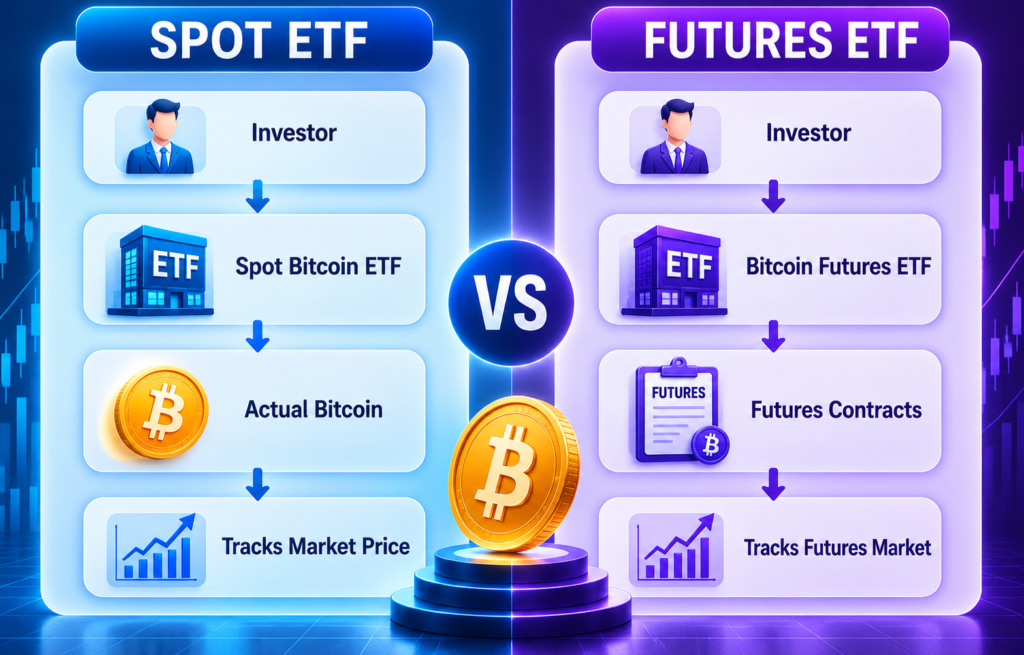
A Spot Exchange-Traded Fund (Spot ETF) is an investment fund that holds the actual underlying asset it is designed to track. In the case of a Spot Bitcoin ETF, the fund purchases and securely stores real Bitcoin on behalf of its investors.
When investors buy shares of a Spot Bitcoin ETF, they don’t directly own Bitcoin. Instead, they own shares in a fund whose value is closely linked to the market price of the Bitcoin it holds.
Because the ETF owns the underlying asset, its performance generally reflects Bitcoin’s spot market price more accurately than products based on derivatives.
Key Characteristics of a Spot ETF
- Holds actual Bitcoin in custody.
- Designed to closely track Bitcoin’s market price.
- Offers exposure without requiring investors to manage crypto wallets.
- Trades on regulated stock exchanges.
- Suitable for investors seeking straightforward Bitcoin exposure.
For many traditional investors, Spot ETFs provide a familiar and regulated way to participate in the cryptocurrency market without dealing with the technical aspects of digital asset ownership.
What Is a Futures ETF?
A Futures ETF provides Bitcoin exposure through futures contracts rather than owning Bitcoin directly.
A futures contract is a financial agreement to buy or sell an asset at a predetermined price on a future date. Bitcoin Futures ETFs invest in these contracts, typically traded on regulated futures exchanges.
Since the ETF’s value depends on futures contracts instead of actual Bitcoin holdings, its performance may differ from Bitcoin’s spot price, especially over longer periods.
To maintain exposure, Futures ETFs regularly replace expiring contracts with new ones through a process known as contract rollover.
While this allows investors to gain Bitcoin exposure within a regulated framework, it can introduce additional costs and affect long-term performance.
Key Characteristics of a Futures ETF
- Invests in Bitcoin futures contracts.
- Does not own actual Bitcoin.
- Performance depends on futures market pricing.
- Requires periodic contract rollovers.
- Commonly used by institutional and professional investors.
Spot ETF vs Futures ETF: Key Differences
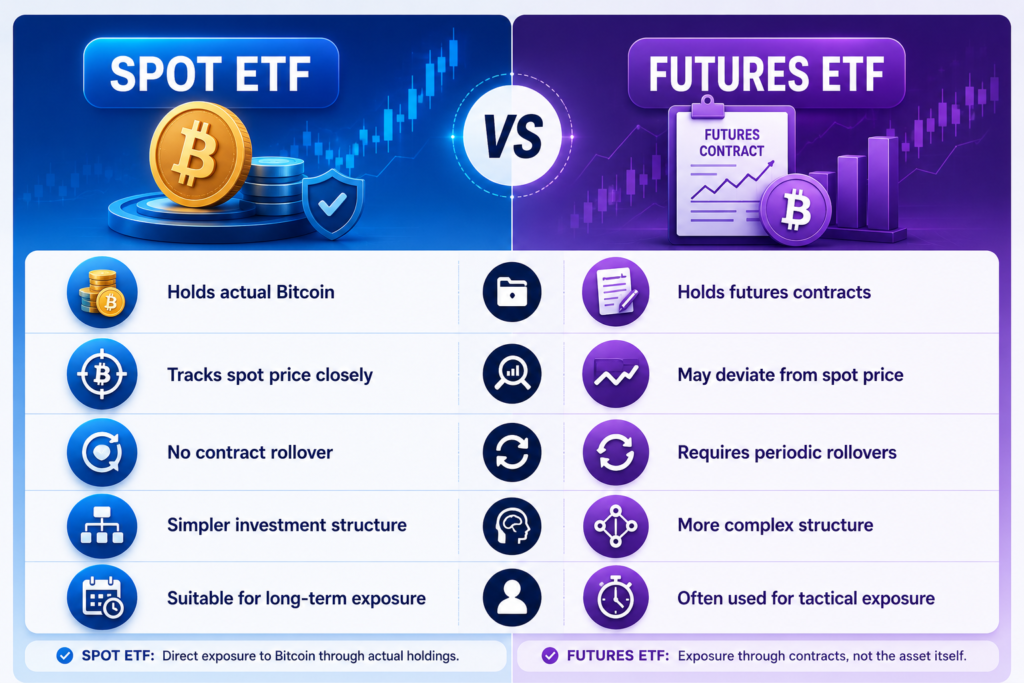
Although both investment products offer Bitcoin exposure, they differ in several important ways.
| Feature | Spot ETF | Futures ETF |
|---|---|---|
| Underlying Asset | Actual Bitcoin | Bitcoin Futures Contracts |
| Ownership | Holds Bitcoin | Holds derivatives |
| Price Tracking | Closely follows spot market | May deviate from spot price |
| Contract Rollovers | Not required | Required periodically |
| Complexity | Relatively simple | More complex |
| Tracking Error | Typically lower | Can be higher |
The biggest distinction is that Spot ETFs reflect the value of Bitcoin directly, while Futures ETFs derive their value from contracts tied to Bitcoin’s expected future price.
Benefits of Spot ETFs
Spot ETFs have become increasingly popular because they offer a relatively simple way to access Bitcoin through traditional financial markets.
Some of their key advantages include:
Closer Price Tracking
Since Spot ETFs hold actual Bitcoin, they generally mirror the cryptocurrency’s market value more accurately than derivative-based products.
Simplicity
Investors don’t need to understand futures contracts, rollover strategies, or derivatives markets.
Regulated Access
Spot ETFs allow investors to gain Bitcoin exposure through familiar brokerage platforms while benefiting from the oversight of regulated financial markets.
No Wallet Management
Investors avoid the responsibility of managing private keys or securing digital wallets, reducing operational complexity.
Benefits of Futures ETFs
Despite their additional complexity, Futures ETFs also offer several advantages.
Established Futures Market
These ETFs operate within regulated futures exchanges, providing a structured investment environment.
No Direct Bitcoin Custody
The fund doesn’t store Bitcoin directly, which may simplify custody arrangements for some institutional investors.
Portfolio Flexibility
Certain investors may prefer futures-based products as part of broader portfolio or risk-management strategies.
Risks of Spot ETFs and Futures ETFs
Every investment carries some level of risk, and Bitcoin ETFs are no exception. Although Spot ETFs and Futures ETFs both provide regulated exposure to Bitcoin, the risks associated with each product differ.
Understanding these risks can help investors set realistic expectations and make better-informed decisions.
Risks of Spot ETFs
Bitcoin Price Volatility
A Spot ETF closely follows Bitcoin’s market price. If Bitcoin experiences sharp price movements, the ETF’s value will generally move in the same direction. While this provides accurate exposure, it also means investors remain exposed to the cryptocurrency’s inherent volatility.
Market Sentiment
Bitcoin’s price is influenced by a wide range of factors, including macroeconomic conditions, institutional demand, regulatory developments, and investor sentiment. These factors can lead to rapid price fluctuations.
Regulatory Changes
Although Spot ETFs operate within regulated financial markets, future regulatory decisions affecting cryptocurrencies may influence market performance and investor confidence.
Risks of Futures ETFs
Tracking Error
One of the biggest differences between Spot and Futures ETFs is tracking accuracy.
Because Futures ETFs follow futures contracts rather than Bitcoin itself, their performance may not perfectly match the spot price. This difference is known as tracking error.
Contract Rollovers
Futures contracts have expiration dates.
To maintain exposure, the ETF manager must replace expiring contracts with new ones. Depending on market conditions, this rollover process can affect long-term returns.
Contango and Backwardation
Futures markets don’t always trade at the same price as the underlying asset.
- Contango occurs when futures contracts trade above the spot price.
- Backwardation occurs when futures contracts trade below the spot price.
These conditions can influence ETF performance over time and may create differences between Bitcoin’s actual price and the ETF’s returns.
Higher Complexity
Compared to Spot ETFs, Futures ETFs involve additional layers of complexity due to derivatives markets and contract management. Investors should understand these mechanics before investing.
Which ETF May Suit Different Investors?
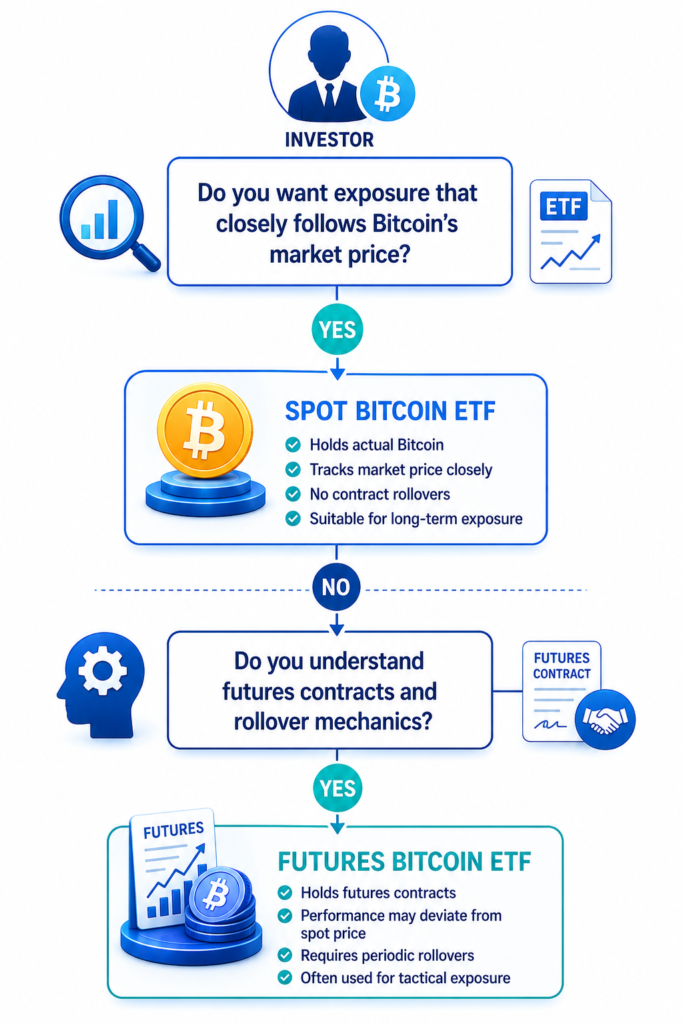
There is no universally “better” option. The right ETF depends on an investor’s objectives, investment horizon, and understanding of the underlying product.
A Spot ETF may appeal to investors who:
- Want exposure that closely reflects Bitcoin’s market price.
- Prefer a simpler investment structure.
- Plan to hold Bitcoin exposure over a longer period.
- Want to avoid the complexities of futures markets.
A Futures ETF may be more appropriate for investors who:
- Understand derivatives markets.
- Are comfortable with futures-based products.
- Want exposure through regulated futures contracts.
- Have specific portfolio or risk-management strategies.
Rather than choosing based on popularity, investors should evaluate how each ETF aligns with their financial goals, risk tolerance, and investment experience.
Frequently Asked Questions
What is the main difference between a Spot ETF and a Futures ETF?
A Spot ETF holds actual Bitcoin, while a Futures ETF gains exposure through Bitcoin futures contracts rather than owning the cryptocurrency directly.
Does a Spot Bitcoin ETF own Bitcoin?
Yes. A Spot Bitcoin ETF typically purchases and holds Bitcoin on behalf of investors, with the value of the ETF closely tracking the market price of those holdings.
Why don’t Futures ETFs buy Bitcoin directly?
Futures ETFs are designed to invest in regulated futures contracts, allowing investors to gain Bitcoin exposure without holding the underlying asset.
Which ETF tracks Bitcoin’s price more closely?
Spot ETFs generally track Bitcoin’s market price more closely because they own the underlying asset rather than derivative contracts.
Are Futures ETFs riskier than Spot ETFs?
They introduce additional considerations such as tracking error, contract rollovers, and futures market dynamics. Whether they are “riskier” depends on an investor’s understanding of these products and their investment objectives.
Can beginners invest in Bitcoin ETFs?
Bitcoin ETFs provide a more familiar investment structure than buying cryptocurrency directly. However, beginners should still understand how each ETF works, the risks involved, and how Bitcoin fits into a diversified portfolio.
Do I need a crypto wallet to invest in a Bitcoin ETF?
No. Investors purchase ETF shares through traditional brokerage accounts, so managing a crypto wallet is generally not required.
Conclusion
Spot ETFs and Futures ETFs both provide regulated ways to gain exposure to Bitcoin, but they do so through different investment structures.
A Spot ETF holds actual Bitcoin, making it a straightforward option for investors seeking exposure that closely reflects the cryptocurrency’s market price. In contrast, a Futures ETF invests in Bitcoin futures contracts, offering an alternative route to exposure through regulated derivatives markets.
Neither structure is inherently superior. Each has its own advantages, limitations, and risk profile. The right choice depends on factors such as investment goals, time horizon, risk tolerance, and familiarity with financial products.
As Bitcoin continues to become part of mainstream investment portfolios, understanding the differences between Spot and Futures ETFs can help investors make more informed decisions and avoid common misconceptions. Before investing, take time to research the product, review official fund documents, and ensure it aligns with your broader financial strategy.