


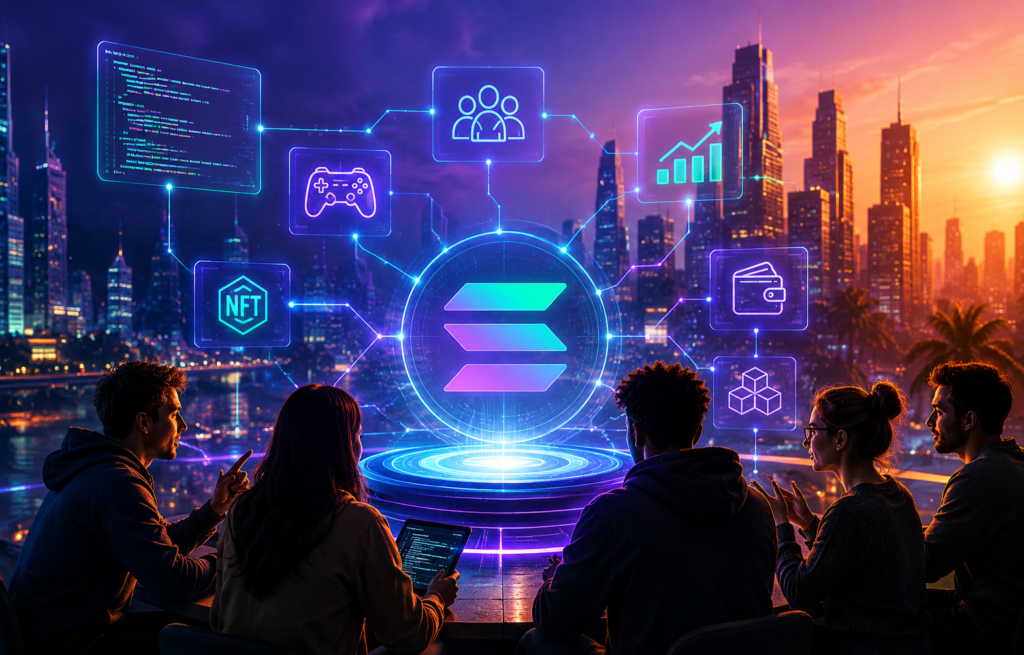
Solana’s growing network of startups and developers is drawing comparisons to Silicon Valley, with the ecosystem’s close-knit builder community emerging as one of its primary competitive advantages. Through high composability and talent mobility between projects, Solana is fostering a digital innovation cycle across DeFi, payments, consumer apps, and gaming.
Solana’s growing network of startups and developers is drawing comparisons to Silicon Valley, with the ecosystem’s close-knit builder community emerging as one of its potential competitive advantages.
In a recent post, Solana highlighted comments from Nic Cabana, who described the network as a kind of “digital Silicon Valley.” His argument centers on more than the number of projects being built. It is about how founders, developers and startups interact, share ideas and move between projects, potentially creating a cycle of innovation within the ecosystem.
That dynamic could become increasingly important as blockchain competition shifts beyond transaction speed and fees toward developer activity, applications, users and the strength of the communities building around each network.
Key Highlights
- Solana is being compared with Silicon Valley because of its interconnected startup and developer community.
- Composability allows projects to build applications that can interact with existing blockchain infrastructure.
- Talent moving between startups can help transfer experience, relationships and technical knowledge.
- Solana’s ecosystem has expanded across finance, payments, consumer applications, gaming and other sectors.
- The network effect could become a long-term advantage, although a large builder community does not guarantee successful startups.
Table of Contents
What Happened?
The Solana post focused on comments from Nic Cabana about the network’s startup environment and its similarities to Silicon Valley.
Cabana pointed to the “composability of projects and startups” as an important characteristic. He also described Solana’s community as a digital version of Silicon Valley, where startups emerge, people build relationships and experienced talent can later move into new companies.
For entertainment businesses, that network can create another advantage. New projects may be introduced through existing relationships, giving companies opportunities to discover technology and products before they become widely known.
The argument suggests that Solana’s ecosystem should not be evaluated only through technical metrics. The people building applications and the connections between those projects can also influence how quickly an ecosystem evolves.
Why It Matters
Silicon Valley’s influence has historically come from the concentration of founders, engineers, investors, universities and technology companies in one connected environment.
That proximity creates what economists often call network effects. One successful company can produce experienced employees who later join or launch another startup. Investors build relationships with founders, developers share knowledge and service providers develop expertise around the local technology industry.
A blockchain network cannot reproduce Silicon Valley’s physical geography, but it can create some similar digital connections.
Solana already provides infrastructure for developers building across multiple sectors. Its ecosystem currently includes areas such as DeFi, payments, consumer applications, developers and institutional finance.
How Solana Could Create a Startup Flywheel
The potential network effect can be understood as a simple cycle:
-
Builders
Developers join established projects to gain technical expertise and build founder relationships.
-
Startups
Experienced builders launch new startups within the ecosystem.
-
Products
Teams deploy decentralized applications, financial tooling, and consumer products.
-
Users
Product adoption drives activity and capital into the ecosystem.
-
Talent
Experienced talent moves across companies, transferring knowledge and relationships.
-
New Startups & More Builders
The continuous flywheel attracts new waves of global developers.

A developer might begin by joining an established Solana project, gain experience and build relationships with other founders. That experience could later help the developer launch another application or join a different startup.
As more people move through the ecosystem, knowledge and connections can spread between projects.
Solana’s funding programs are also designed to bring builders and founders into the ecosystem. The Solana Foundation says its grants programs have funded more than 500 projects with over million in funding across six continents.
Why Composability Could Give Solana an Edge
Composability is another important part of the argument.
In simple terms, it means developers can build applications that interact with existing blockchain programs and infrastructure instead of creating every component from scratch.
That can reduce development friction and make experimentation easier.
Solana has continued expanding its developer infrastructure. In March, the Solana Foundation launched its Solana Developer Platform, which brings together infrastructure through APIs for enterprises and financial institutions building products on the network.
The ecosystem has also continued adding projects across tokenized assets, payments, artificial intelligence, trading and consumer applications. Solana’s May ecosystem roundup, for example, highlighted new developer tooling, RWA infrastructure and regional builder programs.
Entertainment Could Benefit From the Network Effect
The entertainment sector could be particularly suited to this model because companies often need to combine multiple technologies.
A single entertainment application might require payments, digital assets, identity, gaming infrastructure, community tools and data services.
If those components already exist within the same ecosystem, a startup can potentially focus more heavily on its core product rather than building every underlying system independently.
Solana has also been expanding its activity across consumer applications and entertainment-related use cases, giving builders more infrastructure to experiment with.
Opportunities and Risks
Opportunities
- A dense startup community could help Solana attract more developers, encourage collaboration and accelerate product experimentation.
- It could also improve talent retention because builders have more opportunities to move between projects without leaving the broader ecosystem.
Risks
- A large ecosystem does not automatically produce successful companies.
- Startups still face funding challenges, competition, regulatory uncertainty and market cycles. There is also a risk that excessive concentration around one blockchain could create dependencies for businesses that build heavily on its infrastructure.
- The Silicon Valley comparison should therefore be viewed as an analogy for network effects, not evidence that Solana has already replicated Silicon Valley.
What’s Next?
The most important indicators will be whether Solana can continue attracting developers, producing successful startups and retaining experienced builders.
Funding programs, hackathons, accelerator programs, developer tooling and new consumer applications will remain important signals.
Solana’s current developer-focused activity suggests the ecosystem is continuing to invest in that foundation. Its official developer coverage includes regular tooling releases and infrastructure upgrades, while the Foundation continues supporting builders through funding programs and ecosystem initiatives.
Conclusion
The Solana startup ecosystem is increasingly being defined by more than the blockchain itself. Its growing network of founders, developers and applications could create a digital version of the network effects that helped Silicon Valley become a global technology hub.
The strongest advantage may ultimately come from how easily people and projects can interact, exchange knowledge and build on existing infrastructure.
Whether Solana can sustain that momentum remains an open question. But if successful startups continue producing experienced founders, developers and new companies, the ecosystem could develop a self-reinforcing cycle that becomes increasingly difficult for competing networks to replicate.
Frequently Asked Questions
Why is Solana popular with startups?
Solana offers developers a broad ecosystem of infrastructure, funding opportunities and applications to build around. Its Foundation also supports projects through grants and ecosystem programs, while the wider community provides additional funding and accelerator opportunities.
What makes the Solana ecosystem different?
One distinguishing feature is the combination of blockchain infrastructure, developer tooling, funding programs and applications across several sectors. This can give builders access to existing components and communities when developing new products.
What is Solana composability?
Composability refers to the ability of blockchain applications and programs to interact with existing infrastructure. Developers can use established components as building blocks rather than creating every part of an application independently.
How many developers are building on Solana?
Developer numbers vary depending on the methodology and measurement period. Solana’s own current materials report a large and active developer ecosystem, while its Foundation continues to publish developer and ecosystem updates.
Why is Solana being compared to Silicon Valley?
The comparison focuses on network effects. Like Silicon Valley, Solana has a concentration of founders, developers and startups that can exchange ideas, form relationships and move between projects.
What startups are building on Solana?
Solana’s ecosystem spans DeFi, payments, consumer applications, trading, tokenized assets, AI and other areas. Its official ecosystem coverage regularly highlights new projects and developer initiatives.
Is Solana good for Web3 startups?
Solana provides infrastructure, developer resources and ecosystem funding opportunities that can be useful for Web3 startups. However, startup success still depends on product-market fit, funding, execution and user adoption.
What industries are building on Solana?
Current ecosystem activity includes finance, payments, consumer applications, tokenized assets, DeFi, developer infrastructure and AI-related projects.