


If you’ve ever wished you could trade your opinion on who wins the Champions League final or whether Bitcoin cracks $100K before July, Binance just made it a whole lot easier. On May 25, the exchange’s Web3 Wallet quietly launched Event Rush a feature that transforms real-world outcomes into on-chain tokens you can buy and sell like any other crypto asset.
This isn’t your grandfather’s sportsbook. We’re talking about event tokens that trade dynamically based on collective sentiment, with prices shifting in real time as news breaks, injuries happen, or macro conditions change. And it’s all happening inside the same wallet app that 300 million people already have on their phones.
From Static Bets to Living Markets
The old way of betting on events was binary: you pick a side, lock in your odds, and wait. Event Rush throws that playbook out the window.
Instead of fixed odds, each event gets tokenized into tradeable outcomes think “YES” and “NO” shares that fluctuate between $0.01 and $0.99 based on what the crowd believes will happen. A share priced at $0.75 implies the market thinks there’s a 75% chance of that outcome occurring. When the event resolves, winning shares pay out $1. Losers go to zero.
What makes this different from traditional prediction markets is the liquidity model. Rather than waiting for a bookmaker to set lines, prices are discovered continuously through peer-to-peer trading. If a star player gets injured an hour before kickoff, the market reprices instantly. No phone calls to your bookie. No locked-in regrets.
What’s Actually Tradeable?
At launch, Event Rush covers three main categories:
Sports outcomes match results, tournament winners, player stats. The platform uses a BNB Chain dApp under the hood, meaning settlements happen on-chain with full transparency.
Crypto price targets Will ETH hit $5,000 this quarter? Will SOL flip BNB in market cap? These aren’t just moonshot guesses; they’re tradable positions with real capital at stake.
Major news events Political outcomes, economic data releases, even celebrity announcements. The idea is to capture anything with a binary or finite set of possible results.
Binance has hinted at expanding into culture, entertainment, and weather forecasting down the line essentially anywhere there’s uncertainty worth pricing.
The Tech Stack: How It Actually Works
Here’s where it gets interesting for the technically curious.
Event Rush is built on the BNB Smart Chain and integrated directly into Binance Wallet’s interface. When you first access it, the app auto-generates a secure keyless wallet using multi-party computation (MPC) no seed phrases to write down, no private keys to lose. Your existing spot or funding account balances can flow directly into this prediction account.
Trading supports both market orders (instant execution at current price) and limit orders (set your price and wait). The gas fees? Covered by Binance. That’s a big deal for onboarding nothing kills a new user’s enthusiasm faster than paying $2 in BNB to place a $10 prediction.
Critically, Binance is positioning itself as the access layer, not the counterparty. The actual markets run through third-party dApps, with Predict.fun being the first integration partner. This “centralized interface + decentralized backend” hybrid is becoming a template for how major exchanges package DeFi products to mainstream audiences.
Why Now? The $20 Billion Prediction Market Land Grab
This launch isn’t happening in a vacuum. Prediction markets have exploded from a crypto curiosity into a legitimate financial vertical. Monthly trading volume across platforms has consistently exceeded $20 billion, with some months touching $25.7 billion. That’s roughly 20x growth from early 2025.
The space is currently dominated by a duopoly: Polymarket and Kalshi, which together account for 85-93% of global prediction market activity. Polymarket built its reputation on political events (remember the 2024 election cycle?), while Kalshi became the first CFTC-regulated prediction marketplace in the US, treating event outcomes as tradable contracts.
But both have regulatory headaches. Polymarket is blocked in about 33 countries. Kalshi faces restrictions in roughly 50 jurisdictions and ongoing lawsuits from multiple US states alleging unlicensed sports betting. The CFTC has stepped in to defend prediction market companies, but the legal landscape remains murky.
Binance sees the opening. By wrapping on-chain infrastructure in a familiar centralized app, they’re betting that 300 million existing users won’t need to learn DeFi complexity to participate. It’s the same playbook that made Binance Pay and Binance Earn successful abstract the blockchain, keep the functionality.
And they’re not alone. MetaMask integrated Polymarket directly into its wallet last December, offering “one-tap funding” from any EVM chain. Coinbase has expanded into event trading. Even Fanatics – yes, the sports merchandise company is building prediction market infrastructure.
The User Experience: What It Feels Like
Let’s walk through the actual flow, because that’s where Binance typically wins or loses.
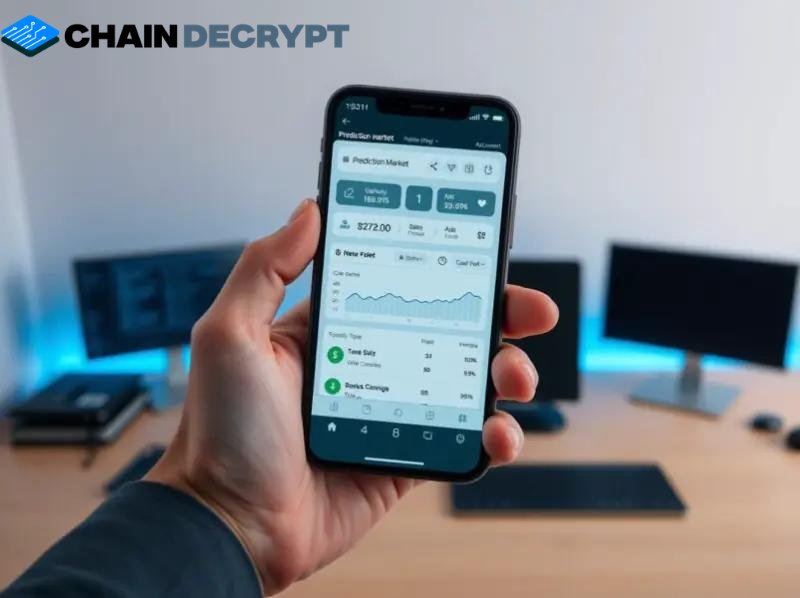
Open your Binance app. Navigate to the Markets tab. Tap Prediction. You’ll see categories Sports, Crypto, World Events with live markets showing real-time probability pricing. Pick a market, choose YES or NO, enter your amount, and execute. Your position lives under Assets > Prediction, where you can track P&L, claim winnings, or exit early by selling your shares back to the market.
The gasless experience is genuinely smooth. For casual users who’ve never interacted with a smart contract, this removes the biggest friction point. No MetaMask pop-ups asking you to confirm a 0.003 BNB transaction. No failed transactions because you set the gas limit too low. It just works.
That said, the feature isn’t available everywhere. Binance Wallet services are operated by Binance Barbados Limited and aren’t regulated by any financial authority. The prediction markets feature is region-restricted, and users in certain jurisdictions won’t see the tab at all.
The Bigger Picture: When Everything Becomes a Market
Prediction markets aren’t just about gambling on sports. At their core, they’re information aggregation machines arguably more accurate than polls, pundits, or prediction models because participants have real money on the line.
Want to know the actual probability of a recession? Check the yield curve, sure, but also check what prediction markets are pricing. Trying to forecast whether a drug trial succeeds? There’s probably a market for that. Curious about AI regulation timelines? The crowd has already priced it in.
Binance’s move accelerates a trend where on-chain infrastructure absorbs real-world finance. We’re already seeing tokenized government bonds, on-chain private credit, and 24/7 stock perpetuals. Prediction markets are the natural next frontier turning opinions and forecasts into liquid, tradable instruments.
The integration with Binance Wallet also matters for BNB Chain’s broader ecosystem. After a year of watching Solana capture retail mindshare with memecoins and Base dominate L2 revenue, BNB Chain needs flagship consumer apps that aren’t just DeFi yield farms. Event Rush, built natively on BSC, gives the chain a sticky use case with genuine mainstream appeal.
Risks and Realities
Let’s not pretend this is all upside.
Regulatory risk is the elephant in the room. Prediction markets sit in a gray zone between financial derivatives and gambling, and regulators worldwide are still figuring out where the line sits. If major jurisdictions crack down or if the CFTC loses its battle to assert jurisdiction over platforms like Kalshi the entire sector could face existential headwinds.
Smart contract risk exists too. While Binance covers gas fees, the underlying dApps run on BNB Smart Chain code that could have bugs or exploits. The exchange explicitly states it doesn’t act as market counterparty, meaning if something goes wrong with the settlement oracle or contract logic, your recourse is limited.
And then there’s the behavioral risk. Prediction markets are addictive by design. The same psychological mechanisms that make crypto trading compelling variable rewards, near-instant feedback, social signaling apply here, often more intensely because events have natural resolution dates that create countdown pressure.
What’s Next
Binance has already signaled that Predict.fun is just the beginning. More prediction market platforms will be integrated into the wallet app, potentially including cross-chain options. The exchange is also exploring AI-driven market analytics and expanded event categories beyond the initial sports-crypto-news trio.
For the crypto industry, this launch represents another step toward the “financial super app” vision where your wallet isn’t just for storing coins, but for trading, predicting, earning, and spending across every financial vertical imaginable. Binance’s 2026 trend report explicitly called out wallet + on-chain infrastructure bundling as the next evolution of DEX business models.
Whether Event Rush becomes a genuine mainstream hit or remains a niche feature for crypto natives depends on execution. The tech is there. The user base is there. The market opportunity is measured in tens of billions. Now it’s about whether Binance can make predicting the future feel as natural as checking your portfolio balance.