


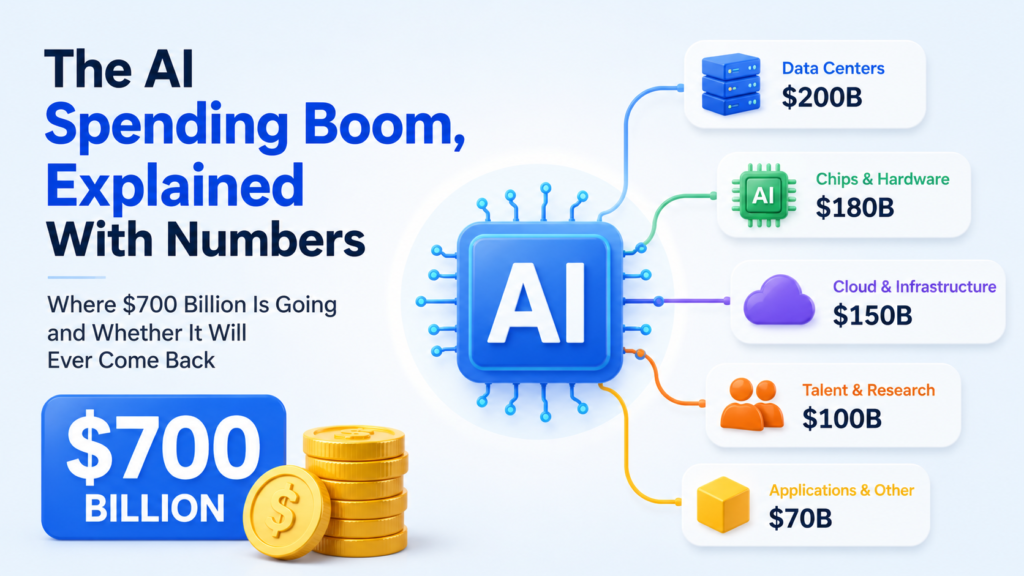
The scale of what is happening right now in artificial intelligence infrastructure is genuinely difficult to process through words alone. So here is the clearest way to understand it: in 2026, the five largest technology companies in the United States will collectively spend more money building AI infrastructure than the entire GDP of Switzerland. They will do the same in 2027. And possibly 2028.
This is not speculative. These are binding commitments contracted GPU orders, signed data center leases, power purchase agreements with utilities that are already in motion. The question driving serious debate across Wall Street, Silicon Valley, and governments around the world is not whether the spending is real. It is whether any of it will produce returns sufficient to justify the cost.
Here is what the data actually shows.
The Numbers: A Spending Surge With No Historical Precedent
Start with the aggregate. The five largest U.S. cloud and AI infrastructure providers Microsoft, Alphabet, Amazon, Meta, and Oracle have collectively committed to spending between $660 billion and $690 billion on capital expenditure in 2026. That is nearly double the $448 billion they spent in 2025, which itself was nearly triple their 2022 combined total of $162 billion.
Expand the lens to the 14 largest publicly traded data center operators globally, and the 2026 capital expenditure figure approaches $750 billion up from just under $450 billion in 2025. Goldman Sachs projects the cumulative hyperscaler capital spend from 2025 through 2027 will reach $1.15 trillion, more than double the $477 billion spent across 2022 through 2024 combined.
To put that in a different frame: the world’s largest technology companies are spending, in three years, roughly what the United States spends on its entire military budget in five years.
Company by company, the 2026 commitments:
- Amazon approximately $200 billion, up from $131 billion in 2025. The bulk flows into AWS data centers. CEO Andy Jassy defends the scale by noting that AI capacity is being monetised as quickly as it is installed, and that AWS reached a $142 billion annualised revenue run rate growing at 24% year-over-year.
- Alphabet $175 billion to $185 billion, revised upward three times from an initial $71–73 billion range set for 2025. CEO Sundar Pichai acknowledged the scale causes internal concern, while pointing to a cloud backlog that surged 55% sequentially to over $240 billion.
- Meta $115 billion to $135 billion, nearly double its $72 billion spend in 2025. At the midpoint of $125 billion, Meta’s annual capital spending exceeds the GDP of more than 120 countries.
- Microsoft tracking toward $120 billion or more in fiscal 2026, having already spent $37.5 billion in its most recent quarter.
The inflection point in this spending curve came in mid-2023, when investment shifted from gradual growth to steep acceleration the moment when AI moved from internal experimentation to full-scale commercial deployment. Since then, combined capex at the five major hyperscalers has grown at an average annual rate of 72%.
What the Money Is Actually Buying
The headline figure of $700 billion obscures an important internal structure. Not all of it is the same kind of spending, and understanding the breakdown changes what questions make sense to ask about returns.
Approximately 60% of data center capital expenditure goes toward the technology and hardware required to run the facilities processors, networking equipment, storage, and increasingly, custom AI accelerator chips. About 25% goes toward power generation and cooling infrastructure, which has become one of the binding constraints on how quickly data centers can be built. The remaining 15% covers land and physical construction.
The hardware spending flows overwhelmingly to Nvidia, which produces the H100, H200, and B200 GPU chips that have become the essential computing substrate for training and running large AI models. Nvidia’s market capitalisation has exceeded $3 trillion at various points during this period, reflecting its position as the single largest beneficiary of the infrastructure arms race. Jensen Huang, Nvidia’s CEO, has stated publicly that the current surge in data center investment related to AI will last for seven to eight more years a projection that, if accurate, would imply total global AI infrastructure spending through 2033 well exceeding $5 trillion.
The energy requirement embedded in all this hardware is one of the less-discussed aspects of the AI boom. Over 23 gigawatts of data center capacity was under construction globally at the end of September 2025, with roughly three-quarters of it in the United States. A single gigawatt of data center capacity requires enough electricity to power approximately 750,000 average American homes. New facilities are being sited adjacent to nuclear plants, natural gas generators, and renewable energy installations specifically because the grid cannot absorb the incremental demand without dedicated generation.
Amazon’s Hyperion project in Louisiana a 2,250-acre site expected to cost $10 billion and deliver 5 gigawatts of compute includes an arrangement with a local nuclear power plant to handle the electricity load. Microsoft has announced plans to restart a decommissioned reactor at Three Mile Island. The energy dimension of the AI boom is, in physical infrastructure terms, as large as the computing dimension.
The Return Question: What Is All This Spending Actually Generating?
This is where genuine uncertainty lives, and where the debate between technology optimists and financial skeptics is most intense.
The revenue being generated by AI products and services is real and growing, but it remains a fraction of the infrastructure investment being deployed. OpenAI’s annualised revenue has grown rapidly through 2025 and 2026, but the combined revenues of the leading pure-play AI companies remain far smaller than the capital being spent to build the infrastructure they run on.
For the hyperscalers themselves, the revenue case is more developed. Alphabet’s cloud backlog surpassing $240 billion, growing 55% in a single quarter, represents committed future revenue from customers who have signed long-term cloud and AI service contracts. AWS at a $142 billion annualised run rate growing at 24% suggests the returns on data center investment are compounding. Microsoft’s Azure revenue has accelerated alongside AI feature rollouts. These are not speculative future numbers they are current commercial velocity.
The efficiency trend running alongside the spending numbers is also important and often underreported. Alphabet disclosed reducing the cost of serving its Gemini AI model by 78% over 2025 through model optimization. This means the same computational investment produces dramatically more output than it did twelve months ago a dynamic that improves the economics of every piece of infrastructure already built and changes the payback period calculation.
The Investor Skepticism Gap
Despite the revenue momentum, Wall Street has remained ambivalent about the spending commitments. When Amazon announced its $200 billion 2026 capex guidance, the stock dropped roughly 8–10% on the announcement, reflecting concern about the payback period.
This investor reaction reflects a structural tension at the heart of the AI boom. Technology executives are making binding multi-year commitments based on their assessment of where AI demand is going. Wall Street analysts, constrained by shorter-horizon earnings models, see the spending before they see the revenue it generates and respond with skepticism.
Gil Luria, an equity analyst at DA Davidson, articulates the moderate position: the companies making these investments represent real demand, not manufactured expectations. If the largest companies on Earth are buying chips and building data centers at this scale, they are doing so with contract commitments from customers who are paying for AI capacity.
The bear case is more straightforward: not all infrastructure booms translate into equivalent economic value. History has examples of enormous capital investment cycles fiber optic cables in the late 1990s, solar manufacturing capacity in the 2010s where the infrastructure was real and useful but the investment returns were insufficient because supply outpaced the pace of economic absorption.
The AI case differs from prior examples in one important respect: the demand for AI compute is not coming from one industry or one application. It is diffuse across healthcare, software development, financial services, manufacturing, logistics, and consumer applications simultaneously. The breadth of demand makes the comparison to more sector-specific infrastructure booms imperfect. But it does not eliminate the question about whether $700 billion in annual spending can generate returns sufficient to satisfy the expectations embedded in current valuations.
The Crypto and AI Intersection
For readers of this publication, the AI infrastructure boom has a direct relevance beyond the technology sector. Bitcoin mining companies that have pivoted to hosting AI compute in their data centers have become dual-revenue businesses. When Nvidia’s earnings confirm accelerating AI infrastructure demand, those mining companies’ HPC contracts become more valuable alongside their Bitcoin production.
The energy infrastructure being built for AI data centers dedicated power generation, cooling systems, grid upgrades shares significant engineering requirements with large-scale Bitcoin mining operations. Several major mining operators, including Iris Energy, Core Scientific, and Applied Digital, have announced or completed conversions of mining facilities to AI hosting, effectively becoming infrastructure providers for the same hyperscaler spending boom described above.
The deeper connection is through risk appetite and macro conditions. AI infrastructure investment signals sustained institutional commitment to building compute capacity regardless of market conditions, which historically correlates with the kind of long-duration risk appetite that also supports Bitcoin institutional demand.
Where This Goes From Here
The current trajectory is set by binding contracts that will not reverse quickly. The 23+ gigawatts of data center capacity under construction globally will be completed regardless of whether quarterly earnings satisfy short-term investor expectations. The GPU orders placed with Nvidia and TSMC have lead times that make them nearly impossible to cancel without substantial penalties.
By the end of this decade, global data center capacity could reach approximately 200 gigawatts, driven primarily by continued hyperscale expansion and accelerating AI infrastructure demand. The investment supporting that outcome potentially $5 trillion through 2030 would represent the largest capital allocation to a single technological infrastructure category in human history.
Whether the returns justify that investment will determine whether the AI boom becomes a permanent feature of the global economy or a cautionary chapter in the history of technological optimism. The companies making the bets believe they know the answer. The question is whether the revenue arrives fast enough to make the believers right before the skeptics run out of patience.