


Key Highlights
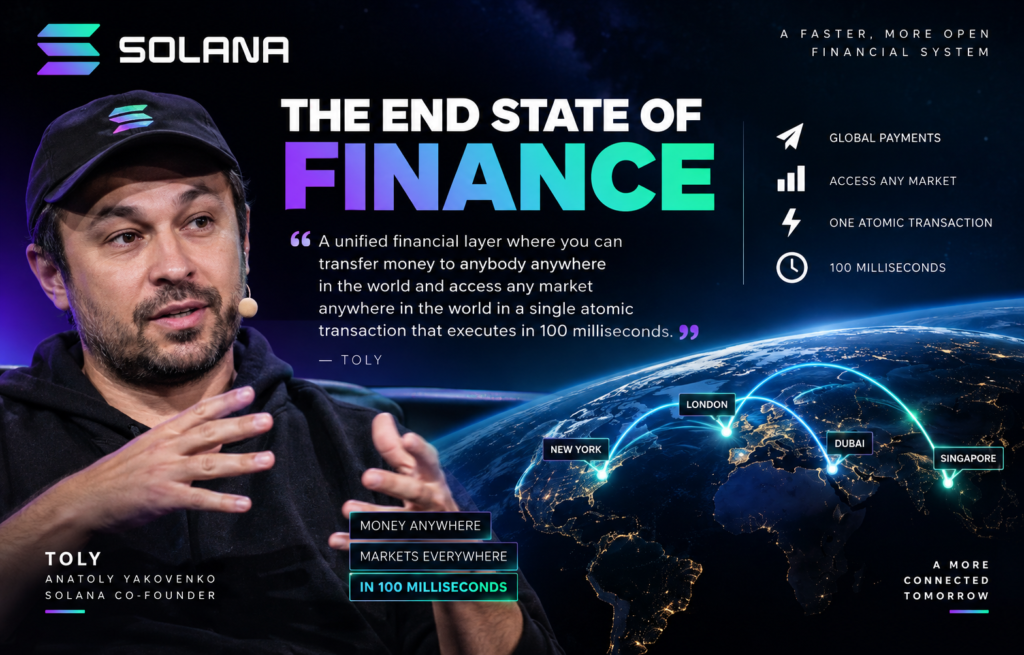
- Solana co-founder Anatoly Yakovenko outlined a long-term vision to process global payments and market trades in a single 100-millisecond atomic transaction.
- Network target slot times were recently reduced from 400ms to 350ms as engineering moves toward a 200ms target alongside faster finality upgrades.
- The single global state design enables composable transactions where payments, DEX trades, and lending operations execute or fail together.
- Realizing the vision will depend on scaling real-world asset (RWA) liquidity, regulatory compliance, and network stability.
Solana is positioning speed, composability and global access as the foundation for what its co-founder Anatoly Yakovenko, widely known as Toly, describes as the “end state of finance.” In a recent Solana post, Yakovenko outlined a vision where users could transfer money to anyone around the world and access financial markets globally through a single atomic transaction that executes in roughly 100 milliseconds.
The statement goes beyond faster crypto payments. It presents Solana as a potential unified financial infrastructure where payments, trading and market access operate on the same underlying network rather than across disconnected systems.
Solana’s 100-Millisecond Vision
According to Yakovenko’s vision, the future financial system could function through a unified layer that allows users to move funds and interact with markets almost instantly.
The central idea is straightforward: instead of navigating different intermediaries, settlement systems and market venues, a user could potentially execute multiple financial actions within one atomic transaction.
That transaction model is particularly important for markets because atomic execution allows several operations to succeed together or fail together. Solana’s documentation highlights its single global state and the ability for decentralized exchanges, lending markets and other financial applications to interact within a single atomic transaction.
Yakovenko’s argument therefore focuses not simply on making individual transactions faster, but on reducing the friction between different parts of the financial system.
Why 100 Milliseconds Matters
Traditional financial infrastructure is built around multiple layers of intermediaries, databases, exchanges, clearing systems and settlement processes.
Blockchain networks can reduce some of that complexity, but speed remains critical if they are going to support high-frequency financial activity and consumer-facing applications.
Solana has been steadily pushing its infrastructure toward shorter execution times. The network recently reduced its target slot time from 400 milliseconds to 350 milliseconds as part of a broader effort to eventually reach a 200-millisecond target.
At the same time, the broader Solana development roadmap has focused on significantly faster transaction finality. That distinction is important because slot time and finality are not the same thing. Slot time describes how quickly blocks are produced, while finality concerns when a transaction can be considered settled and irreversible.
Solana’s current public positioning highlights a measured path toward 200-millisecond performance, with network metrics being monitored publicly.
Trading Could Be the Bigger Opportunity
The financial vision becomes particularly significant when applied to trading.
Yakovenko has previously argued that blockchain infrastructure should be optimized for demanding financial applications such as trading because simpler use cases, including payments, can then benefit from the same performance improvements.
That approach could make fast onchain execution more relevant to decentralized exchanges, tokenized securities, derivatives and other markets where milliseconds can influence execution quality.
Solana’s architecture is designed around a single execution environment, which allows applications to interact with shared liquidity without requiring users to move assets between separate networks.
That composability could become increasingly valuable as more traditional financial assets move onchain.
What Happened Next: Solana Is Already Building Toward Faster Settlement
The latest statement comes as Solana’s infrastructure is already moving toward faster execution.
The network’s reduction to a 350-millisecond target slot time represents one step in the path toward a 200-millisecond target. Meanwhile, the ecosystem has been preparing for much faster finality through its broader consensus upgrades.
The significance is that Yakovenko’s 100-millisecond financial vision is not being presented in isolation. It follows a broader engineering direction centered on reducing latency and increasing network capacity.
However, it is important to distinguish between the 100-millisecond vision described by Yakovenko and a guaranteed network-wide settlement time. The statement represents a long-term view of what financial infrastructure could look like rather than a promise that every Solana transaction currently settles in 100 milliseconds.
A Unified Market Instead of Fragmented Finance
If this model develops as envisioned, the bigger change may not be transaction speed alone.
A unified blockchain-based financial layer could allow users to move capital between payments, trading and other markets without repeatedly switching platforms or settlement systems.
For example, a single transaction could potentially route capital through multiple liquidity venues, execute a trade and settle the resulting asset without requiring separate manual steps.
That is where Solana’s emphasis on atomic transactions becomes important. The network’s financial infrastructure is designed to keep different applications composable within the same global state.
What Comes Next for Solana
The next phase will be about whether improvements in speed can translate into meaningful adoption across real financial markets.
Faster execution alone will not create a global financial layer. Liquidity, regulatory compatibility, reliable infrastructure, security and access to real-world assets will also determine whether the vision can scale.
Still, Yakovenko’s latest message provides a clear direction for Solana: finance that operates at internet speed, with global market access and settlement compressed into a single transaction.
The immediate development is the network’s continued push toward shorter slot times and faster finality. The longer-term goal is considerably bigger, turning Solana from a fast blockchain into a unified settlement layer for global finance.