


The U.S. Senate has failed to advance the CLARITY Act, dealing a setback to efforts to establish a comprehensive regulatory framework for the American cryptocurrency market.
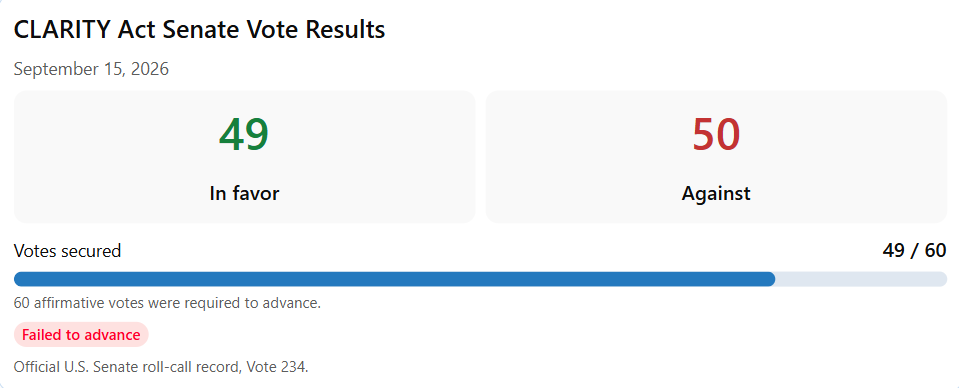
The September 15, 2026, procedural vote ended 49-50, falling short of the 60 votes required to move forward. The result leaves the Digital Asset Market Clarity Act of 2025, also known as H.R. 3633, stalled in the Senate.
The latest CLARITY Act news raises questions about the future of U.S. crypto regulation, particularly how lawmakers will address digital asset classification, trading platforms and the division of responsibilities between federal regulators.
Key Highlights
- The Senate failed to advance the CLARITY Act in a September 15 procedural vote.
- The legislation received 49 votes in favor and 50 against, below the required 60-vote threshold.
- The bill previously passed the House and advanced through the Senate Banking Committee.
- The failed vote delays efforts to establish a comprehensive statutory framework for U.S. digital asset markets.
- The SEC and CFTC can continue developing crypto regulations under their existing legal authority.
CLARITY Act Senate Vote: What Happened?
The CLARITY Act reached a critical stage after progressing through the House and Senate Banking Committee.
The House approved H.R. 3633 in July 2025 by a vote of 294-134. In May 2026, the Senate Banking Committee advanced the legislation by 15-9, moving it closer to consideration by the full Senate.
However, the bill encountered difficulties as lawmakers continued negotiating several provisions, including consumer protection, ethics requirements and the treatment of decentralized financial services.
On September 15, the Senate voted on whether to invoke cloture on the motion to proceed to the legislation.
The proposal failed to secure enough support. All Democrats present and four Republicans voted against advancing the measure.
The distinction between a procedural vote and final passage is important. Senators did not vote on whether to enact the CLARITY Act. They voted on a procedural step necessary to begin considering the legislation.
Because the motion failed, the Senate did not proceed to debate and amend the bill at that stage.
Why Did the CLARITY Act Fail to Advance?
The unsuccessful vote followed disagreements over several aspects of the proposed regulatory framework.
One major concern involved ethics provisions and potential conflicts of interest involving public officials and digital asset businesses.
Lawmakers also debated the treatment of stablecoins, consumer protection measures and regulatory obligations for decentralized finance.
Supporters argued that establishing a federal framework would reduce uncertainty for businesses and investors. Opponents maintained that additional safeguards were necessary before the legislation could advance.
The revised legislative text attempted to address several disputed provisions. However, the changes did not attract enough support to overcome the Senate’s procedural threshold.
The result highlights the difficulty of reaching agreement on legislation that covers both emerging blockchain technology and established financial regulation.
What Does the Failed Vote Mean for U.S. Crypto Regulation?
The CLARITY Act was designed to clarify how digital assets should be classified and which federal agencies should regulate different activities.
Its proposed framework would give the CFTC a defined role in digital commodity spot markets while preserving the SEC’s responsibilities under securities laws.
Without the legislation, crypto companies must continue operating under existing laws, regulatory interpretations and applicable agency requirements.
For exchanges and brokers, this means monitoring developments that could affect registration and compliance. DeFi developers must also consider how existing financial regulations apply to their particular activities.
The Senate setback does not eliminate these regulatory obligations. Instead, it delays the possibility of replacing parts of the existing framework with comprehensive legislation.
For a detailed explanation of the proposed rules, readers can explore ChainDecrypt’s pillar article: .
SEC and CFTC Move Forward Without the CLARITY Act
Although the bill has stalled, regulatory developments have continued.
On September 17, the SEC introduced a temporary Innovation Exemption allowing qualifying trading venues to facilitate certain tokenized stock transactions under specified conditions.
The exemption includes investor protection requirements, trading restrictions and operational safeguards. It is scheduled to expire five years after publication.
This development demonstrates that regulators can address specific areas of the digital asset market without waiting for Congress to enact comprehensive legislation.
However, agency actions and federal legislation serve different purposes. Regulatory exemptions and rules operate within existing legal authority, while legislation can establish more durable statutory requirements.
For businesses, the distinction matters when planning long-term compliance, product development and market expansion.
What Happens Next for the CLARITY Act?
The September vote leaves the legislation’s immediate future uncertain.
Senator Thom Tillis filed a motion to reconsider the failed procedural vote. This preserves a possible route for further Senate consideration, although it does not guarantee another vote or eventual passage.
Several developments deserve attention in the coming months, particularly renewed congressional negotiations, revised legislative language and additional SEC or CFTC regulatory actions.
The remaining congressional calendar is another consideration. Any renewed effort would still need sufficient support to overcome the Senate’s procedural requirements.
Until further legislative action occurs, the CLARITY Act remains a proposal rather than an enacted federal law.
Frequently Asked Questions
Did the CLARITY Act pass the Senate?
No. The Senate failed to advance the CLARITY Act on September 15, 2026. The procedural vote ended 49-50, falling short of the required 60 votes. The result did not constitute a final vote on passage.
Why did the CLARITY Act fail?
The legislation encountered disagreements involving ethics provisions, consumer protection, stablecoins and DeFi regulation. Despite revisions to the proposed framework, supporters could not secure the votes necessary to advance the bill.
What happens to crypto regulation without the CLARITY Act?
Existing U.S. financial laws remain applicable. The SEC and CFTC can continue developing regulatory measures within their existing authority while Congress considers whether to revisit comprehensive digital asset legislation.
Conclusion
The failed Senate vote represents a significant setback for the CLARITY Act, but it does not bring U.S. crypto regulation to a halt.
The legislation remains stalled following its unsuccessful September 15 procedural vote. Meanwhile, federal regulators continue addressing digital asset markets through existing legal mechanisms.
The next important development will be whether lawmakers can reach an agreement that allows the bill to return to the Senate floor. Until then, regulatory actions and potential legislative revisions remain important areas to monitor.