



Indian investigators have uncovered another example of how modern financial crime is evolving, with authorities alleging that proceeds from a fake international call centre were routed through crypto hawala networks to disguise the movement of funds.
The investigation, led by law enforcement agencies in Hyderabad, points to an increasingly sophisticated combination of traditional underground money transfer systems and digital assets. While the investigation remains ongoing, officials believe the operation relied on cryptocurrency transactions alongside informal hawala channels to move illicit proceeds across multiple jurisdictions.
The case highlights how criminals are adapting to emerging financial technologies while presenting new challenges for investigators responsible for tracing digital money trails.
How the Alleged Operation Worked
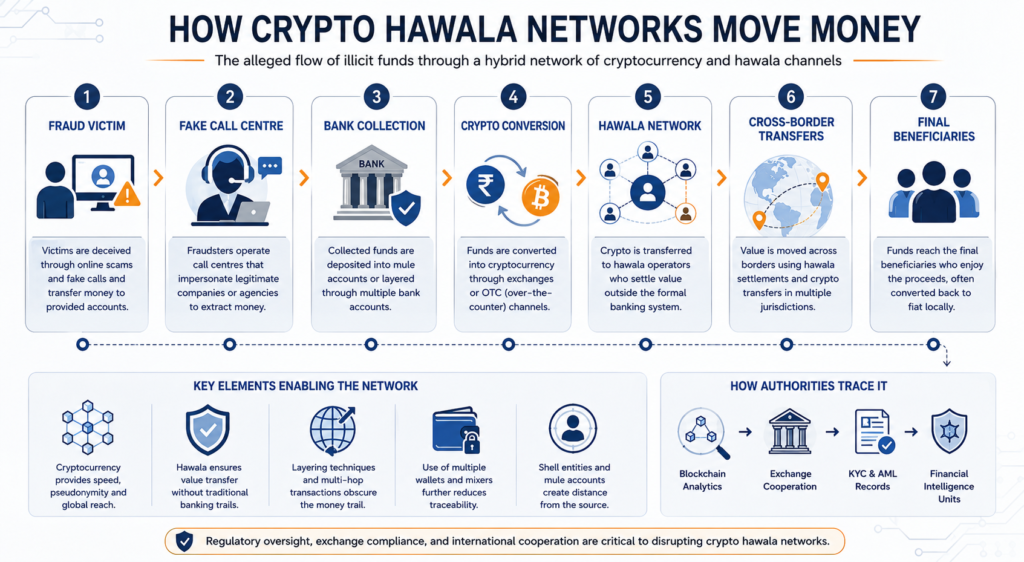
According to investigators, the fake call centre primarily targeted overseas victims through fraudulent schemes. Once funds were collected, they were allegedly transferred through multiple financial layers before being converted into cryptocurrency.
Authorities suspect the funds were then routed using hawala operators, allowing transactions to move without relying solely on conventional banking infrastructure.
This layered approach makes it more difficult for investigators to immediately identify the final destination of illicit proceeds. Digital wallets, cross-border transfers, and peer-to-peer transactions can add further complexity when combined with informal settlement systems.
Law enforcement officials continue examining wallet activity, transaction histories, and communication records to establish the complete financial trail.
Why Crypto Is Increasingly Appearing in Financial Crime Cases
Cryptocurrency itself is not illegal, and millions of legitimate users rely on blockchain technology for payments, investment, and decentralized finance.
However, law enforcement agencies worldwide have increasingly identified cases where criminals attempt to misuse digital assets because blockchain transactions can move across borders quickly.
Despite this perception, public blockchains are often transparent. Investigators frequently analyze wallet addresses, transaction histories, and blockchain analytics to reconstruct financial activity.
Specialized forensic tools have significantly improved the ability of agencies to identify suspicious transaction patterns and connect multiple wallets involved in complex operations.
Hawala and Digital Assets Create New Challenges
Hawala has existed for decades as an informal value transfer system operating outside traditional banking networks.
When cryptocurrency is combined with hawala settlements, investigators face additional challenges because funds may move through multiple intermediaries before reaching their final destination.
Authorities increasingly cooperate with cryptocurrency exchanges, financial intelligence units, and blockchain analytics firms to identify suspicious activity and recover digital assets linked to criminal investigations.
The Hyderabad investigation reflects a broader global trend where financial crimes increasingly involve both conventional underground networks and modern digital payment technologies.
The Importance of Blockchain Forensics
One important misconception is that cryptocurrency transactions are completely anonymous.
In reality, many blockchain networks maintain permanent public transaction records that investigators can analyze using forensic software.
By combining blockchain intelligence with banking records, telecommunications data, and exchange compliance information, authorities can often reconstruct complex financial networks.
This growing field of blockchain forensics has become an essential tool for governments seeking to combat money laundering, fraud, ransomware, and cross-border financial crimes.
What This Means for the Industry
Cases involving alleged crypto hawala networks may encourage regulators to strengthen compliance requirements for virtual asset service providers and improve cooperation between domestic and international enforcement agencies.
The investigation also serves as a reminder that while blockchain technology offers legitimate financial innovation, misuse by criminal actors continues to attract greater regulatory attention.
For cryptocurrency businesses operating within legal frameworks, stronger compliance standards and improved transparency may ultimately strengthen public confidence in the digital asset ecosystem.
Final Thoughts
The Hyderabad fake call centre investigation illustrates how financial crime is evolving alongside technological innovation. The alleged use of crypto hawala networks demonstrates that criminals are increasingly combining traditional underground systems with digital assets to obscure money trails.
As investigations continue, blockchain analytics, international cooperation, and financial intelligence are expected to play a central role in uncovering complex transaction networks. The outcome of this case could influence future enforcement strategies and reinforce the importance of compliance across the rapidly expanding cryptocurrency industry.