



Ethereum strengthened its position against Bitcoin throughout July as institutional investors increasingly favored Ethereum-focused investment products. Strong inflows into spot Ethereum exchange-traded funds, renewed corporate accumulation, and improving market sentiment helped Ether outperform the world’s largest cryptocurrency. However, despite the encouraging momentum, blockchain data suggests investors should remain cautious before declaring the beginning of a long-term trend reversal.
The latest developments surrounding the iShares Staked Ethereum Trust ETF highlight the growing institutional appetite for Ethereum exposure. Yet, valuation indicators and exchange activity continue to show that the market has not fully reached the conditions typically associated with previous cycle bottoms.
Key Highlights
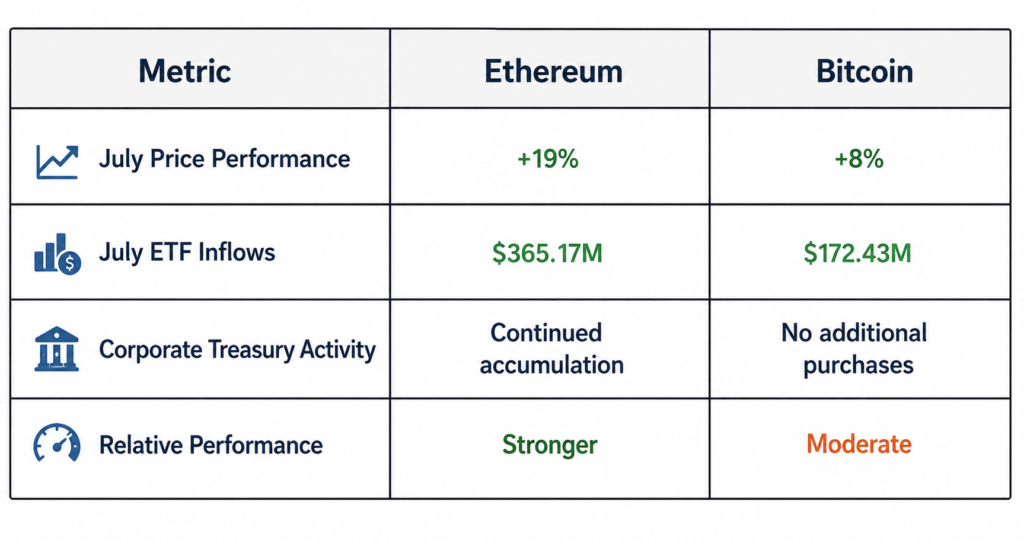
- Ethereum gained 19% during July, outperforming Bitcoin’s 8% monthly increase.
- U.S. spot Ethereum ETFs attracted approximately $365 million in net inflows.
- Bitcoin ETFs recorded around $172 million in monthly inflows.
- The ETH/BTC ratio climbed above 0.030, reaching its highest level in three months.
- On-chain indicators continue to suggest that Ethereum’s recovery has not yet confirmed a historical market bottom.
Ethereum Attracts Institutional Capital
Institutional demand played a major role in Ethereum’s strong July performance. According to the data provided, U.S. spot Ethereum ETFs recorded their strongest monthly inflows of the year, reversing two consecutive months of heavy outflows.
Investor confidence also received additional support from the launch of new Ethereum investment products, including the Morgan Stanley Ethereum Trust. While relatively small compared with established funds, its distribution network introduces Ethereum exposure to a much broader wealth management audience.
Although the iShares Staked Ethereum Trust ETF continues attracting attention among investors searching for regulated Ethereum products, competition across Ethereum ETFs is expected to intensify as more financial institutions expand their digital asset offerings.
Bitcoin Remains Stable but Loses Momentum
Bitcoin continued to trade below the $65,000 resistance level despite recording respectable gains during July. Unlike Ethereum, Bitcoin did not benefit from equally strong ETF inflows during the month.
Corporate buying also diverged between the two leading cryptocurrencies. Ethereum treasury accumulation continued as BitMine increased its Ether holdings throughout July, while Strategy, historically one of Bitcoin’s largest corporate buyers, did not add to its Bitcoin reserves during the same period.
This difference in institutional activity contributed to Ethereum’s relative strength against Bitcoin.
On-Chain Data Suggests Investors Should Stay Cautious
Despite Ethereum’s improving performance, blockchain indicators tell a more balanced story.
Several valuation metrics remain above the historical levels that previously marked major market bottoms. Likewise, exchange flow data indicates that selling pressure has eased but has not declined to the levels seen during earlier recovery cycles.
These indicators suggest Ethereum may be recovering from an extended period of weakness rather than entering a fully confirmed bullish cycle.
For long-term investors, this distinction is important because strong ETF demand alone does not guarantee sustained price appreciation.
Why This Matters
Ethereum’s recent outperformance demonstrates that institutional investors are becoming increasingly comfortable allocating capital to regulated Ether investment products.
If this trend continues, Ethereum could strengthen its position within institutional portfolios alongside Bitcoin.
At the same time, investors should monitor blockchain fundamentals rather than relying solely on ETF inflows. On-chain activity often provides valuable insight into whether market momentum is supported by genuine network participation or short-term investor enthusiasm.
What Investors Should Watch Next
Several developments could determine Ethereum’s next move:
- Continued inflows into spot Ethereum ETFs.
- Growth of products such as the iShares Staked Ethereum Trust ETF.
- Whether the ETH/BTC ratio can remain above the 0.030 level.
- Corporate treasury accumulation.
- Exchange inflows and outflows.
- On-chain valuation metrics approaching historical reversal zones.
A combination of sustained institutional demand and improving blockchain activity would strengthen the case for a longer-term recovery.
Conclusion
Ethereum entered August with stronger momentum than Bitcoin after attracting significantly higher ETF inflows and renewed institutional interest. The growing attention surrounding the iShares Staked Ethereum Trust ETF reflects the increasing demand for regulated Ethereum investment vehicles.
However, blockchain data presents a more measured outlook. Valuation indicators and exchange flows suggest that while Ethereum has recovered meaningfully from recent lows, the market has not yet confirmed the type of structural bottom seen during previous cycles. Investors may therefore continue balancing optimism over institutional demand with close attention to on-chain fundamentals before expecting a sustained trend reversal.
FAQs
What is the iShares Staked Ethereum Trust ETF?
It is an Ethereum-focused investment product designed to provide regulated exposure to Ether, appealing to institutional and traditional investors seeking access through familiar financial markets.
Why did Ethereum outperform Bitcoin in July?
Ethereum benefited from stronger ETF inflows, continued corporate treasury accumulation, and improving investor sentiment, while Bitcoin experienced comparatively weaker institutional demand.
What does the ETH/BTC ratio indicate?
The ETH/BTC ratio measures Ethereum’s performance relative to Bitcoin. A rising ratio generally indicates Ethereum is outperforming Bitcoin over the same period.
Why are on-chain indicators important?
On-chain metrics help investors evaluate blockchain activity, valuation levels, and exchange behavior to determine whether price movements are supported by underlying network strength.
What should investors monitor next?
Key indicators include ETF inflows, corporate treasury purchases, exchange flows, ETH/BTC performance, and valuation metrics that historically signal sustainable market reversals.