


Key Highlights
- Pons is a non-custodial token launchpad on Robinhood Chain featuring 1 billion fixed-supply tokens, a 0.0005 ETH launch fee, and a 4.2 ETH graduation threshold.
- PONS token trading went live on Kraken on September 25, driving 24-hour trading volumes over $55 million across major exchanges.
- Founder MEADGod announced an upcoming social trading upgrade featuring real-time onchain wallet tracking, copy trading alerts, and trader leaderboards.
- Onchain analysis linked $18.43 million in alleged extractions across 53 memecoin launches to a single operation, highlighting the importance of inspecting liquidity and holder concentration.
The Pons launchpad Robinhood Chain ecosystem is entering a new phase as activity around PONS continues to attract attention. The token is trading near $0.53 after reaching an all-time high of about $0.776 on September 18, while new developments around exchange access, social trading and the launchpad’s infrastructure are giving the project fresh momentum.
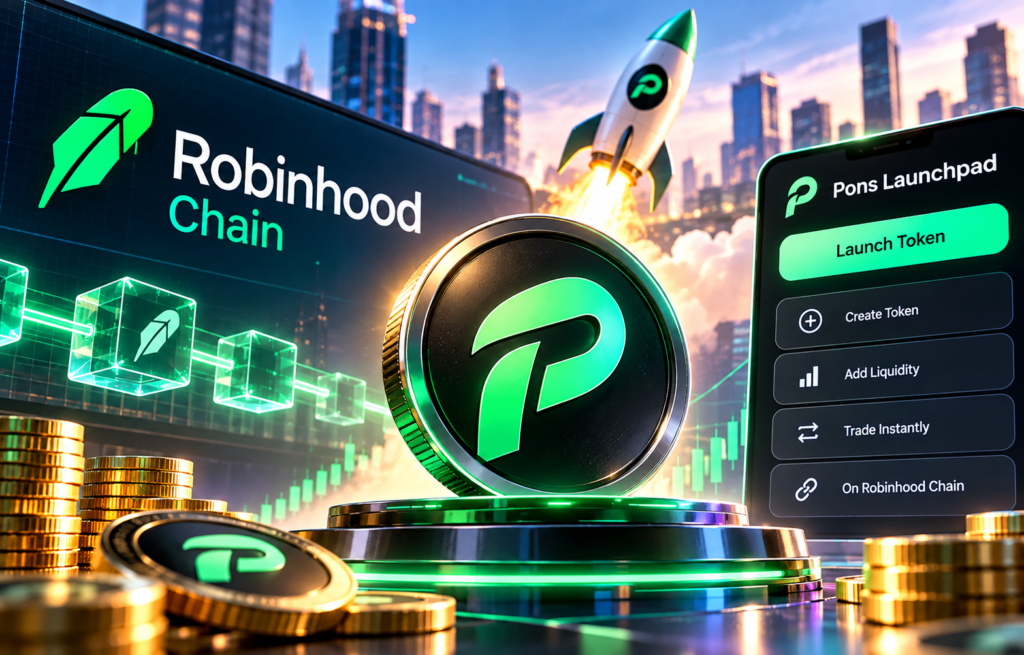
Pons is a non-custodial token launch platform built on Robinhood Chain. It allows creators to deploy fixed-supply tokens and enables trading directly through connected wallets. According to its documentation, Pons does not hold user funds, while token creation and trading transactions are approved through users’ own wallets.
What Is the Pons Launchpad on Robinhood Chain?
Pons is designed around a relatively simple token-launch model.
Creators can choose a token name, symbol, image, description and associated links. The token and its trading pool are created in the same transaction. Current Pons documentation states that launches use a fixed supply of 1 billion tokens, trade against WETH and carry a 0.0005 ETH launch fee.
The platform also includes launch protection during the first few blocks. This is intended to limit extremely early concentration while allowing normal trading to develop after the initial protection period.
Once a token reaches the required liquidity threshold, it can graduate while continuing to trade through the same pool. Pons currently lists 4.2 ETH as its default graduation threshold. Importantly, graduation itself does not guarantee the quality, liquidity or future value of a token.
PONS Gains Wider Market Access
One of the biggest recent developments for the Pons ecosystem came in late September.
PONS trading went live on Kraken on September 25, giving the token access to another established trading venue. The exchange described PONS as the ERC-20 token associated with the Pons launchpad and noted its fixed 1 billion token supply.
The market has remained volatile. Data available on September 29 showed PONS around $0.527, down roughly 5.8% over 24 hours, with an intraday trading volume of more than $55 million on OKX. The token remains well below its September 18 peak of approximately $0.776.
That price action highlights how quickly sentiment can change around launchpad tokens.
Social Trading Could Be the Next Pons Update
Another development attracting attention is a planned social trading feature.
On September 29, Pons founder MEADGod indicated that a social trading feature is approaching. The proposed concept has been described as including real-time onchain buying and selling activity, wallet tracking, alerts, profit and loss records and trader leaderboards.
If implemented, such functionality could make wallet activity and trader behavior easier to follow directly through the Pons ecosystem.
For a launchpad built around rapid token creation and trading, this would represent a move beyond basic token deployment toward a broader trading-oriented platform.
Pons Faces a Growing Risk Challenge
The rapid growth of the Robinhood Chain launchpad ecosystem has also brought increased scrutiny.
An onchain investigation published September 27 linked at least $18.43 million in alleged extractions from 53 memecoin launches between July 10 and September 21 to a single operation. The investigation identified several Pons V2 launches where certain wallets were reportedly exempted from the platform’s early anti-sniping tax and subsequently accumulated large portions of token supplies. The reported figures were based on onchain analysis and were not independently replicated in full.
This does not mean every token launched through Pons is affected. However, it reinforces why users need to examine token contracts, creator wallets, holder concentration and liquidity before trading.
Pons itself warns that its launches are experimental and that tokens can be highly volatile or become illiquid.
What Comes Next for Pons?
The combination of wider exchange access, planned social trading tools and continued activity on Robinhood Chain puts Pons at an interesting point in its development.
The next stage will likely depend on whether the platform can maintain trading activity while improving transparency and reducing risks associated with highly concentrated token launches.
For users researching the Pons launchpad Robinhood Chain ecosystem, the key distinction is important: Pons is the independent launchpad, Robinhood Chain is the underlying blockchain, and PONS is the associated token. They are related, but they are not the same thing.