


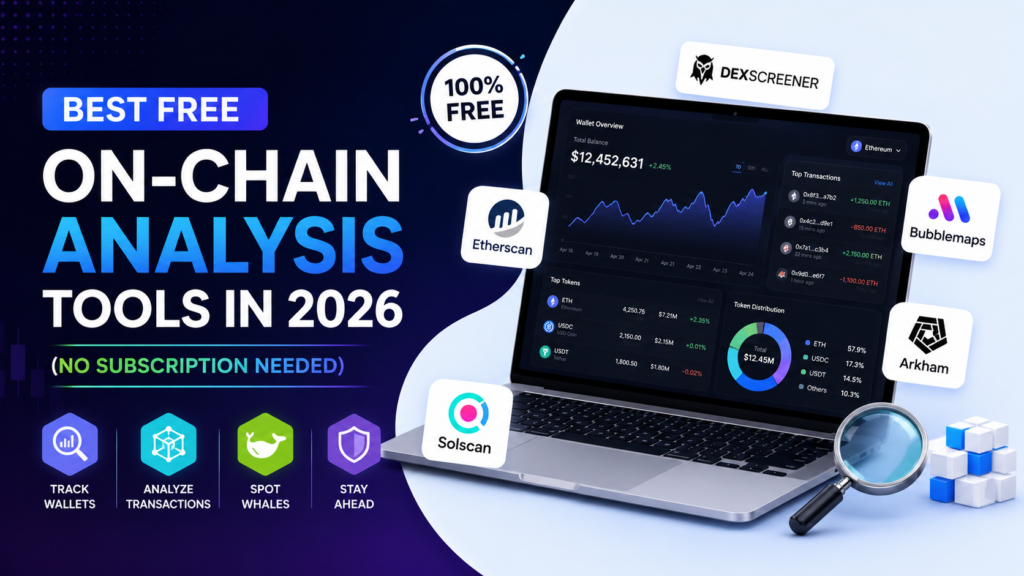
Here’s something the paid tool marketing doesn’t want you to know: the most important on-chain signals available in 2026 are entirely free. No credit card. No subscription. No trial period that quietly rolls into a $99/month charge.
The best strategy in 2026 is to use the free versions of five tools rather than paying for the Pro version of just one. You only go Pro when your trading volume actually justifies the monthly cost. Until then, the free stack covers 80% of what serious research requires and for many traders, it covers 100%.
This guide walks through the best free on-chain tools available right now, what each one genuinely does well at no cost, and how to combine them into a research workflow that competes with paid setups.
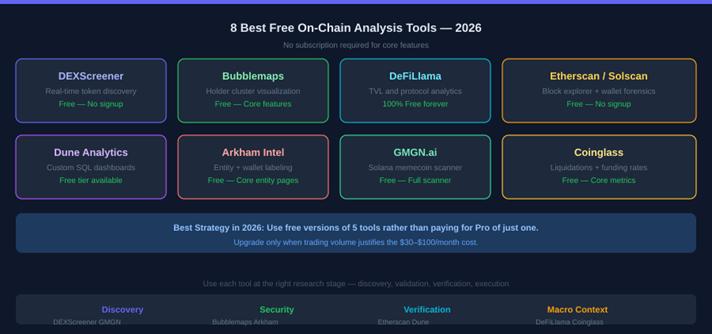
The 8 best free on-chain analysis tools in 2026, organized by research function: discovery, security, verification, and macro context. Use each at the right stage of your research workflow.
1. DEXScreener: Real-Time Token Discovery, Zero Cost
DEXScreener is the starting point for most on-chain research sessions, and the entire core product is free no account, no trial, no catch. Open the URL and you’re immediately looking at real-time DEX activity across more than 80 blockchains.
The platform indexes new liquidity pools within one second of creation, meaning tokens appear on DEXScreener before they appear anywhere else. The advanced screener lets you filter by market cap, token age, liquidity depth, transaction count, and volume surfacing tokens with early traction without requiring you to manually scan hundreds of new pairs.
- What’s free: Real-time charts, new pairs feed, multi-chain screener, buy/sell ratio, liquidity depth, and boosted token identification across 80+ chains
- What requires payment: Advanced watchlist alerts (free account needed, no subscription)
Best use case: First-pass token discovery. DEXScreener tells you what’s moving. Every other tool on this list tells you whether you should care.
2. Bubblemaps: Insider Detection in 60 Seconds
Bubblemaps is the tool that has made holder distribution analysis accessible to every retail trader, not just institutional researchers. It converts raw wallet data into an interactive visual map where bubbles represent holders and connecting lines show transfers between wallets. Insider clusters multiple wallets controlled by the same entity become immediately visible as tight constellations of large, densely connected bubbles.
The core functionality is entirely free: token holder maps, the Bundle Checker (which shows what percentage of supply was coordinated at launch), Time Travel (historical holder distribution at any point), and Magic Nodes (AI-powered detection of hidden wallet connections). These features were previously restricted to paying users but are now available without any account.
- What’s free: Holder visualization, Bundle Checker, Time Travel, Magic Nodes, token security flags across Solana, Ethereum, BSC, Base, and more
- What requires payment: Wallet-level PnL data, cross-chain analytics, Intel Desk participation (BMT token gated)
Best use case: Always run Bubblemaps before entering any memecoin position. A bundle check above 20% is a serious red flag that no price action or smart money signal can override.
3. DeFiLlama: The Only Fully Free Tool on This List
DeFiLlama is the exception to every freemium rule in this space. It is completely free, has no paid tier, serves no ads, and has no intention of adding a subscription. The team is committed to open financial data, full stop.
What you get for nothing: total value locked (TVL) across every DeFi protocol on every chain, yield aggregation showing the best rates across hundreds of pools, bridge volume data, DEX volume rankings, stablecoin flows, and protocol revenue comparisons. These are macro-level signals that tell you where capital is accumulating in the DeFi ecosystem which sectors are growing, which protocols are losing TVL, and where liquidity is rotating.
- What’s free: Everything. TVL, yields, stablecoin data, bridge stats, DEX volumes, protocol revenue, chain comparisons — all without an account
- What requires payment: Nothing. There is no paid tier.
Best use case: Understanding macro DeFi capital flows before entering any protocol or ecosystem. Rising TVL in a chain often precedes token price appreciation across that ecosystem.
4. Etherscan and Solscan: The Raw Data Layer
Block explorers are the most underrated free tool in any trader’s stack. Etherscan for Ethereum and EVM chains, Solscan for Solana both are completely free and require no account for core functionality.
What you can do with a block explorer that most traders don’t: verify token contract code and whether it has been audited, check if mint authority has been revoked, trace the funding history of any wallet to its origin address, identify developer wallet addresses from contract deployment records, see the full transaction history of any address with timestamps and USD values, and confirm token holder distribution from the contract’s token holder list.
- What’s free: Full transaction history, wallet balances, contract code, token holders, internal transactions, event logs, gas analysis
- What requires payment: Bulk API access ($199+/month), high-volume data exports
Best use case: Forensic wallet research. When you want to trace where a suspicious wallet was funded from, or verify a contract’s code before interacting with it, the block explorer is your source of truth.
5. Dune Analytics: Community Intelligence for Free
Dune Analytics is a SQL-based blockchain analytics platform where users build and share custom dashboards. The free tier gives you access to thousands of community-created dashboards covering virtually every on-chain question anyone has thought to ask: whale wallet rankings, stablecoin supply changes, protocol revenue trends, NFT floor price history, DEX market share, and much more.
You don’t need to write a single line of SQL to get value from Dune. Browsing the community dashboards alone gives you access to custom research that would take professional analysts weeks to build from scratch. The most important dashboards are bookmarked and shared across the research community, and they update automatically as new blockchain data comes in.
- What’s free: Browse and view all public dashboards, run existing queries, create basic dashboards with free execution credits
- What requires payment: Private queries, CSV export, faster query refresh, higher execution limits
Best use case: Deep research on specific protocols or chains. Search for the topic you’re researching and you’ll find someone has already built the dashboard.
6. Arkham Intelligence: Entity Labeling Without the Price Tag
Arkham’s free tier is more capable than most people realize. The platform has labeled over 300 million wallet addresses and makes those labels searchable without any subscription. Type any wallet address and you get the entity page: current holdings, transaction history, transfer network visualization, and whatever label Arkham has assigned (fund, exchange, whale, government wallet, known protocol).
The Intel Exchange where users buy and sell on-chain intelligence using ARKM tokens is also accessible at the free tier for browsing. This means you can benefit from crowdsourced wallet attribution research without paying for it. The free search and entity identification is the most practically useful part of Arkham for non-institutional traders, and it costs nothing.
- What’s free: Wallet entity pages, transfer history, holdings visualization, Intel Exchange browsing, basic wallet search
- What requires payment: API access, deeper label data, premium Intel Exchange features (ARKM token gated)
Best use case: Identifying who is behind a wallet. When DEXScreener shows unusual buying, Arkham tells you whether that buyer is a known fund, a retail wallet, or a government seizure address.
7. GMGN.ai: Solana’s Best Free Scanner
For Solana memecoin hunters specifically, GMGN.ai offers a genuinely powerful free tier. The token scanner, smart money feed, security scoring, and wallet categorization (whale, KOL, sniper) are all available without paying. The Telegram bot integration for manual copy-trading requires connecting a wallet but no subscription.
GMGN’s free tier covers the full discovery and validation workflow: find a token in the new pairs feed, check its security score against 27 parameters, verify whether any labeled smart money wallets have entered, and execute the buy through the Telegram bot all without spending anything on the platform itself.
- What’s free: Full token scanner with security scoring, smart money feed (whale, KOL, sniper wallets), anti-MEV routing, Telegram bot execution
- What requires payment: 1% handling fee per transaction, enhanced copy-trading automation
Best use case: Solana memecoin security validation. Run every new token through GMGN’s free security score before committing capital. A score below 60 is a rejection.
8. Coinglass: Market Sentiment and Liquidation Data
Coinglass provides free access to the derivatives market data that helps you understand overall crypto market sentiment: liquidation heatmaps, open interest by exchange, funding rates across perpetual contracts, and long/short ratios. These aren’t token-specific signals they’re macro market health indicators.
A funding rate that has turned deeply positive means longs are paying shorts to hold their positions the market is overleveraged to the upside and vulnerable to a squeeze. A liquidation heatmap shows where clusters of stop losses sit at different price levels. Both types of data are available free on Coinglass and add context that pure on-chain token analysis doesn’t provide.
- What’s free: Liquidation maps, open interest, funding rates, long/short ratios, Bitcoin dominance, fear and greed data
- What requires payment: Deep historical data, CSV export, advanced API
Best use case: Timing entries. Before buying into a token move, check Coinglass to confirm the broader market isn’t overleveraged and due for a squeeze that would kill momentum regardless of on-chain signals.
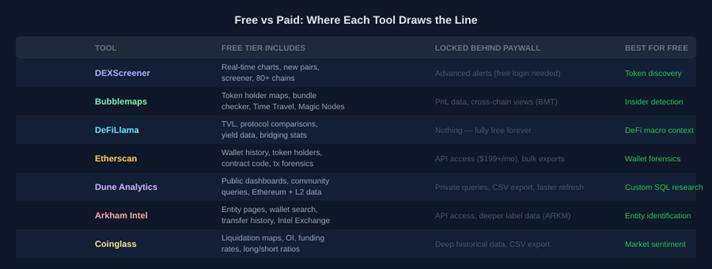
Free vs. paid feature comparison across the 8 tools. The free tier covers the most essential research functions for each platform the paid features are mostly convenience upgrades, not capability gates.
How to Build Your Free Research Stack
The power of these tools isn’t in any one of them individually it’s in how they sequence together. Here’s the workflow that experienced on-chain traders run:
- DEXScreener: Find tokens under 24 hours old with positive buy/sell ratio and minimum $20K liquidity
- GMGN.ai: Run the security score on any token that passes the DEXScreener filter. Reject anything below 60
- Bubblemaps: Check the bundle percentage and holder distribution. Reject anything with more than 20% bundled or a single cluster controlling more than 30% of supply
- Arkham / Etherscan: Identify who the smart money wallets are and trace the deployer’s funding source
- Coinglass: Check market-wide funding rates before entering. Avoid entering when the market is heavily overleveraged
This full workflow costs nothing. It covers discovery, security, holder verification, entity identification, and macro timing the five dimensions of on-chain research that determine whether a trade has edge or is just gambling with extra steps.
Going Deeper: The Methodology Behind the Tools
Knowing which tools to use is the starting point. Understanding the analytical framework that makes those tools powerful is what separates traders who use on-chain data as decoration from those who genuinely extract edge from it.
The methodology behind reading capital flows, identifying real smart money accumulation, understanding whale behavior patterns, and building a systematic research process is exactly what the guide below covers in depth. It’s the essential complement to the free tools listed above the thinking that makes the data actionable.
When to Actually Pay for a Tool
The honest answer: not yet, for most traders. The free tiers described above cover the full research workflow for anyone trading at a retail level. The signals they surface are real, the data is accurate, and the workflow is practical.
Upgrading to paid makes sense when one of three things happens:
- Volume justifies it: If a single trade informed by better data covers three months of subscription cost, the math works
- You hit a specific free tier wall: Running out of Dune query credits or needing CSV exports are concrete limitations that justify spending money
- You’re running a systematic process: Traders monitoring dozens of wallets simultaneously need Cielo or Nansen’s alert infrastructure, which requires a subscription
Until those conditions apply, the free stack described in this guide is not a compromise. It’s the right tool for the job.