


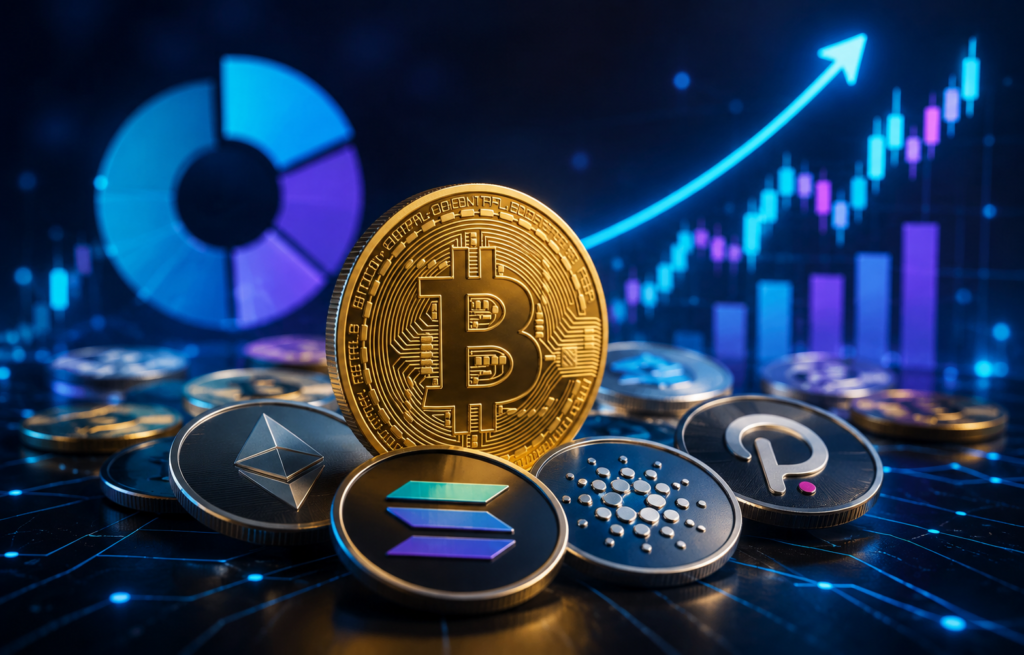
The altcoin market is experiencing a selective rotation rather than a broad market-wide altseason. With Bitcoin trading around $63,000 and controlling near 58% dominance, Ethereum’s low ETH/BTC ratio (0.026) and a mid-range Altcoin Season Index (45-50) indicate that capital remains concentrated in Bitcoin and select large-cap assets.
The altcoinok market is facing a very different environment from the broad, speculative rallies seen in previous crypto cycles. Bitcoin remains near the center of capital flows, while most altcoins continue to struggle to produce sustained outperformance.
As of mid-August 2026, Bitcoin is trading around the $63,000 area, while Ethereum remains below $1,900. Recent market reports point to weak liquidity and softer Bitcoin ETF demand as factors limiting broader crypto momentum.
That matters because a traditional altseason usually requires more than a handful of tokens moving higher. It requires broader participation, improving liquidity and a sustained shift in relative performance.
Key Highlights
- The term altcoinok is the Hungarian plural form commonly used for “altcoins,” or cryptocurrencies other than Bitcoin.
- The current crypto market remains tilted toward Bitcoin rather than a broad altcoin rotation.
- CoinMarketCap’s recent analysis places the Altcoin Season Index around the 45 to 50 range, well below its 75 threshold for broad altseason.
- Ethereum’s relative weakness remains an important obstacle to a traditional market-wide altcoin rotation.
- Investors should watch Bitcoin dominance, ETH/BTC, altcoin breadth and liquidity rather than relying on a single altseason indicator.
Table of Contents
- What Does Altcoinok Mean?
- What Is Happening in the Altcoin Market?
- Why Ethereum Matters to Altseason
- Altcoin Season Index Remains Below Confirmation Levels
- Why This Altcoin Cycle Looks Different
- What Could Trigger a Broader Altcoin Rotation?
- Risks Facing the Altcoin Market
- What Should Traders Watch Next?
- Altcoinok Market Outlook
- Conclusion
- Frequently Asked Questions
What Does Altcoinok Mean?
Altcoinok is the Hungarian plural form of altcoin. In English-language crypto coverage, the equivalent term is altcoins.
An altcoin generally refers to a cryptocurrency other than Bitcoin. The category now includes a wide range of assets, from Ethereum and Solana to DeFi, infrastructure, gaming, RWA and meme tokens.
The exact term has also appeared in search contexts related to the Altcoin Season Index, which measures the relative performance of altcoins against Bitcoin.
That distinction is important for understanding the current search intent around altcoinok. The term is not the name of a single cryptocurrency. It refers to the broader altcoin category and, in some search results, the market conditions surrounding altseason.
What Is Happening in the Altcoin Market?
The current market is showing a selective rather than broad rotation.
Bitcoin has remained around the $63,000 level despite softer US inflation data, with weak liquidity limiting the market’s ability to sustain a stronger move. Recent reports also pointed to reduced Bitcoin ETF demand as a source of caution.
That environment makes it harder for capital to spread across the wider altcoin market.
CoinMarketCap recently reported that its Altcoin Season Index was sitting around 45 to 50, indicating that Bitcoin continued to outperform most major altcoins. The publication also noted that more than 260 days had passed since the last confirmed altseason.
This does not mean altcoins cannot rally.
Instead, it suggests that individual sectors and tokens can move higher without producing the broad market-wide participation associated with classic altseason.
Why Ethereum Matters to Altseason
Ethereum has historically played an important role in crypto market rotations.
When ETH begins outperforming Bitcoin, traders often interpret the move as evidence that risk appetite is moving beyond BTC. Stronger Ethereum performance can then create a foundation for broader interest in other large-cap altcoins.
The current setup is less convincing.
CoinMarketCap’s recent analysis said the ETH/BTC ratio reached a 10-month low around 0.026 in June 2026, while ETH remained significantly below its previous all-time high. The weakness means Ethereum has not yet provided the relative-strength signal normally associated with a broader rotation.
That makes ETH/BTC one of the most important indicators to watch.
Altcoin Season Index Remains Below Confirmation Levels
The Altcoin Season Index is designed to measure how many leading altcoins are outperforming Bitcoin over a specified period.
CoinMarketCap defines its broad altseason condition when 75 of the top 100 coins outperform Bitcoin over the trailing 90 days. Its recent reading in the mid-40s to 50 range remains well below that threshold.

The index should therefore be treated as a confirmation tool rather than a prediction mechanism.
Why This Altcoin Cycle Looks Different
The altcoin market has changed significantly.
There are now millions of digital assets competing for the same pool of capital, while institutional participation is increasingly concentrated in a smaller number of liquid assets.
Binance’s 2026 market analysis highlighted this shift, noting that flows have increasingly concentrated in large-cap names such as Ethereum, Solana and XRP rather than spreading evenly across the entire altcoin market.
That creates a more selective market.
Instead of:
Bitcoin → Ethereum → Everything Rallies
the current environment can look more like:
Bitcoin → Large-Cap Altcoins → Specific Narratives → Selective Tokens
This distinction is critical for anyone following altcoinok trends.
What Could Trigger a Broader Altcoin Rotation?
Several conditions would strengthen the case for a genuine altseason.
Falling Bitcoin Dominance
A sustained decline in Bitcoin’s market share could indicate capital moving toward other crypto assets.
Stronger ETH/BTC
Ethereum would ideally need to establish sustained relative strength against Bitcoin.
Higher Altcoin Breadth
More cryptocurrencies need to outperform BTC, rather than only a few high-profile tokens.
Improved Liquidity
A stronger liquidity environment could give traders more capacity to move further down the risk curve.
Stablecoin Growth
Stablecoin liquidity can provide potential buying power for crypto markets, although rising stablecoin supply alone does not guarantee that capital will flow into altcoins.
Risks Facing the Altcoin Market
The bullish case remains incomplete, and several risks could delay a broad rotation.
Bitcoin Weakness
If Bitcoin breaks down sharply, altcoins could experience even greater losses because of their higher volatility.
Weak Ethereum Performance
A continued decline in ETH/BTC would make a traditional altseason harder to establish.
Token Supply
Large token unlocks can increase circulating supply and create selling pressure when demand fails to absorb the additional tokens.
Liquidity
Smaller altcoins can experience significant price movements when trading liquidity is thin.
Narrative Dependence
AI, RWA, DePIN, gaming and other themes can attract capital quickly, but attention can disappear just as quickly.
What Should Traders Watch Next?
The most useful approach is to track several indicators together.
- Bitcoin Dominance: A sustained breakdown would strengthen the capital-rotation argument.
- ETH/BTC: A recovery would indicate improving Ethereum relative strength.
- Altcoin Season Index: A move toward and eventually above 75 would provide much stronger evidence of broad altcoin participation.
- Altcoin Market Breadth: Watch how many major altcoins are actually outperforming Bitcoin.
- Liquidity: Monitor stablecoin growth, trading volume and broader risk appetite.
- Institutional Flows: Institutional capital remains important because current market structure is more concentrated than in earlier retail-driven cycles.
Altcoinok Market Outlook
The current evidence points to a selective altcoin market rather than a confirmed altseason.
Some individual assets and sectors can still outperform. Recent CoinMarketCap analyses, for example, have shown episodes where the Altcoin Season Index moved above 50 and individual tokens benefited from broader rotation.
But the broader conditions remain less convincing.
Bitcoin continues to command substantial market attention, Ethereum has yet to establish sustained relative strength and the Altcoin Season Index remains below the level typically associated with broad altcoin outperformance.
That means traders should be careful about treating every altcoin rally as the beginning of a new cycle.
Conclusion
The current altcoinok landscape is defined more by selective rotation than a full-scale altseason.
Bitcoin remains the dominant market reference point, while Ethereum’s relative weakness and a mid-range Altcoin Season Index suggest that capital has not yet moved broadly across the altcoin market.
The next major signal will not necessarily come from one token’s price surge. A more convincing shift would involve falling Bitcoin dominance, stronger ETH/BTC performance, expanding altcoin breadth and improving liquidity at the same time.
Until those conditions align, the more defensible view is that the altcoin market remains in a transition phase.
For readers tracking altcoinok trends, the question is therefore not simply “Which altcoin will pump next?” The more useful question is whether the underlying market structure is actually changing.
Frequently Asked Questions
What does altcoinok mean?
Altcoinok is the Hungarian plural form of “altcoin,” referring to cryptocurrencies other than Bitcoin. In some search contexts, the term also appears alongside discussions of the Altcoin Season Index and broader altcoin market conditions.
What are altcoins?
Altcoins are cryptocurrencies other than Bitcoin. The category includes assets with very different purposes, including smart-contract platforms, DeFi protocols, blockchain infrastructure, gaming networks, RWA projects and meme coins.
What is altcoin season?
Altseason generally refers to a period when a broad group of altcoins outperforms Bitcoin. It is different from an isolated rally in one or two tokens because broad participation is an important part of the concept.
How does the Altcoin Season Index work?
The index measures the relative performance of leading altcoins against Bitcoin over a defined period. CoinMarketCap’s methodology uses the performance of the top 100 coins, with 75 or more outperforming Bitcoin over 90 days used as its altseason threshold.
Is it altcoin season right now?
Current evidence does not support calling a broad altseason confirmed. CoinMarketCap’s recent analysis placed the Altcoin Season Index around 45 to 50, below its 75 threshold, while Bitcoin continued to outperform many altcoins.
What could trigger the next altseason?
A combination of falling Bitcoin dominance, stronger ETH/BTC performance, increasing altcoin breadth and improved market liquidity would provide a stronger confirmation of a broad rotation.
Why is Ethereum important for altseason?
Ethereum has historically acted as an important bridge between Bitcoin and the broader altcoin market. Strong ETH/BTC performance can indicate that capital is moving beyond Bitcoin, while persistent ETH weakness can make a broad rotation more difficult.
Are altcoins riskier than Bitcoin?
Many altcoins carry greater volatility, liquidity risk and project-specific risks than Bitcoin. Their performance can also depend heavily on tokenomics, adoption, market narratives and individual project developments.