


Key Highlights
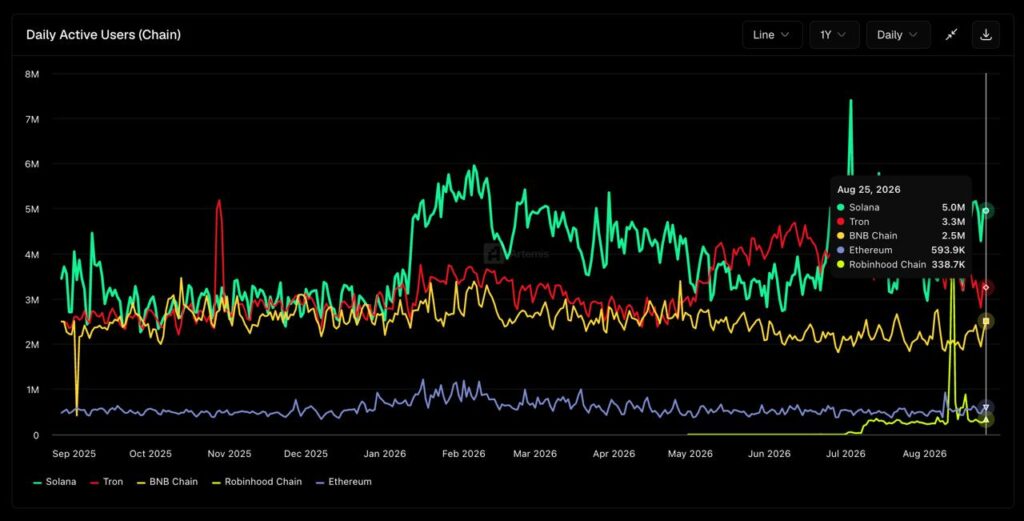
- Solana daily active addresses reached 5.0 million on August 25, 2026, marking a major milestone for on-chain user engagement.
- Solana outperformed competing major blockchains in daily participation, including Tron (3.3M) and BNB Chain (2.5M).
- On-chain activity was driven by broad participation across DeFi, memecoin trading, token transfers, and decentralized applications.
- Analysts emphasize that maintaining elevated active address levels is crucial to proving long-term ecosystem retention rather than a short-term spike.
Solana is seeing a fresh surge in network activity, with Solana daily active addresses reaching 5 million. The milestone highlights the growing number of users interacting with the blockchain and puts Solana among the most active major networks by daily participation.
The latest figures show Solana recording around 5.0 million daily active addresses on August 25, 2026. The increase comes after months of fluctuating activity and represents a notable recovery from the lower levels seen earlier in the year.
The development also comes as activity across several competing blockchain networks remains elevated, making daily active addresses an important metric for measuring where users are spending their time on-chain.
Solana Daily Active Addresses Reach 5 Million
The 5 million mark is significant because daily active addresses provide a snapshot of how many unique blockchain addresses are interacting with a network during a given period.
For Solana, the latest figure represents a substantial level of engagement. The network has maintained relatively high activity throughout 2026, although daily participation has moved considerably from month to month.
The chart shows Solana activity climbing sharply during several periods earlier this year before experiencing periods of cooling. More recently, activity has increased again, culminating in the latest 5 million daily active addresses reading.
This suggests that users are once again becoming more active across the Solana ecosystem.
What Is Driving Solana Network Activity?
Several parts of the Solana ecosystem can contribute to increased daily activity.
Decentralized finance, token trading, memecoins, payments, decentralized applications and new token launches all generate on-chain transactions. When activity increases across multiple segments, the number of active addresses can rise quickly.
Solana’s transaction speed and relatively low transaction costs have also helped it attract users who frequently interact with blockchain applications.
The recent increase in Solana daily active addresses therefore should not be viewed as the result of a single application or token. It reflects broader participation across the network.
Solana Remains Highly Active Compared With Other Networks
The latest chart compares daily active users across Solana, Tron, BNB Chain, Ethereum and Robinhood Chain.
Solana stands out with approximately 5 million daily active addresses on August 25. Tron follows at around 3.3 million, while BNB Chain records approximately 2.5 million. Ethereum and Robinhood Chain remain considerably lower based on the figures displayed in the chart.
The comparison provides useful context for understanding the scale of Solana’s current activity.
However, daily active address figures should not be treated as a direct measure of network value or economic activity. Different blockchains can have different methods of counting addresses, transaction patterns and user behavior.
Why Active Addresses Matter
Active addresses are one of several metrics investors and analysts use to evaluate blockchain adoption.
A rising number can indicate that more users are interacting with decentralized applications, transferring assets or trading tokens. Sustained growth can also suggest that a network is attracting continued attention rather than relying entirely on short-term speculation.
For Solana, the latest increase is particularly interesting because the network has experienced significant changes in activity throughout 2026.
The move toward 5 million daily active addresses indicates that the blockchain is currently experiencing another period of strong engagement.
At the same time, active address data should be considered alongside transaction volume, fees, decentralized application usage, stablecoin activity and capital flows to understand the network’s overall health.
A Strong Signal for the Solana Ecosystem
The latest Solana daily active addresses milestone could have wider implications for the ecosystem.
More users interacting with the network can translate into greater demand for decentralized applications and blockchain infrastructure. Developers may also benefit from a larger active user base, particularly if activity remains strong over an extended period.
For projects building on Solana, a growing pool of active addresses creates a larger potential audience. This can support everything from decentralized exchanges and lending protocols to gaming applications and consumer-focused blockchain products.
The challenge will be maintaining this level of activity.
A single spike can be caused by temporary market conditions, popular token launches or unusual trading activity. A sustained elevated level would provide a stronger indication of long-term user engagement.
What Comes Next for Solana?
The next few weeks will be important for determining whether the 5 million milestone becomes a new baseline for Solana or represents a temporary peak.
If daily active addresses remain close to current levels, it could strengthen the argument that Solana is experiencing a broader resurgence in network usage. Continued growth would make the metric even more significant.
If activity falls sharply, the latest spike could instead prove to be a short-term surge.
For now, the numbers tell a clear story. Solana daily active addresses have reached 5 million, highlighting the intensity of activity taking place across the network.
With Solana continuing to compete for users across decentralized finance, trading, payments and other blockchain applications, maintaining this momentum could become one of the most important indicators to watch for the ecosystem through the remainder of 2026.