


Key Highlights
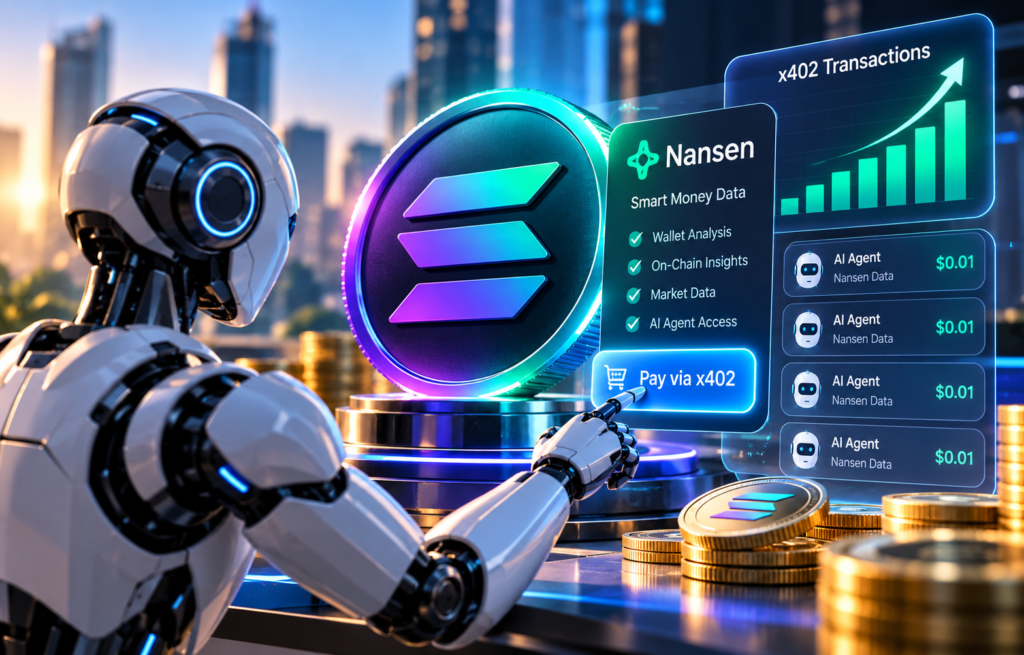
- Solana highlighted an all-time high for Nansen-related x402 payment transactions, with AI agents purchasing smart money data via sub-cent micropayments.
- The x402 protocol enables machine-to-machine HTTP payments, allowing autonomous software to access paid APIs and data feeds without traditional accounts or subscriptions.
- Solana handles over 37 million x402 transactions and accounts for roughly 70% to 76% of all monthly x402 network volume worldwide.
- Payment channels for x402 allow AI agents to authorize spending limits for batch settlement, reducing friction during high-frequency API queries.
Solana’s push into the AI agent economy is gaining another signal of momentum as x402 activity reaches a new weekly high tied to automated purchases of blockchain intelligence.
In a September 29 update, Solana highlighted a new all-time high for Nansen-related x402 transactions on Solana, with the network saying Nansen transactions through the x402 payment system now settle more frequently than on all other networks combined. The accompanying update from PayAI Network added another interesting detail: AI agents are purchasing Nansen’s smart money data in tiny payments, with activity rising to nearly three times the previous week’s level.
The development offers a glimpse into a different type of blockchain demand, where software is not simply interacting with decentralized applications but actively paying for data and services on its own.
AI Agents Are Becoming Blockchain Customers
The latest activity revolves around x402, an open payment protocol designed to allow internet services and APIs to charge users automatically through HTTP payment requests.
Instead of requiring an AI agent to create an account, enter billing information or maintain a conventional subscription, x402 can allow an agent to discover a paid resource, authorize a payment and receive the requested data as part of the same workflow.
Solana’s own documentation describes the model as a way for agents to pay for resources such as data queries, model inference and tool calls without first creating a traditional billing account or copying an API key.
That makes blockchain infrastructure particularly relevant to autonomous software.
An AI agent that needs a small piece of information does not necessarily need to purchase an expensive monthly subscription. It can potentially pay only for the specific information required at that moment.
Nansen Data Becomes an Example of Machine-to-Machine Demand
The Nansen activity highlighted by Solana provides a practical example.
According to the update shown by Solana, AI agents are purchasing smart money data through x402, with each transaction reportedly involving payments of around one cent. PayAI Network said weekly purchases increased to almost three times the level recorded during the previous week.
The significance is not the size of an individual payment.
A one-cent transaction is economically unremarkable for a human trader. But an autonomous software agent may need thousands of small pieces of information while performing research, monitoring wallets, comparing market conditions or executing other tasks.
At that scale, micropayments can become a useful economic primitive.
The model effectively turns blockchain data into a service that machines can consume on demand.
What Happened Next? x402 Activity Expanded on Solana
The Nansen development comes as Solana’s wider x402 ecosystem has already reached substantial transaction activity.
Solana currently reports more than 37 million x402 transactions on its network and says the network accounts for roughly 70% of monthly x402 volume. The ecosystem includes payment facilitators, data providers, API services and applications designed for autonomous agents.
Independent tracking has also shown Solana handling the largest share of recent x402 activity. Data covering four weeks through September 19 showed approximately 23.2 million x402 transactions on Solana, representing about 76% of tracked activity during that period.
The numbers illustrate how quickly machine-driven payments are becoming a measurable source of blockchain activity.
Why Tiny Payments Matter
Traditional online payments are often poorly suited to extremely small transactions.
Processing a payment worth a few cents can involve fees, account systems, authentication and settlement processes that make the transaction uneconomical or inconvenient.
x402 takes a different approach by allowing services to request payment directly through an HTTP workflow.
For AI agents, this creates the possibility of a much more granular economy.
An agent could pay a fraction of a dollar for a wallet analysis, another small amount for a market-data query, and then pay for additional information only if it becomes necessary.
That is fundamentally different from the subscription-heavy model used by many data platforms.
Solana’s low transaction costs and fast settlement are part of the reason the network is being positioned as infrastructure for these machine-to-machine payments. Solana’s documentation specifically highlights x402 use cases involving AI agents paying for API access, data feeds and compute resources.
Solana Is Preparing for More Agentic Payments
The network is also working on infrastructure designed to handle situations where an AI agent makes a large number of payments.
Solana introduced payment channels for x402 and other agentic payment protocols, allowing an agent to authorize a spending limit and make multiple purchases against that limit before settling the final amount. The approach is designed to reduce the friction created when agents make hundreds of small paid requests.
That could become increasingly important as autonomous software moves beyond simple chatbot interactions.
An agent that continuously researches markets, monitors wallets or consumes multiple APIs could generate a steady stream of tiny payments throughout the day.
The Bigger Story Is the Rise of Machine-Native Commerce
The latest Nansen activity highlights a broader shift taking place on Solana.
Blockchain networks have traditionally measured success through human users, trading activity and decentralized applications. The emerging agent economy introduces another category: machines that transact independently.
In that environment, transaction count can represent more than speculative trading. It can reflect software buying information, accessing APIs, requesting computation and interacting with other services.
The Nansen example is still an early signal rather than proof that autonomous commerce has reached mass adoption. But the direction is becoming clearer.
Solana is increasingly being used as a settlement layer for small, automated and recurring payments between software systems.
If AI agents continue moving from passive assistants to autonomous economic actors, the ability to make inexpensive payments without human intervention could become an important part of the internet’s financial infrastructure.