


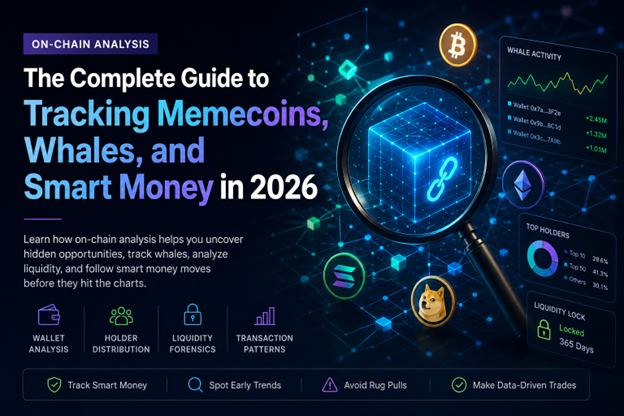
Crypto markets have changed dramatically over the past few years. In earlier cycles, most traders relied heavily on hype, influencer posts, and chart patterns to make decisions. Today, that approach alone is no longer enough — especially in the memecoin market where trends can explode and collapse within hours.
This is where on-chain analysis becomes valuable.
On-chain analysis is the process of studying blockchain activity directly. Instead of guessing what’s happening behind the scenes, traders can verify wallet activity, liquidity movements, token transfers, and holder behavior in real time. Because blockchains are public ledgers, every transaction leaves behind a transparent record.
For memecoin traders, this information can be the difference between catching a strong opportunity early and entering a project moments before a collapse.
Why On-Chain Analysis Matters in 2026
Memecoin markets move faster than almost any other sector in crypto. A token with a $200,000 market cap can suddenly surge into millions overnight simply because a few influential wallets begin buying aggressively.
At the same time, scams have become more sophisticated. Rug pulls, honeypots, fake volume, and insider manipulation are still common.
On-chain analysis helps reduce those risks by focusing on objective blockchain data instead of social media narratives.
Instead of asking “What are influencers saying?” experienced traders ask:
– Who owns the supply?
– Is liquidity locked?
– Are smart wallets accumulating?
– Is trading activity organic?
– Are developer wallets behaving suspiciously?
These questions matter far more than temporary hype.
Understanding Wallet Analysis
Wallet analysis is one of the most important parts of on-chain research.
Every blockchain wallet tells a story. Some wallets repeatedly buy successful projects early, while others are linked to failed launches or insider activity.
When analyzing a wallet, traders usually study:
– Historical trades
– Profitability patterns
– Funding sources
– Interaction with developer wallets
– Entry and exit timing
If a wallet consistently enters strong projects before major price movements, many traders classify it as “smart money.”
In smaller memecoin ecosystems, even a relatively small whale can influence market direction. A single wallet buying heavily into a low-cap token often attracts additional traders and increases visibility.
The Importance of Holder Distribution
Many beginners focus entirely on price action while ignoring token distribution. This is one of the biggest mistakes in crypto trading.
A token may appear healthy on the surface, but if a few wallets secretly control most of the supply, the risk becomes extremely high.
That’s why experienced traders always review the top holder list before entering any memecoin trade.
Generally:
– A single wallet holding more than 5% can create concentration risk.
– Top 10 wallets controlling more than 30% increases insider risk significantly.
– Connected wallets often signal coordinated manipulation.
This is where visual tools like Bubblemaps have become extremely popular. Instead of manually reviewing dozens of addresses, traders can quickly identify wallet clusters and suspicious relationships.
Liquidity Pools and Why They Matter
Liquidity is the foundation of every tradable token.
Without enough liquidity, traders cannot buy or sell efficiently. Even small transactions can create huge price swings.
Before buying any memecoin, experienced traders usually check:
– Total liquidity size
– Liquidity lock duration
– Burned LP tokens
– Ownership of liquidity
A liquidity lock helps reduce rug-pull risk because it prevents developers from instantly removing funds from the pool.
However, many beginners misunderstand this concept.
A locked liquidity pool does not automatically make a project safe. If insiders still control large portions of the token supply, they can dump tokens onto the market regardless of LP status.
Recognizing Suspicious Activity
One of the strongest advantages of on-chain analysis is the ability to spot unusual behavior early.
Some of the most common red flags include:
Wash Trading:
Wash trading happens when wallets repeatedly trade back and forth to create fake volume. It gives the illusion of demand even when real interest is weak.
Sniper Bot Activity:
Sniper bots buy tokens within seconds of launch, often using multiple fresh wallets funded from the same source. These bots usually aim to sell quickly into early hype.
Artificial Holder Growth:
Some projects distribute tiny token amounts across many wallets to create the appearance of widespread adoption.
Developer Wallet Movement:
Unexpected transfers from developer wallets can signal upcoming sell pressure or liquidity manipulation.
Learning how to recognize these patterns takes practice, but over time they become easier to identify.
Best Free Tools for Beginners
One reason on-chain analysis has become so popular is because many powerful tools are completely free.
Some of the most widely used include:
For most beginners, these tools provide more than enough data to start learning.
Dexscreener is especially useful for memecoin discovery because it combines charts, liquidity information, volume tracking, and transaction feeds in one place.
Paid Tools for Advanced Traders
As traders become more experienced, many eventually invest in premium analytics platforms.
Popular paid tools include:
These platforms specialize in wallet labeling, smart-money alerts, and advanced tracking systems.
However, paid tools alone do not guarantee profits. Strong research habits matter far more than expensive dashboards.
How Smart Money Traders Find Opportunities
Most profitable traders do not randomly chase trending tokens.
Instead, they follow structured workflows.
A typical smart-money process looks like this:
- Track successful wallets
- Monitor new buys in real time
- Compare overlapping wallet activity
- Verify liquidity and holder distribution
- Enter only after confirming risk factors
The strongest signals usually happen when multiple profitable wallets buy the same token within a short period.
This type of “wallet convergence” often attracts additional attention quickly.
The Role of Psychology in On-Chain Trading
One underrated aspect of on-chain analysis is emotional discipline.
Crypto markets are driven heavily by fear and greed. Traders often enter projects emotionally after seeing rapid price increases.
On-chain analysis creates a more structured decision-making process.
Instead of reacting emotionally, traders rely on measurable blockchain data.
This does not eliminate risk entirely, but it improves consistency.
Common Beginner Mistakes
New traders often repeat the same errors:
- Buying based only on Twitter hype
- Ignoring wallet concentration
- Failing to verify liquidity locks
- Confusing trending tokens with quality projects
- Assuming all “renounced contracts” are safe
Perhaps the biggest mistake is verifying information after buying instead of before.
Experienced traders perform research first and enter positions later.
Can On-Chain Analysis Predict Price?
No tool can predict price with certainty.
On-chain analysis is not magic.
What it does provide is probability-based decision making. It helps traders identify:
- Higher-quality setups
- Lower-risk entries
- Suspicious behavior
- Strong wallet activity
- Potential manipulation
In volatile markets like memecoins, improving probabilities matters significantly.
Building a Daily Research Workflow
Successful traders usually follow simple routines.
Morning:
– Scan Dexscreener for trending pairs
– Filter by liquidity and volume
– Build a shortlist
Midday:
– Check holder concentration
– Review liquidity locks
– Analyze transaction activity
Evening:
– Monitor smart-wallet movements
– Review whale alerts
– Track new narratives emerging across chains
This process often takes less than an hour per day but creates much better decision-making.
Final Thoughts
On-chain analysis has become one of the most important skills in modern crypto trading.
In a market filled with noise, speculation, and influencer-driven narratives, blockchain data remains one of the few reliable sources of truth.
By learning how to analyze wallets, liquidity, holder distribution, and transaction patterns, traders can make more informed decisions and reduce unnecessary risk.
No strategy is perfect, and losses are always possible in crypto. But traders who understand on-chain behavior usually operate with a major advantage over those relying purely on hype.
As memecoin markets continue evolving in 2026, on-chain analysis will likely become even more important, not just for advanced traders, but for anyone serious about navigating crypto safely and intelligently.