


Introduction
Imagine being able to send money across the world in minutes, borrow funds without visiting a bank, earn interest on your digital assets, or trade cryptocurrencies 24/7 all without filling out paperwork or relying on a financial institution.
This isn’t a vision of the distant future. It’s happening today through Decentralized Finance (DeFi).
Over the past few years, DeFi has become one of the fastest-growing sectors in the blockchain industry. Built on decentralized blockchain networks and powered by smart contracts, DeFi is redefining how people access financial services. Instead of depending on banks, brokers, or payment providers, users can interact directly with blockchain-based applications while maintaining control over their assets.
Whether you’re new to cryptocurrency or exploring advanced blockchain technologies, understanding what is DeFi is essential. It represents more than a new way to manage money it introduces a financial system designed to be open, transparent, and accessible to anyone with an internet connection.
However, DeFi is about more than just buying and selling cryptocurrencies. It powers decentralized exchanges (DEXs), lending and borrowing platforms, staking, yield farming, tokenized assets, and a growing ecosystem of financial tools that operate without traditional intermediaries.
Like any emerging technology, DeFi also comes with challenges. Smart contract vulnerabilities, market volatility, regulatory uncertainty, and evolving security risks mean users should understand both the opportunities and the responsibilities before participating.
In this comprehensive guide, you’ll learn how DeFi works, why it matters, its core components, real-world applications, advantages, risks, and how it compares with traditional financial systems.
What Is DeFi?
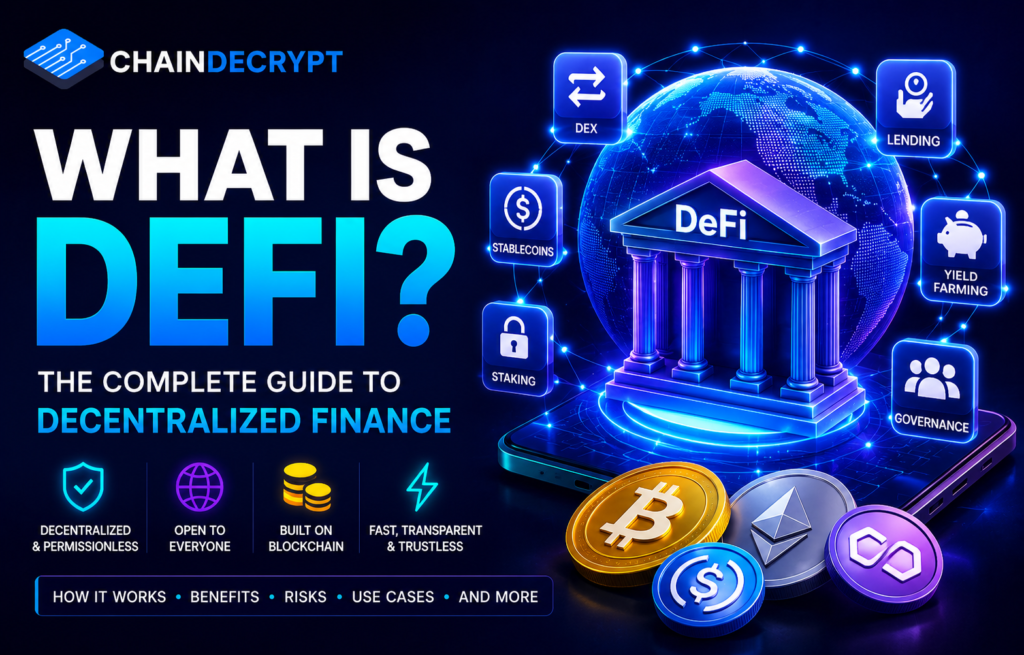
Decentralized Finance (DeFi) is a blockchain-based ecosystem of financial applications that enables users to access services such as trading, lending, borrowing, investing, and earning rewards without relying on centralized financial institutions.
In traditional finance, banks and payment processors act as trusted intermediaries. They verify transactions, manage accounts, approve loans, and maintain financial records.
DeFi removes many of these intermediaries by replacing them with smart contracts self-executing programs that automatically enforce predefined rules on a blockchain.
Instead of opening a bank account, users simply connect a compatible crypto wallet to a decentralized application (dApp). The smart contract handles the transaction, while the blockchain records it transparently and securely.
This permissionless model allows anyone with internet access to participate, regardless of their location or banking history.
Why Was DeFi Created?
To appreciate the significance of DeFi, it’s important to understand the limitations of traditional financial systems.
For decades, financial services have depended on centralized organizations to manage transactions and store customer assets. While this model has supported global commerce, it also introduces several challenges:
- Banking services may not be available to everyone.
- International transfers can be slow and expensive.
- Financial institutions operate within specific business hours.
- Multiple intermediaries increase costs and processing times.
- Users have limited control over how their assets are managed.
Blockchain technology offered an alternative.
Instead of placing trust in a central organization, blockchain distributes trust across a decentralized network. This innovation inspired developers to build financial applications that operate transparently through code rather than institutional oversight.
The result was DeFi a financial ecosystem designed to make services more accessible, programmable, and globally available.
The Evolution of Finance: From Banks to Blockchain
Financial systems have evolved significantly over the past century.
Traditional Banking
Traditional banks provide essential services such as savings accounts, loans, payment processing, and investments. However, these services depend on centralized infrastructure, regulatory oversight, and trusted intermediaries.
Digital Banking
The internet introduced online banking, making financial services more convenient. Customers could transfer money, pay bills, and manage accounts remotely.
Despite these improvements, the underlying financial structure remained centralized.
FinTech Revolution
Financial technology companies introduced innovative payment solutions, mobile banking applications, and digital investment platforms.
While these services improved user experience, they still relied on existing banking infrastructure.
Blockchain Technology
Blockchain fundamentally changed how digital transactions could be verified.
Instead of maintaining records on private databases, blockchain stores information on distributed ledgers that can be independently verified by network participants.
This eliminated the need for a single trusted authority to validate transactions.
The Rise of DeFi
Ethereum’s introduction of smart contracts marked a turning point.
Developers could now create decentralized applications capable of executing financial agreements automatically.
This innovation led to the emergence of decentralized exchanges, lending platforms, synthetic assets, liquidity pools, and countless other DeFi protocols.
Today, DeFi has expanded into a diverse ecosystem supporting millions of users worldwide.
How Does DeFi Work?
Although the technology behind DeFi is sophisticated, the user experience is often straightforward.
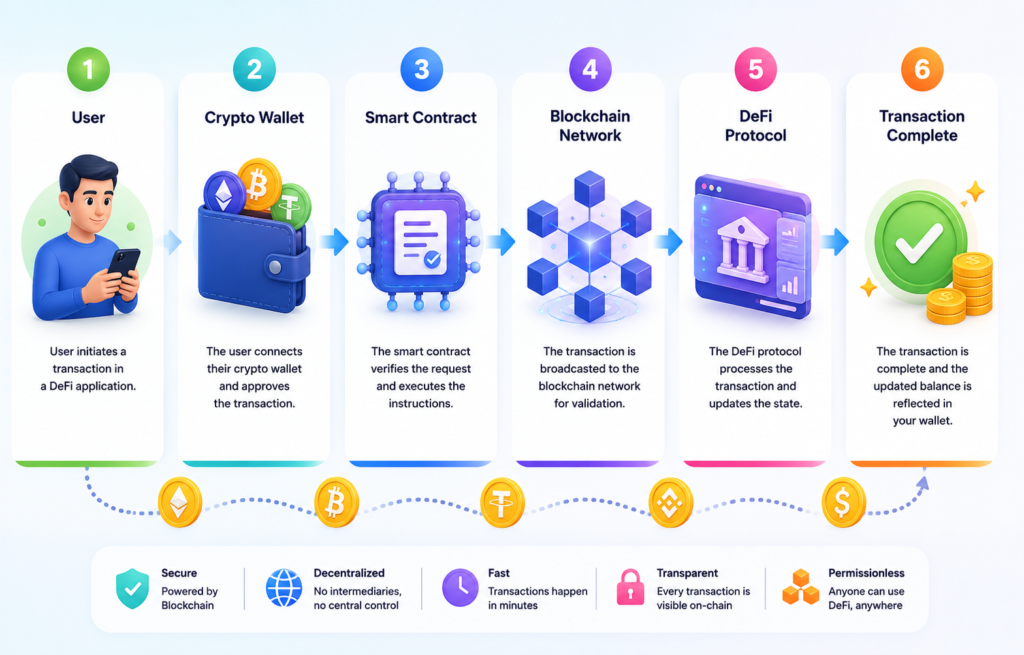
A typical DeFi transaction follows these steps:
Step 1: Create a Crypto Wallet
Before accessing DeFi services, users need a compatible crypto wallet.
Unlike a traditional bank account, a crypto wallet allows users to store digital assets while maintaining control of their private keys.
Popular wallet types include browser extensions, mobile wallets, and hardware wallets.
Step 2: Connect to a Decentralized Application
Users connect their wallet to a decentralized application (dApp).
This connection allows the application to interact with the user’s wallet without taking custody of their funds.
Step 3: Choose a Financial Service
Depending on the platform, users may:
- Swap cryptocurrencies
- Lend assets
- Borrow funds
- Stake tokens
- Provide liquidity
- Participate in governance
- Earn rewards
Each action is managed through smart contracts rather than bank employees or centralized systems.
Step 4: Approve the Transaction
The wallet requests confirmation before the transaction is submitted.
Once approved, the smart contract executes the transaction according to its programmed logic.
Step 5: Blockchain Verification
Validators or miners verify the transaction, depending on the blockchain’s consensus mechanism.
After confirmation, the transaction becomes part of the blockchain’s permanent record.
The Core Building Blocks of DeFi
Understanding the technologies behind DeFi makes it easier to navigate the ecosystem.
Blockchain Networks
Every DeFi application runs on a blockchain that records transactions and executes smart contracts.
Different blockchain networks offer varying levels of scalability, transaction speed, and fees, allowing users to choose platforms that best fit their needs.
Smart Contracts
Smart contracts are the foundation of DeFi.
These self-executing programs automatically process transactions once predefined conditions are met.
Because they operate according to transparent code, they reduce the need for manual intervention while enabling decentralized financial services.
Crypto Wallets
A crypto wallet serves as the gateway to DeFi.
Instead of creating accounts with multiple financial institutions, users connect their wallet directly to decentralized applications.
Since users control their private keys, they also retain ownership of their assets.
Stablecoins
Cryptocurrency prices can fluctuate significantly.
Stablecoins are designed to maintain a relatively stable value, making them useful for payments, lending, borrowing, and trading within DeFi ecosystems.
Decentralized Applications (dApps)
dApps provide the interface through which users interact with DeFi protocols.
Although they resemble traditional websites or mobile applications, their underlying functionality is powered by blockchain technology and smart contracts rather than centralized servers.
Why DeFi Matters
DeFi represents a shift in how financial services can be delivered.
Rather than relying solely on centralized institutions, individuals can access a growing range of financial tools directly through blockchain networks.
This creates opportunities for greater financial inclusion, increased transparency, and more user control over digital assets.
However, it also places greater responsibility on users to understand security, wallet management, and the risks associated with decentralized protocols.
As the ecosystem continues to evolve, DeFi is becoming an important part of the broader Web3 landscape, complementing traditional finance while introducing entirely new ways to interact with money and digital assets.
What’s Next?
Now that we’ve covered the fundamentals of what DeFi is, why it was created, and how it works, the next section will explore the heart of the DeFi ecosystem.
We’ll examine decentralized exchanges, lending protocols, borrowing, liquidity pools, Automated Market Makers (AMMs), staking, yield farming, governance tokens, and Total Value Locked (TVL) the concepts that power modern decentralized finance.
The DeFi Ecosystem: The Building Blocks of Decentralized Finance
Understanding what DeFi is is only the first step. To truly appreciate how decentralized finance is transforming the financial landscape, it’s important to understand the components that power this ecosystem.
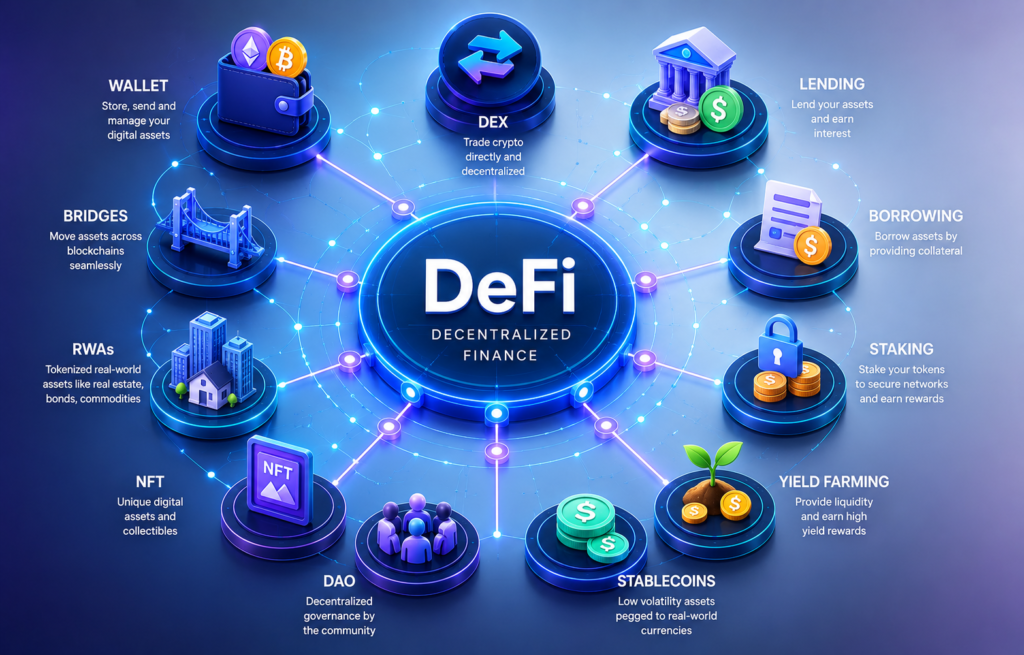
Unlike traditional banking, where different financial services are often offered by separate institutions, DeFi is built like a network of interconnected building blocks. These applications can work together seamlessly, allowing users to combine services such as trading, lending, borrowing, and investing without leaving the blockchain ecosystem.
This composability often referred to as “money Lego” is one of DeFi’s most innovative features. Developers can build new applications by integrating existing protocols, creating an ecosystem that evolves much faster than traditional financial infrastructure.
Let’s explore the core components that make DeFi possible.
Smart Contracts: The Engine Behind DeFi
Every DeFi application relies on smart contracts.
A smart contract is a self-executing computer program stored on a blockchain. Instead of requiring a bank employee, broker, or payment processor to verify transactions, the smart contract automatically performs the agreed actions once predefined conditions are met.
For example, if you deposit cryptocurrency into a lending protocol, the smart contract can automatically calculate your interest, distribute rewards, and allow eligible borrowers to access liquidity all without human intervention.
Why Smart Contracts Matter
Smart contracts provide several advantages:
- Automation reduces manual processing.
- Transactions follow transparent, predefined rules.
- Users don’t need to trust a central authority.
- Operations run continuously without business-hour limitations.
- Records are stored on the blockchain for greater transparency.
However, smart contracts are only as secure as their underlying code. Bugs or vulnerabilities can be exploited, which is why reputable DeFi projects often undergo independent security audits.
Crypto Wallets: Your Gateway to DeFi
Unlike traditional finance, where a bank controls your account, DeFi revolves around self-custody.
A crypto wallet acts as your identity within the blockchain ecosystem. It stores your private keys, enabling you to access decentralized applications while maintaining ownership of your digital assets.
Most wallets support:
- Sending and receiving cryptocurrencies.
- Connecting to decentralized applications.
- Managing NFTs.
- Staking supported assets.
- Viewing transaction history.
Because users control their own wallets, protecting recovery phrases and private keys is critical. Losing them can result in permanent loss of access to your assets.
Decentralized Exchanges (DEXs)
One of the most popular applications within DeFi is the Decentralized Exchange (DEX).
Unlike centralized exchanges, where users deposit funds into company-controlled accounts, DEXs allow peer-to-peer trading directly from users’ wallets.
This approach offers several benefits:
- Users maintain custody of their assets.
- Trading is available 24/7.
- No centralized entity holds customer funds.
- Transactions are recorded on the blockchain.
Instead of relying on traditional order books, many DEXs use Automated Market Makers (AMMs) to facilitate trading.
What Are Automated Market Makers (AMMs)?
Traditional stock exchanges and many centralized crypto exchanges match buyers with sellers using an order book.
DeFi introduced a different model.
Automated Market Makers (AMMs) use liquidity pools instead of matching individual buyers and sellers.
Imagine a vending machine filled with different beverages. Instead of negotiating with another customer, you simply insert payment, and the machine automatically delivers your chosen drink.
AMMs work similarly. Users trade against a pool of assets managed by smart contracts rather than another individual trader.
This innovation enables decentralized trading while reducing reliance on centralized intermediaries.
Liquidity Pools Explained
A liquidity pool is a collection of cryptocurrencies locked within a smart contract.
These pools provide the assets necessary for decentralized trading.
For example, a liquidity pool may contain:
- ETH and USDC
- BTC and ETH
- SOL and USDT
When someone swaps one asset for another, the transaction occurs against the liquidity pool.
Users who contribute assets to these pools are known as Liquidity Providers (LPs).
In return, they often receive a portion of the trading fees generated by the platform.
Liquidity pools form the foundation of many DeFi applications, including decentralized exchanges, lending platforms, and yield farming protocols.
Lending and Borrowing Without Banks
One of DeFi’s most transformative innovations is decentralized lending.
Instead of applying for a loan through a bank, users interact directly with blockchain-based lending protocols.
Here’s how it works:
Lenders
Users deposit cryptocurrency into a lending pool.
Their assets become available for borrowing, and in return, they earn interest.
Borrowers
Users can borrow cryptocurrency by providing collateral.
Since blockchain transactions are transparent and automated, loans are often processed within minutes rather than days.
This model eliminates much of the paperwork associated with traditional lending while making financial services more accessible to users worldwide.
Staking
Although staking is primarily associated with Proof-of-Stake blockchains, many DeFi platforms integrate staking opportunities into their ecosystems.
Staking involves locking eligible digital assets to support blockchain operations or protocol functionality.
In return, participants may receive rewards.
Staking appeals to long-term holders who wish to generate passive income without actively trading their assets.
However, rewards, lock-up periods, and risks vary between protocols.
Yield Farming
Yield farming is one of the most recognized DeFi strategies.
Rather than simply holding cryptocurrency, users allocate their assets to liquidity pools or decentralized protocols to earn additional rewards.
These rewards may come from:
- Trading fees.
- Protocol incentives.
- Governance token distributions.
Yield farming can potentially generate attractive returns, but it also introduces additional risks, including market volatility and impermanent loss.
For beginners, understanding the mechanics of each protocol is essential before participating.
Stablecoins: The Foundation of Everyday DeFi
Cryptocurrency markets can experience significant price fluctuations.
Stablecoins were introduced to provide a more predictable medium of exchange within DeFi.
Unlike many cryptocurrencies, stablecoins aim to maintain a relatively stable value, often by referencing external assets or using algorithmic mechanisms.
Within the DeFi ecosystem, stablecoins are commonly used for:
- Trading.
- Lending.
- Borrowing.
- Payments.
- Yield generation.
- Liquidity provision.
Their relative price stability makes them an important component of decentralized financial applications.
Governance Tokens
Many DeFi protocols are managed by decentralized communities rather than traditional companies.
Governance tokens allow holders to participate in decisions affecting the protocol.
Depending on the project, token holders may vote on:
- Fee structures.
- Treasury allocation.
- Software upgrades.
- New feature implementation.
- Risk management proposals.
This decentralized governance model aligns with DeFi’s broader goal of reducing reliance on centralized decision-makers.
What Is Total Value Locked (TVL)?
If you’ve spent time researching DeFi, you’ve likely encountered the term Total Value Locked (TVL).
TVL represents the total value of assets deposited within a DeFi protocol.
It serves as an important indicator of:
- User participation.
- Liquidity.
- Protocol adoption.
- Overall ecosystem activity.
While a higher TVL can indicate stronger adoption, it should not be viewed as the sole measure of a project’s quality or security. Investors should also evaluate audits, development activity, community engagement, and the protocol’s long-term sustainability.
How the DeFi Ecosystem Works Together
One of DeFi’s greatest strengths is that its components are interconnected.
A user might:
- Store funds in a crypto wallet.
- Swap tokens on a decentralized exchange.
- Deposit assets into a lending protocol.
- Earn additional rewards through yield farming.
- Participate in governance using protocol tokens.
All of these activities can occur without opening a traditional bank account or transferring custody of assets to a centralized institution.
This interoperability encourages innovation and allows developers to build increasingly sophisticated financial products by combining existing protocols.
Key Takeaways
The DeFi ecosystem is far more than a collection of cryptocurrency applications. It represents a new financial infrastructure built on blockchain technology, smart contracts, and decentralized networks.
Smart contracts automate financial agreements, crypto wallets give users direct control over their assets, decentralized exchanges enable peer-to-peer trading, liquidity pools power efficient markets, and lending protocols provide financial services without traditional intermediaries.
Together, these components create an open, programmable financial ecosystem that continues to evolve at a rapid pace.
DeFi vs. Traditional Finance: What’s the Difference?
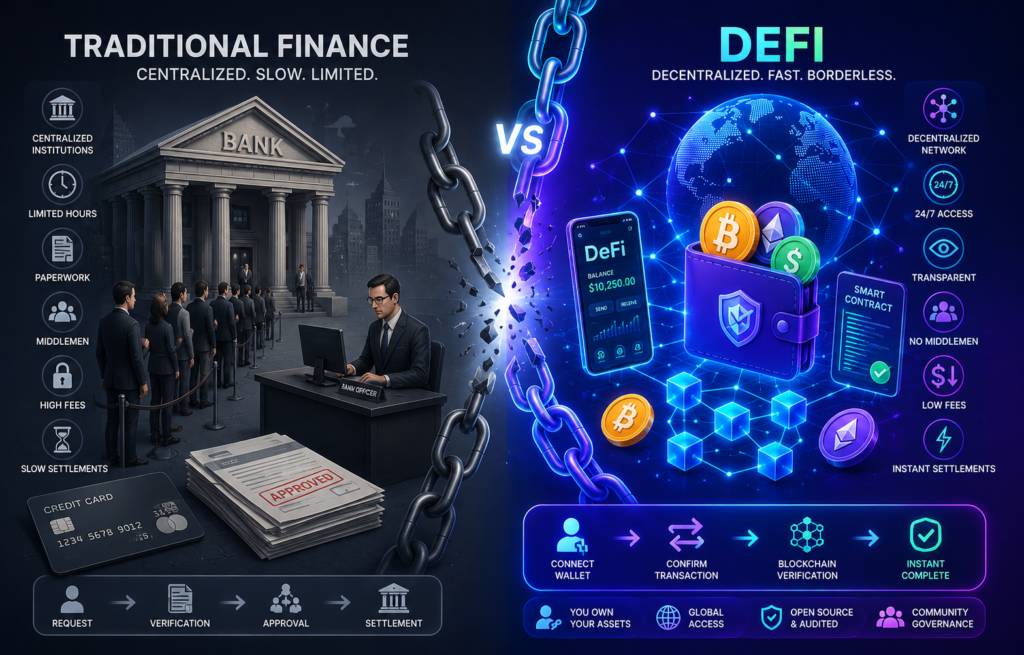
Although DeFi and traditional finance share the same goal providing financial services they operate in fundamentally different ways.
Traditional finance depends on centralized institutions such as banks, payment processors, brokers, and clearing houses to facilitate transactions. These organizations verify identities, manage customer funds, approve loans, and maintain financial records.
DeFi, on the other hand, replaces many of these intermediaries with blockchain technology and smart contracts. Users interact directly with decentralized applications while retaining control of their digital assets.
| Feature | Traditional Finance | DeFi |
|---|---|---|
| Asset Custody | Held by banks or financial institutions | Controlled by users through crypto wallets |
| Access | May require documentation and approval | Generally open to anyone with a compatible wallet |
| Operating Hours | Limited business hours | Available 24/7 |
| Transactions | Processed through intermediaries | Executed by smart contracts |
| Transparency | Internal databases | Public blockchain records |
| Settlement Time | Minutes to several days | Often completed within minutes, depending on the blockchain |
| Geographic Access | Varies by institution and country | Accessible globally where supported |
| Innovation | Institution-led | Community and developer-driven |
While DeFi offers greater transparency and accessibility, traditional finance still provides mature consumer protections, established regulatory frameworks, and broader adoption. For many users, the two systems may increasingly coexist rather than compete directly.
Benefits of DeFi
DeFi has grown rapidly because it introduces new ways to access financial services without relying on centralized intermediaries.
Financial Inclusion
Millions of people around the world remain underserved by traditional banking systems. DeFi can expand access to financial tools for users with internet connectivity and a compatible crypto wallet.
Self-Custody
One of DeFi’s defining characteristics is that users generally maintain control of their own assets. Rather than depositing funds into a bank or centralized platform, users manage their holdings through personal wallets.
Transparency
Transactions are recorded on public blockchains, allowing anyone to verify activity independently. This transparency helps users understand how protocols operate and how funds move within the ecosystem.
24/7 Availability
Unlike traditional financial institutions, many DeFi applications are available around the clock. Users can access services regardless of weekends, holidays, or business hours.
Innovation
Because DeFi protocols are often open source and composable, developers can build new applications on top of existing infrastructure, accelerating innovation across the blockchain ecosystem.
Risks of DeFi
While DeFi offers significant opportunities, it also introduces risks that every user should understand before participating.
Smart Contract Vulnerabilities
Smart contracts automate financial transactions, but programming errors or security flaws can create opportunities for exploits. Even well-established protocols may face unforeseen vulnerabilities.
Rug Pulls
In some cases, developers launch projects, attract liquidity, and then abandon the protocol or withdraw user funds. Conducting thorough research before investing is essential.
Impermanent Loss
Users who provide liquidity to decentralized exchanges may experience impermanent loss if the prices of deposited assets change significantly relative to one another.
Market Volatility
Cryptocurrencies can experience substantial price swings, affecting the value of assets used within DeFi applications.
Phishing and Wallet Scams
Fraudulent websites, fake wallet applications, and phishing attacks remain common threats. Users should verify URLs, avoid sharing recovery phrases, and interact only with trusted platforms.
Regulatory Uncertainty
Regulations surrounding digital assets and DeFi continue to evolve. Requirements differ across jurisdictions, and users should stay informed about the rules applicable in their region.
Real-World Applications of DeFi
DeFi has expanded far beyond cryptocurrency trading. Today, it supports a growing range of practical financial use cases.
Cross-Border Payments
Blockchain networks can facilitate international transfers without relying on multiple banking intermediaries, potentially reducing settlement times and costs.
Savings and Passive Income
Some DeFi protocols allow users to earn returns by lending assets or participating in staking and liquidity provision. Returns vary based on market conditions and protocol design.
Decentralized Trading
Users can exchange supported digital assets directly from their wallets through decentralized exchanges, maintaining custody of their funds throughout the process.
Tokenization of Real-World Assets
DeFi infrastructure is increasingly being explored for representing assets such as real estate, bonds, and commodities on blockchain networks. This trend could improve accessibility and liquidity for certain asset classes.
Gaming and Digital Economies
Blockchain-based games and virtual worlds often integrate DeFi concepts, enabling users to own, trade, and utilize digital assets within decentralized ecosystems.
Is DeFi Safe?
DeFi protocols can offer robust security, but no platform is entirely risk-free.
Before using any DeFi application, consider the following best practices:
- Research the protocol’s reputation and development history.
- Check whether smart contracts have undergone independent security audits.
- Use reputable wallets and secure your recovery phrase offline.
- Start with small amounts while learning how a protocol works.
- Be cautious of unusually high advertised returns.
- Review token approval permissions regularly and revoke unnecessary access.
A careful and informed approach can significantly reduce many common risks.
The Future of DeFi
The DeFi ecosystem continues to evolve as blockchain technology matures and adoption increases.
Several trends are expected to shape the next phase of decentralized finance:
Layer 2 Scaling
Layer 2 solutions aim to improve transaction throughput and reduce costs, making DeFi applications more efficient and accessible.
Cross-Chain Interoperability
Future protocols are increasingly designed to operate across multiple blockchain networks, allowing assets and data to move more seamlessly between ecosystems.
Institutional Participation
Financial institutions are exploring blockchain-based infrastructure for settlement, asset tokenization, and other financial services. While approaches vary, institutional interest in decentralized technologies continues to grow.
Tokenized Real-World Assets (RWAs)
Representing traditional assets on blockchain networks may expand access to investment opportunities and improve market efficiency.
Artificial Intelligence and Automation
AI tools may enhance DeFi by supporting risk analysis, portfolio management, fraud detection, and protocol optimization. These technologies remain in active development and adoption is still evolving.
Frequently Asked Questions
What is DeFi in simple terms?
DeFi, or Decentralized Finance, is a collection of blockchain-based financial services that allow users to lend, borrow, trade, and manage digital assets without relying on traditional financial institutions.
Is DeFi the same as cryptocurrency?
No. Cryptocurrencies are digital assets, while DeFi refers to financial applications and services built on blockchain technology.
Do I need a bank account to use DeFi?
Many DeFi applications do not require a traditional bank account. Users typically need a compatible crypto wallet and supported digital assets.
What is a DeFi wallet?
A DeFi wallet is a crypto wallet that enables users to store digital assets and interact directly with decentralized applications.
Can beginners use DeFi?
Yes, but beginners should first understand blockchain basics, wallet security, transaction fees, and the risks associated with decentralized protocols.
What are gas fees?
Gas fees are transaction costs paid to process operations on blockchain networks. The amount varies depending on network activity and the blockchain being used.
Can I earn passive income through DeFi?
Some DeFi applications allow users to earn rewards through lending, staking, or providing liquidity. Returns are not guaranteed and carry varying levels of risk.
Is DeFi legal?
The legal status of DeFi depends on the jurisdiction. Users should review applicable laws and regulations in their region before participating.
What is Total Value Locked (TVL)?
TVL represents the total value of assets deposited in a DeFi protocol and is often used as one indicator of ecosystem activity.
Can I lose money in DeFi?
Yes. Risks include market volatility, smart contract vulnerabilities, impermanent loss, scams, and user errors such as sending assets to incorrect addresses.
Conclusion
Decentralized Finance has emerged as one of the most influential innovations in the blockchain industry, offering an alternative approach to accessing financial services through decentralized networks and smart contracts.
By reducing reliance on traditional intermediaries, DeFi enables users to trade, lend, borrow, and manage digital assets with greater transparency and control. At the same time, participation requires a solid understanding of blockchain technology, wallet security, and the risks associated with decentralized applications.
As the ecosystem continues to evolve, DeFi is likely to play an increasingly important role alongside traditional financial systems. Advances in scalability, interoperability, tokenization, and regulatory clarity may further expand its adoption across both retail and institutional markets.
Whether you’re a newcomer exploring blockchain or an experienced crypto user looking to deepen your knowledge, understanding DeFi provides valuable insight into one of the fastest-moving areas of digital finance.
The best way to get started is to learn the fundamentals, use trusted platforms, prioritize security, and approach every protocol with careful research. Building a strong foundation today will help you navigate the opportunities and challenges of decentralized finance with greater confidence.