


Introduction
Artificial Intelligence (AI) and blockchain are two of the most transformative technologies shaping the digital economy. While AI is changing how machines learn, automate tasks, and make decisions, blockchain is redefining how data, assets, and transactions are stored and exchanged without relying on centralized intermediaries.
The convergence of these technologies has given rise to AI tokens digital assets that power decentralized AI platforms, incentivize network participants, and enable new business models built around artificial intelligence.
Over the past few years, AI-related cryptocurrencies have attracted significant attention from investors, developers, and enterprises alike. From decentralized computing networks to AI-powered data marketplaces and autonomous agents, AI tokens are supporting projects that aim to make artificial intelligence more accessible, transparent, and collaborative.
However, despite the growing interest, many newcomers still ask a simple question: What are AI tokens?
Are they simply cryptocurrencies with “AI” in their branding, or do they serve a genuine purpose within blockchain ecosystems?
In this guide, we’ll explain AI tokens in simple terms, explore how they work, discuss their practical applications, highlight their benefits and risks, and help you understand why they have become one of the fastest-growing sectors in Web3.
What Are AI Tokens?
AI tokens are cryptocurrencies designed to support blockchain projects that integrate artificial intelligence into their products or services. These tokens typically serve as the economic layer of decentralized AI ecosystems, enabling users to pay for AI services, reward contributors, participate in governance, or access computing resources.
Unlike traditional cryptocurrencies that primarily facilitate value transfers, AI tokens often have specific utility within their respective platforms.
Depending on the project, an AI token may be used to:
- Pay for AI-powered services.
- Access machine learning models.
- Purchase computing resources.
- Reward developers and data providers.
- Participate in decentralized governance.
- Incentivize network participants.
In simple terms, AI tokens help coordinate decentralized AI networks by aligning incentives among users, developers, and infrastructure providers.
Why Are AI Tokens Becoming Popular?
The rapid adoption of AI tools has increased demand for computing power, quality datasets, and collaborative development.
Traditionally, many AI services have been controlled by large technology companies that own the infrastructure, data, and models powering these applications.
Blockchain introduces an alternative approach by enabling decentralized networks where contributors can share resources, receive token-based rewards, and participate in decision-making without relying on a single organization.
Several trends have accelerated interest in AI tokens:
Growth of Artificial Intelligence
The popularity of generative AI, automation, and machine learning has created demand for decentralized AI infrastructure and services.
Expansion of Web3
As blockchain technology matures, developers are combining AI with decentralized applications to create more autonomous and transparent systems.
Token-Based Incentives
AI tokens encourage participation by rewarding users who contribute computing power, data, or other valuable resources to the network.
Community Governance
Many AI projects use governance tokens that allow community members to vote on protocol upgrades, funding decisions, and ecosystem development.
Together, these factors have helped establish AI tokens as an emerging category within the broader cryptocurrency market.
How Do AI Tokens Work?
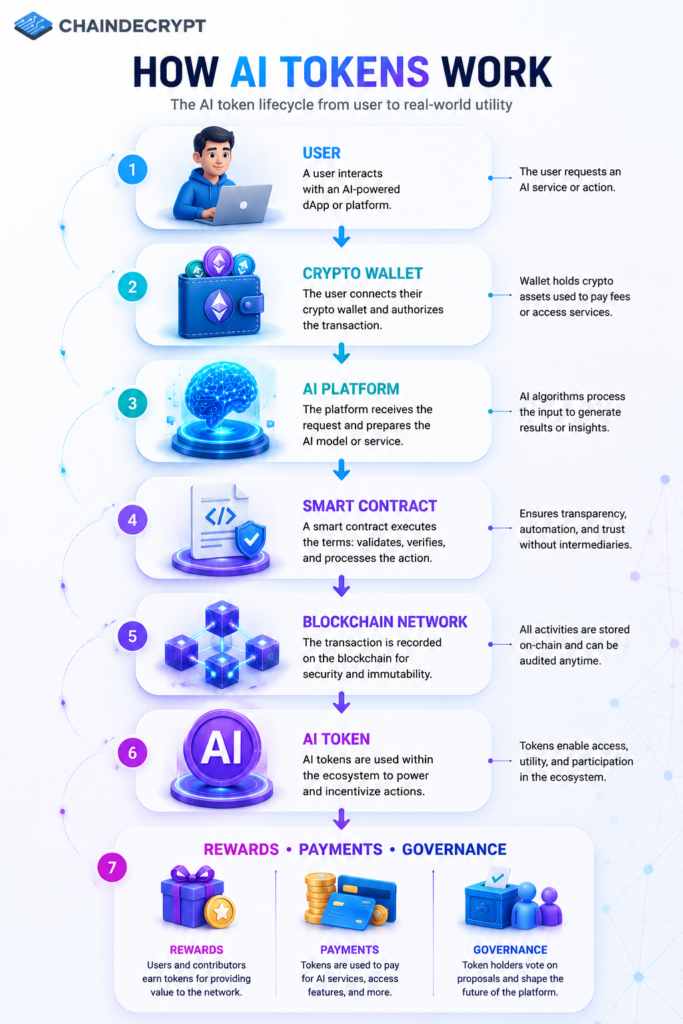
Although every AI blockchain project has its own architecture, most AI token ecosystems follow a similar workflow.
Step 1: A User Accesses an AI Platform
A user connects a compatible crypto wallet to an AI-powered decentralized application.
The platform may provide services such as AI content generation, data analysis, decentralized computing, or machine learning tools.
Step 2: Smart Contracts Manage Transactions
Instead of relying on centralized payment systems, blockchain-based smart contracts automatically process payments, permissions, and reward distribution.
This reduces the need for intermediaries while improving transparency.
Step 3: AI Services Are Delivered
The platform processes the requested AI task using decentralized infrastructure or participating service providers.
Depending on the project, contributors may supply computing power, datasets, machine learning models, or AI algorithms.
Step 4: AI Tokens Power the Ecosystem
AI tokens are used to compensate contributors, pay transaction fees, access premium services, or participate in protocol governance.
This token economy helps keep the ecosystem operational while encouraging continued participation.
The Technology Behind AI Tokens
AI tokens are supported by several interconnected technologies that work together to create decentralized AI ecosystems.
Blockchain
Blockchain provides a transparent and secure ledger that records transactions and ensures trust without requiring centralized control.
Smart Contracts
Smart contracts automate payments, access permissions, and reward distribution based on predefined rules.
Artificial Intelligence
AI algorithms perform tasks such as natural language processing, predictive analytics, computer vision, recommendation systems, and autonomous decision-making.
Decentralized Infrastructure
Many AI projects distribute computing tasks across independent network participants rather than relying on centralized cloud providers.
This approach can improve resilience, encourage broader participation, and create new economic opportunities for contributors.
Types of AI Tokens
Although the sector continues to evolve, most AI tokens fall into several broad categories.
AI Infrastructure Tokens
These projects support decentralized computing, storage, and AI development by providing the underlying infrastructure needed to train and deploy machine learning models.
AI Compute Tokens
Some platforms create decentralized marketplaces where users can contribute unused GPU resources and receive token rewards.
This helps distribute computational workloads across a global network instead of relying solely on centralized data centers.
AI Data Tokens
High-quality datasets are essential for training AI models.
Certain projects reward users for contributing, validating, or sharing valuable datasets while maintaining transparency and traceability through blockchain technology.
AI Service Tokens
These tokens enable users to access AI-powered applications such as content generation, analytics, automation, or specialized machine learning tools.
Real-World Use Cases of AI Tokens
The true value of AI tokens lies in their practical applications. Rather than existing solely for trading or speculation, many AI-focused blockchain projects use tokens to power decentralized services, reward contributors, and create sustainable digital economies.
Here are some of the most common use cases.
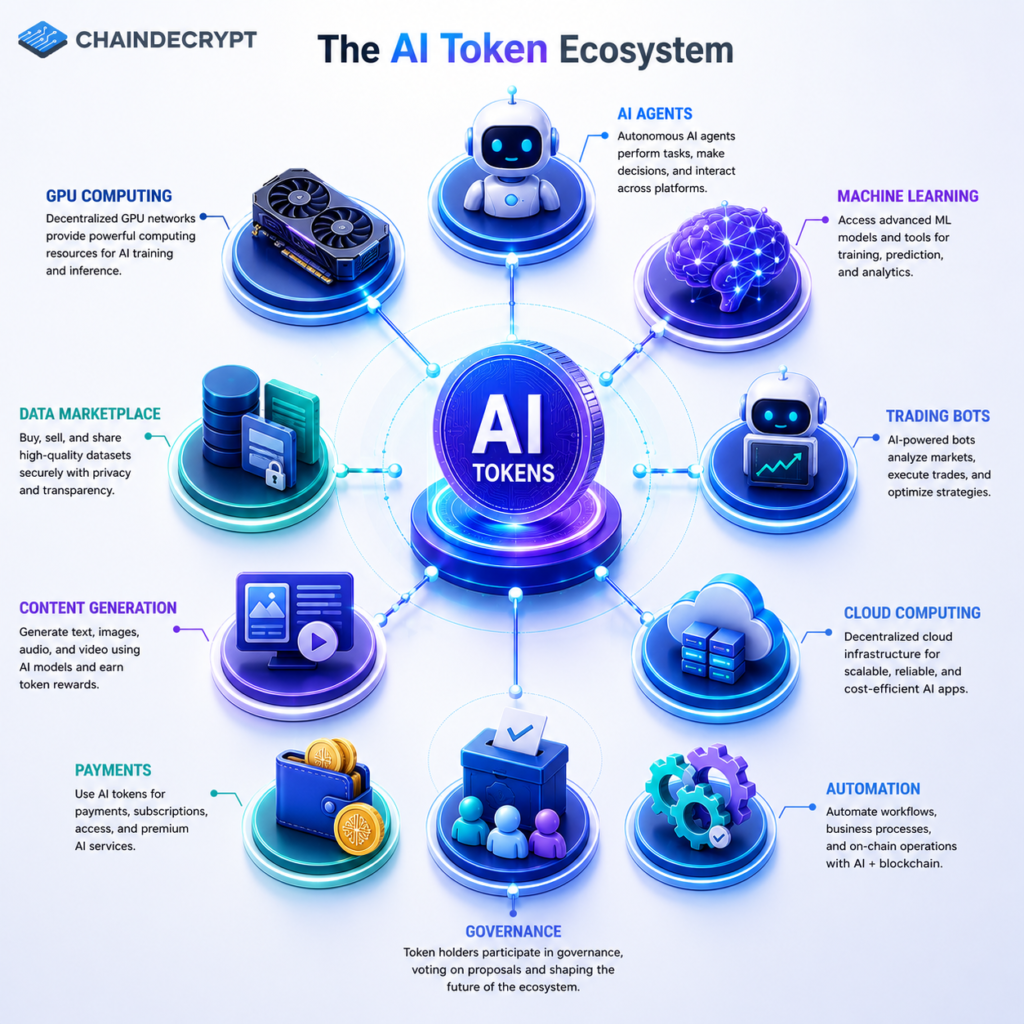
Decentralized AI Marketplaces
Traditional AI services are often controlled by a handful of large technology companies. Decentralized AI marketplaces aim to create open ecosystems where developers can publish AI models and users can access them using AI tokens.
Instead of relying on a single provider, participants interact directly through blockchain-based platforms, encouraging innovation and reducing dependence on centralized infrastructure.
Decentralized GPU Computing
Training advanced AI models requires significant computing power, particularly GPUs.
Some blockchain projects create decentralized networks where individuals and organizations can contribute unused GPU resources in exchange for token rewards. This distributed approach helps improve resource utilization while making AI computing more accessible.
AI-Powered Content Creation
Artificial intelligence is increasingly being used to generate text, images, audio, and video.
AI tokens can facilitate access to these services, compensate content creators, or reward users who contribute data and improvements to AI models.
Autonomous AI Agents
One of the most exciting developments is the rise of AI agents software capable of performing tasks on behalf of users.
These agents may analyze market data, automate workflows, manage digital assets, or interact with decentralized applications. AI tokens can support these systems by enabling payments, governance, and incentives.
Data Sharing and Machine Learning
High-quality data is essential for training AI systems.
Blockchain-based data marketplaces allow contributors to securely share datasets while receiving token-based rewards. This model promotes transparency and helps create more collaborative AI ecosystems.
Benefits of AI Tokens
AI tokens are attracting attention because they combine blockchain’s transparency with artificial intelligence’s automation and analytical capabilities.
Decentralization
Instead of relying on a single company to manage AI infrastructure, decentralized networks distribute responsibilities across multiple participants.
Transparent Incentives
Blockchain records every token transaction, making reward distribution more transparent than many traditional systems.
Community Participation
Many projects allow token holders to vote on upgrades, funding proposals, and governance decisions, giving communities a direct role in ecosystem development.
Borderless Access
Users can often access AI-powered services from anywhere with an internet connection and a compatible crypto wallet, reducing geographical barriers.
Innovation
Open blockchain ecosystems encourage developers to build new AI applications, accelerating experimentation and collaboration.
Risks of AI Tokens
While AI tokens present exciting opportunities, they also involve meaningful risks that should not be overlooked.
Market Volatility
Like most cryptocurrencies, AI tokens can experience significant price fluctuations. Their value may change rapidly due to market sentiment, adoption trends, or broader economic conditions.
Project Execution
Not every AI blockchain project succeeds. Some teams may struggle to deliver promised technology or attract sustainable user adoption.
Regulatory Uncertainty
Both AI and cryptocurrencies continue to evolve under changing regulatory frameworks. Future regulations may influence how certain projects operate.
Security Risks
Although blockchain provides strong security, decentralized applications and smart contracts remain vulnerable to coding errors, exploits, and phishing attacks if proper precautions are not taken.
Hype vs. Utility
Some projects emphasize AI in their marketing without offering meaningful technological innovation. Evaluating a project’s real-world utility is essential before making investment decisions.
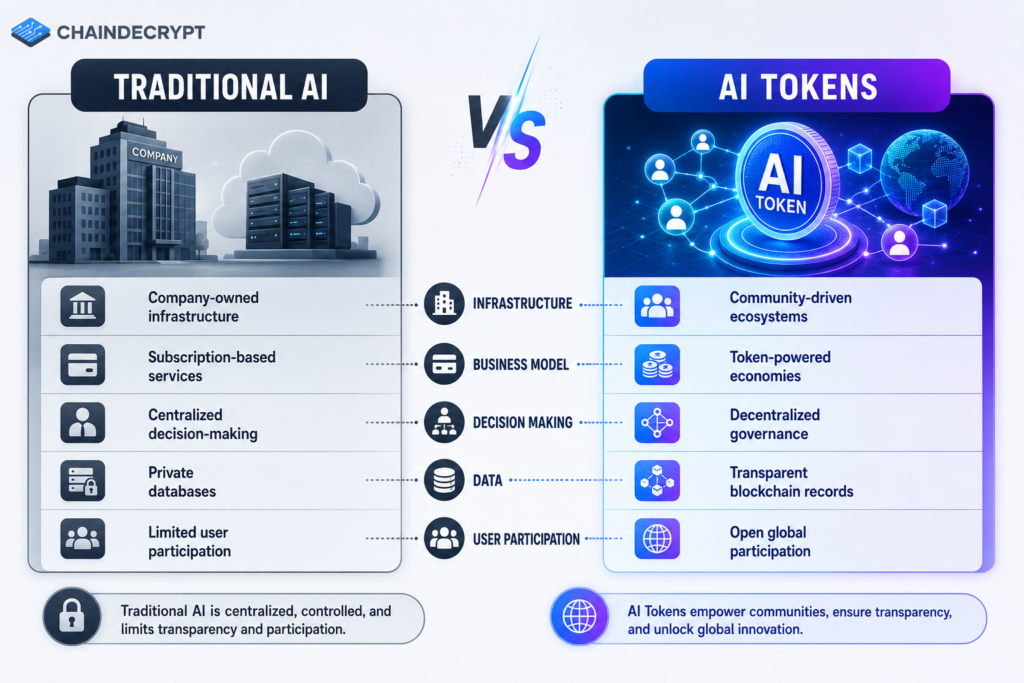
AI Tokens vs. Traditional AI Companies
Although both focus on artificial intelligence, AI token ecosystems and traditional AI companies follow very different business models.
The Future of AI Tokens
Artificial intelligence and blockchain are still in the early stages of integration, but the pace of innovation continues to accelerate.
Several trends are expected to shape the future of AI tokens:
- Increased adoption of decentralized AI infrastructure.
- Expansion of GPU-sharing networks.
- Growth of autonomous AI agents.
- Greater enterprise adoption of blockchain-based AI solutions.
- Improved interoperability between blockchain ecosystems.
- Tokenization of AI services and digital assets.
While the sector remains dynamic, long-term success will likely depend on projects that solve real-world problems rather than relying solely on market speculation.
Frequently Asked Questions
What are AI tokens?
AI tokens are cryptocurrencies that support blockchain-based artificial intelligence platforms by enabling payments, governance, rewards, and access to AI services.
Are AI tokens the same as AI stocks?
No. AI tokens are digital assets used within blockchain ecosystems, while AI stocks represent ownership in publicly traded companies developing AI technologies.
Can AI tokens be used beyond trading?
Yes. Depending on the project, they may be used for accessing AI services, participating in governance, rewarding contributors, or paying for decentralized computing resources.
Are AI tokens a good investment?
Like any digital asset, AI tokens carry risks. Investors should evaluate a project’s technology, team, adoption, and utility before making investment decisions.
Why are AI and blockchain being combined?
Blockchain provides transparency, security, and decentralized incentives, while AI offers automation and advanced data analysis. Together, they enable new decentralized applications and business models.
What industries could benefit from AI tokens?
Potential use cases include healthcare, finance, supply chain management, content creation, cybersecurity, decentralized computing, and autonomous software systems.
Conclusion
AI tokens represent one of the most innovative intersections of blockchain technology and artificial intelligence. Rather than serving as simple digital assets, they enable decentralized ecosystems where users can access AI services, contribute computing power, share data, and participate in governance through blockchain-based incentives.
As the technology matures, AI tokens may play an increasingly important role in supporting decentralized infrastructure, autonomous applications, and collaborative AI development. However, the sector is still evolving, and investors should focus on projects with strong fundamentals, practical utility, and active development rather than short-term hype.
Whether you’re a crypto enthusiast, technology professional, or beginner exploring Web3, understanding AI tokens provides valuable insight into how blockchain and artificial intelligence are shaping the future of digital innovation.
As always, conduct your own research, understand the risks, and prioritize long-term learning before making financial decisions.