


The blockchain industry has entered a new phase where scalability is no longer optional it’s essential. As decentralized finance (DeFi), gaming, AI applications, and tokenized real-world assets continue to grow, traditional blockchain networks often struggle with congestion, slower transaction speeds, and rising fees. This is where Monad crypto aims to make a difference.
Monad is a next-generation Layer 1 blockchain designed to deliver significantly higher performance while remaining fully compatible with Ethereum’s ecosystem. Instead of asking developers to learn a new programming language or rebuild their applications, Monad enables existing Ethereum smart contracts to run with minimal changes while dramatically improving transaction throughput.
In this guide, you’ll learn what Monad crypto is, how it works, its key features, ecosystem, and why many developers and investors consider it one of the most promising blockchain projects to watch.
Table of Contents
- What Is Monad Crypto?
- How Does Monad Work?
- Key Features of Monad
- Monad vs. Ethereum & Solana
- Monad Ecosystem and MON Token
- Advantages and Risks
- Is Monad Crypto a Good Investment?
- Frequently Asked Questions
What Is Monad Crypto?
Monad crypto is a high-performance Layer 1 blockchain built to solve one of blockchain’s biggest challenges scalability without sacrificing Ethereum compatibility.
Unlike many newer blockchains that require developers to adopt entirely new programming languages or development frameworks, Monad is EVM-compatible. This means developers can migrate existing Ethereum decentralized applications (dApps) and smart contracts with minimal modifications, reducing development time and encouraging faster ecosystem growth.
The project was founded with the goal of creating blockchain infrastructure capable of supporting mainstream adoption. By combining advanced execution techniques with an optimized consensus mechanism, Monad seeks to process thousands of transactions per second while maintaining low fees and quick transaction finality.
For developers, this means building scalable decentralized applications without abandoning familiar Ethereum development tools. For users, it translates into faster transactions, lower costs, and a smoother blockchain experience.
Why Was Monad Created?
Ethereum remains the largest smart contract ecosystem, but its popularity also creates challenges:
- Network congestion during periods of high activity
- Increased gas fees
- Limited transaction throughput
- Competition from faster Layer 1 blockchains
Rather than replacing Ethereum, Monad aims to enhance the developer experience by offering Ethereum compatibility with significantly improved performance.
How Does Monad Work?
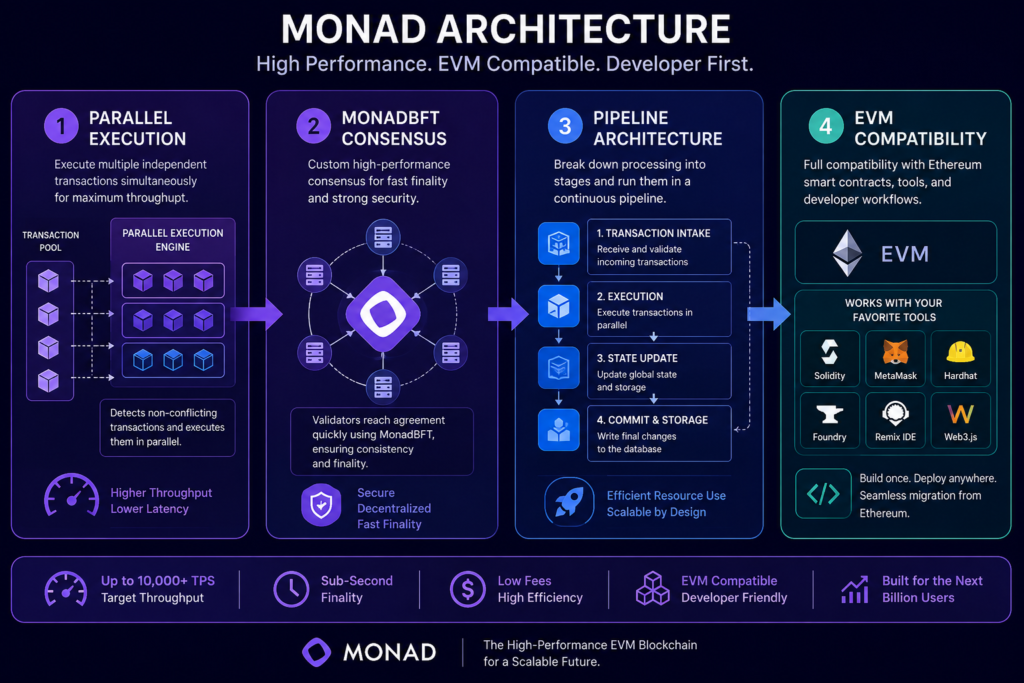
Monad introduces several technical innovations that allow the network to process transactions more efficiently than many traditional blockchain architectures.
Instead of executing transactions one after another, Monad optimizes how work is distributed across the network, allowing higher throughput while preserving compatibility with Ethereum applications.
Parallel Transaction Execution
Most blockchains execute transactions sequentially, meaning every transaction waits for the previous one to finish.
Monad introduces parallel execution, enabling multiple independent transactions to be processed simultaneously whenever they don’t conflict with each other.
This approach helps:
- Increase throughput
- Reduce network bottlenecks
- Improve scalability
- Lower waiting times during network congestion
For users, this results in quicker confirmations, while developers can build applications capable of serving a much larger user base.
MonadBFT Consensus
Another major innovation is MonadBFT, the blockchain’s consensus mechanism.
Consensus determines how validators agree on the correct state of the blockchain. MonadBFT is designed to provide:
- Fast transaction finality
- Strong network security
- Efficient validator communication
- Reliable performance under heavy network activity
By optimizing consensus, Monad can maintain speed without compromising decentralization or security.
EVM Compatibility
One of Monad’s strongest advantages is its full compatibility with the Ethereum Virtual Machine (EVM).
Developers can continue using familiar tools such as:
- Solidity
- MetaMask
- Hardhat
- Foundry
- Remix
- Existing Ethereum libraries
This lowers the barrier to entry for developers while making it easier for established Ethereum projects to expand onto Monad.
Instead of rewriting applications from scratch, teams can focus on improving user experiences and scaling their products.
Pipeline Architecture
Monad also separates different stages of transaction processing including execution, validation, and storage into specialized pipelines.
Rather than waiting for one process to complete before starting another, these operations can occur simultaneously, improving overall efficiency.
This architecture contributes to:
- Higher transaction throughput
- Better hardware utilization
- Lower latency
- Improved scalability during periods of heavy demand
Why Monad’s Technology Matters
The blockchain industry is becoming increasingly competitive, with networks racing to support millions of users across decentralized finance, gaming, AI, and enterprise applications.
Monad’s combination of:
- Parallel execution
- MonadBFT consensus
- EVM compatibility
- Optimized transaction pipelines
positions it as a blockchain focused on solving real scalability challenges while preserving the developer experience that made Ethereum successful.
Key Features of Monad
Monad is designed to deliver enterprise-grade blockchain performance without sacrificing Ethereum compatibility. Its architecture focuses on improving speed, scalability, and developer experience, making it an attractive option for both established Web3 projects and new decentralized applications.
High Transaction Throughput
One of Monad’s biggest selling points is its ability to process up to 10,000 transactions per second (TPS) under its target design. While actual throughput depends on network conditions and future production performance, the architecture is built to handle significantly more transactions than traditional EVM-based blockchains.
Higher throughput helps reduce network congestion, improves application responsiveness, and creates a smoother user experience for high-volume sectors such as DeFi, blockchain gaming, NFT marketplaces, and payment applications.
Low Transaction Fees
As blockchain adoption grows, expensive transaction fees often discourage users from interacting with decentralized applications. Monad addresses this challenge by increasing execution efficiency, enabling the network to process more transactions without driving fees higher.
Lower fees make microtransactions, on-chain gaming, and frequent DeFi trading more practical for everyday users.
Fast Block Times
Speed plays a major role in user experience. Faster block production means transactions are confirmed more quickly, reducing waiting times for traders, developers, and decentralized applications.
This is particularly valuable for:
- Decentralized exchanges
- Real-time blockchain games
- AI-powered applications
- High-frequency trading
- Payment platforms
Ethereum Compatibility
Unlike many competing Layer 1 blockchains that introduce entirely new programming languages, Monad remains fully compatible with the Ethereum Virtual Machine (EVM).
Developers can continue building with familiar tools, including:
- Solidity
- MetaMask
- Hardhat
- Foundry
- Remix IDE
- Existing Ethereum smart contracts
This compatibility significantly lowers migration costs and shortens development cycles.
Developer-Friendly Infrastructure
Monad focuses on making blockchain development more accessible. Existing Ethereum developers can deploy applications without learning a new programming language or rewriting their codebase from scratch.
This approach encourages faster ecosystem growth while preserving the security and maturity of Ethereum’s developer tooling.
Monad vs Ethereum vs Solana
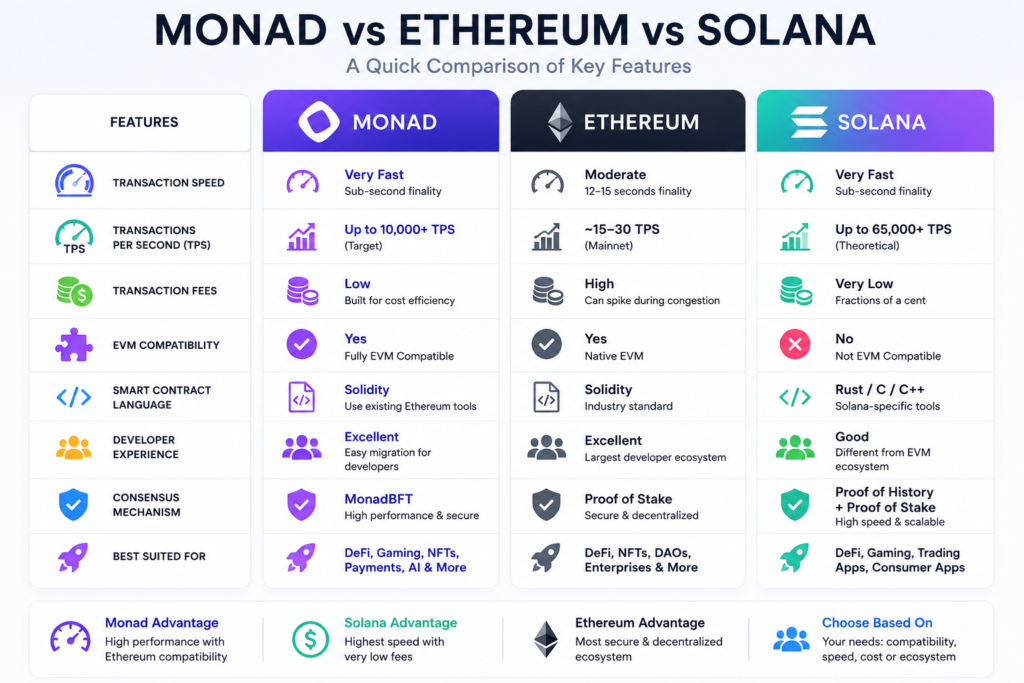
Monad enters a competitive Layer 1 landscape alongside established networks like Ethereum and Solana. While each blockchain has its strengths, they differ in architecture, developer experience, and scalability.
Monad vs Ethereum
Ethereum remains the largest smart contract platform with the most mature ecosystem. However, network congestion and higher gas fees can impact user experience during periods of heavy demand.
Monad seeks to improve this experience by offering:
- Faster execution
- Lower transaction costs
- Higher throughput
- Native EVM compatibility
Rather than replacing Ethereum, Monad aims to complement its ecosystem by providing a more scalable execution environment.
Monad vs Solana
Solana is recognized for its impressive transaction speed, but developers typically need to build applications using Rust or other Solana-specific tools.
Monad takes a different approach by combining high performance with Ethereum compatibility. This allows Ethereum developers to migrate existing applications more easily while continuing to use familiar development tools.
For teams already invested in the Ethereum ecosystem, this can significantly reduce migration complexity.
Monad Ecosystem
Although still in its growth phase, the Monad ecosystem has attracted considerable interest from developers, infrastructure providers, venture capital firms, and decentralized application builders.
As the network expands, several sectors are expected to play important roles.
Decentralized Finance (DeFi)
DeFi protocols are likely to become one of Monad’s strongest ecosystem categories. Faster transaction execution and lower fees create an attractive environment for:
- Decentralized exchanges
- Lending platforms
- Yield farming
- Stablecoin applications
- Liquidity protocols
Blockchain Gaming
Gaming applications require near-instant transaction processing to deliver smooth user experiences.
Monad’s high-performance architecture makes it suitable for:
- On-chain games
- NFT-based assets
- Digital collectibles
- Real-time multiplayer economies
NFT Applications
Lower transaction costs make NFT minting, trading, and marketplace activity more affordable for creators and collectors.
Developers can build scalable NFT ecosystems without exposing users to excessive network fees.
Infrastructure Projects
A healthy blockchain ecosystem depends on supporting infrastructure. As adoption grows, Monad is expected to see continued development of:
- Wallets
- RPC providers
- Blockchain explorers
- Indexing services
- Analytics platforms
- Developer SDKs
These tools simplify application development and improve the overall user experience.
MON Token Utility
At the time of writing, the MON token is expected to serve as the native asset powering the Monad ecosystem. Users should always verify the latest tokenomics through official project documentation, as details may evolve before or after mainnet milestones.
The token is expected to support several core functions.
Transaction Fees
MON will be used to pay network gas fees, allowing users to interact with decentralized applications and execute smart contracts.
Staking
Validators and network participants may stake MON to help secure the blockchain while earning rewards for supporting consensus.
Governance
As the ecosystem matures, token holders may participate in governance by voting on protocol upgrades, ecosystem initiatives, and community proposals.
Ecosystem Incentives
The token may also be distributed through developer grants, ecosystem incentives, liquidity programs, and community initiatives designed to encourage network growth.
Expected Token Utility Overview
| Utility | Purpose |
|---|---|
| Gas Fees | Pay for transactions on the network |
| Staking | Help secure the blockchain |
| Governance | Vote on protocol proposals |
| Ecosystem Rewards | Support developers and community growth |
Unlike speculative assets that rely solely on market demand, utility tokens derive long-term value from the activity taking place across the blockchain ecosystem. As more decentralized applications launch on Monad, demand for its native token could increase alongside network usage.
Advantages of Monad Crypto
Monad combines Ethereum compatibility with a high-performance architecture, making it one of the more compelling Layer 1 blockchain projects to watch. Its design focuses on solving common blockchain challenges without requiring developers to abandon the Ethereum ecosystem.
Some of its key advantages include:
- High scalability: Designed to process thousands of transactions per second.
- Lower transaction costs: Improved efficiency can help reduce gas fees during periods of high demand.
- EVM compatibility: Developers can deploy Ethereum-based smart contracts with minimal changes.
- Developer-friendly tools: Supports familiar development environments such as Solidity, Hardhat, and MetaMask.
- Growing ecosystem: Interest from developers, infrastructure providers, and investors continues to expand the network.
These strengths position Monad as a promising platform for decentralized finance (DeFi), gaming, NFTs, AI applications, and enterprise blockchain solutions.
Potential Risks
While Monad offers several technical advantages, it’s important to recognize that every emerging blockchain project carries risks.
Ecosystem Maturity
Compared with established networks like Ethereum and Solana, Monad is still developing its ecosystem. Long-term success depends on attracting developers, users, and high-quality decentralized applications.
Strong Competition
The Layer 1 blockchain market is highly competitive. Networks such as Ethereum, Solana, Sui, Aptos, Avalanche, and Near Protocol continue to innovate and expand their ecosystems.
Adoption Challenges
Even with superior technology, achieving widespread adoption requires strong developer support, user engagement, strategic partnerships, and a thriving community.
Market Volatility
Like most crypto assets, the value of the native token may experience significant price fluctuations due to market conditions, investor sentiment, and broader macroeconomic factors.
Investors should always conduct their own research and evaluate both opportunities and risks before making investment decisions.
Is Monad Crypto a Good Investment?
Whether Monad crypto is a good investment depends on your investment goals and risk tolerance.
From a technology perspective, Monad addresses several important challenges facing blockchain infrastructure by combining:
- High throughput
- Fast transaction processing
- Low fees
- Ethereum compatibility
- A developer-friendly environment
If the project continues to attract developers and successfully grows its ecosystem, it could become an important player in the next generation of Layer 1 blockchains.
However, investors should remember that Monad is still an emerging network. Its long-term success will depend on ecosystem growth, real-world adoption, continued innovation, and the ability to compete with well-established blockchain platforms.
Rather than focusing solely on short-term price movements, consider monitoring metrics such as developer activity, total value locked (TVL), ecosystem partnerships, and network adoption when evaluating Monad’s long-term potential.
Conclusion
As blockchain technology evolves, scalability and usability are becoming just as important as decentralization and security. Monad crypto aims to bridge this gap by offering a high-performance Layer 1 blockchain that remains fully compatible with Ethereum.
Its combination of parallel execution, optimized consensus, lower transaction fees, and EVM compatibility makes it an attractive platform for developers looking to build scalable decentralized applications without abandoning the Ethereum ecosystem.
Although the project is still in its early stages, Monad has generated significant interest across the Web3 industry. If it successfully executes its roadmap and continues expanding its ecosystem, it could establish itself as one of the most influential Layer 1 blockchain networks in the coming years.
For developers, investors, and blockchain enthusiasts, Monad is certainly a project worth following as the next generation of decentralized infrastructure continues to evolve.
Frequently Asked Questions
What is Monad crypto?
Monad crypto is a high-performance Layer 1 blockchain designed to improve scalability while remaining fully compatible with Ethereum’s Virtual Machine (EVM). It enables developers to build or migrate decentralized applications using existing Ethereum tools.
Is Monad EVM compatible?
Yes. Monad is fully EVM compatible, allowing developers to deploy Solidity smart contracts with minimal modifications while using familiar tools such as MetaMask, Hardhat, and Foundry.
What makes Monad different from Ethereum?
Monad focuses on improving transaction throughput, reducing fees, and increasing execution efficiency while maintaining compatibility with Ethereum applications. This allows developers to scale existing projects without rebuilding them from scratch.
What is the MON token used for?
The MON token is expected to power the Monad ecosystem by supporting transaction fees, staking, governance, and ecosystem incentives. Users should refer to official project documentation for the latest tokenomics and utility details.
Is Monad crypto worth watching in 2026?
Monad has attracted significant attention due to its innovative architecture and Ethereum compatibility. While it remains an emerging blockchain project, its long-term success will depend on developer adoption, ecosystem growth, and continued technological development.